
• The move to the new server is done. There are some software and database maintenance updates in process. This has us passing the hat around to help out. We appreciate any donations. Seriously, even a dollar helps. The payment page may be found here - https://www.audiokarma.org/support.html

Wheels falling off of cars

My dad was a mechanic and had at some point acquired a Cat D9. So he had all these enormous 1” drive sockets, which I inherited. They used to make great paperweights when I had stacks paper that needed weighting.

Now they just sit in my workshop, being heavy.

The most common alternative use for super-large sockets like that that I see, is using them for bearing and seal installers. Find one the right size, and it can help in pressing a bearing or seal into place, without damaging the bearing or seal. Great for wheel bearings, especially.

I've also seen a huge socket, a threaded stud (high-strength all-thread) of appropriate size and thread, a thick washer, and a nut, used as a harmonic balancer installer. The all-thread/stud is important- as you want to screw it ALL the way INTO the crankshaft- using a bolt into the crank, can cause ripping out the threads, if there's too much load before enough threads are engaged! A stud/all-thread will engage all the threads- then a nut is used for the clamping/jacking action...

BTW: Speaking of using those huge sockets and breaker bars on axle hub nuts- Dad used to tell me about one case, where a mechanic DID NOT torque an AMC Model 20 rear axle nut properly, on an AMC Ambassador. The wheel DID eventually go on an extra-curricular excursion, separate from the rest of the vehicle... :eek: Fortunately, it was only when pulling into the driveway of the owner, so no injuries. That was one of those almost impossibly improbable good breaks!

Regards,
Gordon.
 
Last edited:
I don't know much about that bleeder. The one I use is similar to the GearWrench R2901. The same one is sold under several brands and prices. The master cylinder adapters can be expensive. I have a few tips about using these. After filling the bleeder and pressurizing, bleed the air out of the fluid reservoir. You do not want pressurized air against the fluid. With plastic fluid reservoirs on modern cars, I keep the bleed pressure on the low side. Don't want to crack one. When you are done bleeding (the vehicle, not you) you can shut off the pressure from the bleeder. But the vehicle system is still pressurized. Don't pop the brake bleeder fitting off the adapter until you relieve the vehicle pressure by slowly loosening the adapter on the master cylinder. If not, you get a face full of brake fluid. Believe me, it tastes like s***. A couple times I have had the bleeder make the vehicle system believe there is a leak in the wheel you are trying to bleed, and shut off that wheel. Cut the pressure down a bit until it doesn't do that. Prior to antilock brakes, the pressure distribution valve had a pin sticking out the end. Some were covered with rubber. If you pushed that, the wheel would then bleed. Last, be sure of the brake fluid your vehicle calls for. Dot 3 and 4 can mix. The difference is boiling point. Do not mix these with silicone fluid. My 2018 F-150 specifies DOT 4 LV (low viscosity). The anti lock system is also the anti skid system. The LV is to make sure it still works in very cold temps. Maybe in southern climates, this is not as important. I live in Wyoming at 6200 Ft. It gets cold and can stay that way. Not typically found in parts stores, I buy DOT 4 LV online. Made in Germany by Pentosin. I am typed out. Any questions, please ask. I am not an expert. Just someone that has done this for 40+ years and learned by many mistakes. Paul.
Thanks for the tips. I can get Pentosin Super DOT 4 at O'Reilly's, and I've used Valvoline DOT4 for many years.
 
My dad was a mechanic and had at some point acquired a Cat D9. So he had all these enormous 1” drive sockets, which I inherited. They used to make great paperweights when I had stacks paper that needed weighting.

Now they just sit in my workshop, being heavy.
I worked for Fish & Wildlife for a few years in the late 70's-early 80's until I was told that if I wanted my job it had moved to Montana and I'd have to go to keep it... I passed on that opportunity. Worked on a couple dozers (old D8 and a D9), a drag-link, tractors & mowers, trucks, etc, etc. We had a 6 feet long breaker bar (1" drive) for the CATs and an adjustable wrench that was 3 1/2 feet long and opened up 8" wide, it felt like it weighed 1000 lbs !
 
My Dad's "First Law of Auto Mechanics":

Never tighten ANY of the bolts and/or screws in any part, before ALL the bolts/screws are started and threaded in correctly!

Tolerance stack-up can be a harsh mistress!

Regards,
Gordon.
I love the "Hey! Why is this bolt not tightening? I keep tightening it and...." SNAP!

:(
 
Especially with alloy wheels lig nut or bolt torque is critical. After wheel rotation or tire replacement they need to be retorqued at least once after a few miles.
With torquing I mean using a torque wrench and hand torquing.
Torque sticks are too unreliable with many variables and should not be used, at least not for the final torque.
^this
This is a relatively recent phenomenon - in my day, the majority of vehicles had steel wheels and hubcaps.
You would tighten them till they made creaking sounds, and they seldom if ever developed bead leaks.
Modernly, alloy wheel lug nuts, are often under-tightened, in the interest of not cracking them. Next time you're in the tire shop, check the fine print - you're expected to bring the car back after 50-100 miles for a re-torque.
 
I have driven Mopar autos exclusively since 2002... my 2002 Chrylser 300M had 330,000 miles on it when I gave it to kars for kids (didn't know about the issues with this bunch until recently). My PT Looser just rolled 190,000 miles, my wife's Charger is getting ready to go past 100,000 miles soon. The only issues I've had with any of the cars is the master cylinder which just went out on my 2016 Charger, and the A/C gave up the ghost in the PT last year (orifice valve is bad).

My Charger is only used on road trips and over the last 10 years it's only accumulated 40,000 miles. I neglected to change the brake fluid, mostly due to my knee replacement surgeries and not wanting to crawl around on the garage floor with the new knees. When cars sit too long without use the brake fluid becomes contaminated with water from the atmosphere (hydroscopic) and the water slowly corrodes the master cylinder letting the fluid leak past the pistons in the cylinder. My father collected antique autos and all the ones with hydraulic brakes had this problem, I just forgot about it until it was almost too late.
The only thing that matters is what works.:thumbsup: The car lines are something that I have little knowledge of.

I've seen much from the HD truck and Jeep lines that I can't forget.

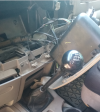
The dash broke off and puked all over the shifter a few days ago. Dodge activities :rolleyes: Gently pushed it over with my foot and continued on.
1786900350313.png
 
^this
This is a relatively recent phenomenon - in my day, the majority of vehicles had steel wheels and hubcaps.
You would tighten them till they made creaking sounds, and they seldom if ever developed bead leaks.
Modernly, alloy wheel lug nuts, are often under-tightened, in the interest of not cracking them. Next time you're in the tire shop, check the fine print - you're expected to bring the car back after 50-100 miles for a re-torque.
I've heard of people not being able to remove flat tires after shops use those high-powered impact guns on the lug nuts. I mean those 20-volt cordless pro guns can torque a nut to 1000s of ft-lbs. Good luck with the stupid, spindly 12-inch tool that is in most cars.
 
the other problem with that is the studs will stretch and weaken. Steel has a finite tensile strength and cranking the BS out of the lug nuts will produce an awful lot of pull.
Yes! It's recommended to replace all wheel studs if they were ever over-tightened. You will never be able to properly tighten them once stretched.

:thumbsup:
 
Many tire shops use torque limiting socket extensions anymore because of problems. The big trouble is no one uses thread lubricants or anti-seize, foolishness I say. Between the crappy metals used to build wheels and wheel nuts and the animals who think tighter is better whatya gonna do?
 
My Dad used to have a ONE INCH DRIVE, five foot long breaker bar.

It was used to install and remove, the axle hub nuts on American Motors Model 10 and Model 20 rear axles. They were specified to 260 foot pounds of torque. And they would take a real "set" when they had been on there for a while Sometimes, when one of them didn't want to come loose by normal means- he would have to use his "extender". That was made from an old AMC driveshaft torque tube, that he would hang over the end of the breaker bar. This would make the apparatus about a total of EIGHT feet long. He would then STAND on the tube, and rock up and down until it broke loose.

That's about the most extreme bolt-removal technique I have ever seen in person, I think.

Regards,
Gordon.

When the 1-inch drive breaker bar with the 8-foot-long pipe broke, I got the 1-inch drive air gun. The gun made light work of the problem with a little 150 psi pancake compressor.
Half a dozen hits, wait for air, another few hits, off it comes.
My 1-inch drive impact gun is the bomb.
 
When the 1-inch drive breaker bar with the 8-foot-long pipe broke, I got the 1-inch drive air gun. The gun made light work of the problem with a little 150 psi pancake compressor.
Half a dozen hits, wait for air, another few hits, off it comes.
My 1-inch drive impact gun is the bomb.

None of the impact drivers they had at the time back in the 1960s, would budge the darn things. I guess that's one place where technology HAS gotten better?

Regards,
Gordon.
 
Back
Top Bottom