
• The move to the new server is done. There are some software and database maintenance updates in process. This has us passing the hat around to help out. We appreciate any donations. Seriously, even a dollar helps. The payment page may be found here - https://www.audiokarma.org/support.html

Where to connect the sub on a Marantz 2270

DomPal

New Member
Hello,

Is it right that you connect the sub on the remote speaker termials on a Maratnz 2270 and the stereo speakers on the main terminals? So when you are listening to music you should have both main and remote speakers switches turned on. Is this bad for the amplifier or is a 2270 made for this application? If not, how should one connect the sub then?

greetings
 
Register to hide this ad
How you connect your subwoofer depends on whether it has speaker level inputs or line level inputs. Usually, the sub will have both a left and right channel inputs and combine both to drive the sub. If your sub will accept speaker level inputs you should be able to connect it in parallel with the main speakers or use the remote speaker terminals. What make and model subs do you have?
 
Hello,

Is it right that you connect the sub on the remote speaker termials on a Maratnz 2270 and the stereo speakers on the main terminals? So when you are listening to music you should have both main and remote speakers switches turned on. Is this bad for the amplifier or is a 2270 made for this application? If not, how should one connect the sub then?

greetings
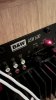
They are the red and black connections to the left of area pictured.

https://cdn11.bigcommerce.com/s-6na...7089/120144/13059-1__40646.1525292599.jpg?c=2

Based upon the picture opnly bafld posted, run your main left and right speaker wire pairs from your Marantz to the "input from amplifier" binding posts on your subwoofer, and then run another pair of speaker wires from the "output to speakers" binding posts on your subwoofer to the binding posts on your main pair of speakers. Done.
 
The "In from amplifier" and "Out to speakers" should be pretty self explanatory.
You'd think so, but I confess that, even after five decades in this hobby/profession, I STILL sometimes overthink the "tape out" and "tape in" labels on preamps.... does that mean, "Plug in the signal output from the tape deck, i.e., tape out, here" or does it mean "The output TO the tape deck comes from here." I mean, I know the answer, but I get why folks don't always see the obvious immediately.
 
You'd think so, but I confess that, even after five decades in this hobby/profession, I STILL sometimes overthink the "tape out" and "tape in" labels on preamps.... does that mean, "Plug in the signal output from the tape deck, i.e., tape out, here" or does it mean "The output TO the tape deck comes from here." I mean, I know the answer, but I get why folks don't always see the obvious immediately.

“Tape out” outputs always have a fixed volume level (independent of the amp/preamp/receiver main volume so that tape recordings aren’t affected by what volume you happen to be listening at at the time you are recording). Therefore, tape out never works well for a sub where you need the sub volume to scale in lockstep with your main volume control. "Tape In" is useful for 3-had tape decks because it allows you to listen to the actual recording from tape as it is being recorded (toggling back and forth between tape monitor on and off allows you to compare the recording versus original). Tape monitor is also useful for inserting an equalizer or processor (where you can switch the processor on and off via the tape monitor control). Not useful for subs though, because of fixed volume.

It looks like the 2270 doesn't have a separate preamp out, just a jumper between preamp out and main in. I'm not a fan of tapping into that preamp/main loopback, so speaker-level would be the preferred choice I think. If it had a separate preamp out that was buffered from the internal preamp/main loop, then it would be a tossup. A preamp output would scale with volume. The speaker-level connection to the sub will also scale with volume.

I prefer speaker-level connections for music-only 2-channel. Most prefer preamp connections. There are pluses and minuses to either approach, so neither “camp ” is right (nor wrong) :).
 
Last edited:
Hello,

Is it right that you connect the sub on the remote speaker termials on a Maratnz 2270 and the stereo speakers on the main terminals? So when you are listening to music you should have both main and remote speakers switches turned on. Is this bad for the amplifier or is a 2270 made for this application? If not, how should one connect the sub then?

greetings

Probably the cleanest way is the 2270 main speaker into the sub speaker input, sub speaker output to main speakers.

You could also run wires from the 2270 remote speaker outputs to the sub's speaker level input as you discussed (you'd have to select main+remote on the 2270), but there is no advantage to this unless you wanted to be able to turn the sub on and off with the speaker selector. If you were adding another pair of speakers to the 2270 "remote" outputs, then you'd need to be worried about overall impedance going too low from having 2 sets of speakers in parallel, but the impedance of the sub's speaker level input is very high, so there is no such impedance concern and it doesn't have any meaningful impact on the amp or circuit to the main speakers.
 
Last edited:
“Tape out” outputs always have a fixed volume level (independent of the amp/preamp/receiver main volume so that tape recordings aren’t affected by what volume you happen to be listening at at the time you are recording). Therefore, tape out never works well for a sub where you need the sub volume to scale in lockstep with your main volume control.

....
Just to be clear, I was NOT suggesting using "Tape out" for a subwoofer feed. That would be unworkable. I think my earlier post detailing the correct routing for the OP was pretty clear. I used the "tape out" example only to point out that what may appear obvious to one person may not be obvious to another. That's all.
 
Just to be clear, I was NOT suggesting using "Tape out" for a subwoofer feed. That would be unworkable. I think my earlier post detailing the correct routing for the OP was pretty clear. I used the "tape out" example only to point out that what may appear obvious to one person may not be obvious to another. That's all.

Sorry for misunderstanding your tape monitor post. Hopefully the subsequent post addressing the speaker wiring question is helpful.
 
Wow! Thank you for the very informative replies. It really clears things up for me :D I wonder if connecting the stereo speakers from the sub affevts the sound compared to when it is connected directly from the amp?
 
Wow! Thank you for the very informative replies. It really clears things up for me :D I wonder if connecting the stereo speakers from the sub affevts the sound compared to when it is connected directly from the amp?
You should get a better cross from the main speakers to the sub if you use the sub to filter the low frequencies.
What's happening at that point is the sub, since it's producing the lower frequencies, that sub only passes the higher frequencies to your main speakers. Doing this prevents both the sub and the main speakers playing the same frequencies, at the same time.
And it helps unload your amp, since the sub produces those low frequencies with it's own amp.
EDIT:
I see your sub isn't set up with speaker out terminals as I described above. So forget all that. In your case, just get some RCA splitters, run those from the pre-out, one end to the amp-in and the other pair to the sub. Sorry for the confusion.
 
Wow! Thank you for the very informative replies. It really clears things up for me :D I wonder if connecting the stereo speakers from the sub affevts the sound compared to when it is connected directly from the amp?

Most subs don’t have a high-pass filter on the speaker output — I think because they’d need a pretty beefy circuit to handle an unknown (to the sub designer) power level from whatever amp you happen to use with the sub. So, typically, there is no difference wiring it either way.

Would need to look at the owners manual to know if tOP’s sub has a filter.

For those subs that do have a filter, they are typically at a fixed relatively high-ish frequency (eg 75 hz). When using small speakers, it can be good to route the speaker wires through the sub/filter to offload the main speakers from outputting low frequencies they can’t easily reproduce. If you have large mains that go deep, then you’d typically want to wire directly to the amp so there is no filtering and you can take advantage of the mains low-frequency output. Again, this applies only for the minority of subs that have high-pass filters in the speaker-level outputs.
 
Receiver + Sub = Receiver PRE-OUT L/R to Sub IN L/R(LFE), then Sub OUT L/R(Line Level) to Receiver MAIN-IN L/R
You will need some Y splitters like dingman said.
Look at this thread.
https://audiokarma.org/forums/index...sub-svs-to-a-vintage-receiver-marantz.801531/

Btw I have had connected sub that way almost a year and it was good. Then I got tower speakers. You know on the bass when it come from sub or from towers. Its totaly different matter. Well for partying I guess its ok.
 
Back
Top Bottom