• The move to the new server is done. There are some software and database maintenance updates in process. This has us passing the hat around to help out. We appreciate any donations. Seriously, even a dollar helps. The payment page may be found here - https://www.audiokarma.org/support.html

Why are chip amps often described as having "tube sound"? What are the similarities between them??

Wait... Found an interesting article here. Yes, indeed, push-pull amplifier suffers from crossover distortion.
That flat spot in the middle of the waveform is called 'crossover distortion' and is an intrinsic feature of Class B.

However, there is no mention about Class D suffering from crossover distortion. In fact, crossover distortion is said to be an intrinsic feature of class B. Does Class D amp really lack of crossover distortion? And if that's true, perhaps the absence of crossover distortion is what makes Class D sound sweeter than your typical Class A/B amp, thus earning it the (perhaps mistakenly named) "tube-sound" label?

It's also mentioned that a simple Class D amplifier has relatively poor damping factor:
Thirdly — not finally, but enough for now — a Class-D amplifier has a relatively poor damping factor. The damping factor is the ratio of the impedance of the loudspeaker to the output impedance of the amplifier (it's a little more complex than that, but let's not get bogged down with details). In simple terms, it's a measure of how well the amplifier can control the movement of the diaphragm of the loudspeaker. A good amplifier doesn't just give it a push and hope for the best; it senses where the diaphragm is from moment to moment and controls its position. To do that, a high damping factor is desirable, and, as mentioned above, a simple Class-D amplifier has a low damping factor.

If I recall correctly, low damping factor is actually desirable in driving highly sensitive, full range single-driver loudspeakers. Also, if I'm not mistaken, single-ended tube amplifier also has low damping factor. A Class D chip amp is a simple Class D amp, isn't it? Perhaps that's the reason why Class D chip amp is often used to drive full range single-driver speakers, while traditional Class A/B amp is almost never used in such situation.

Also, such low damping factor perhaps makes bass sound bloomy and flabby, which people (mistakenly?) associate with tube amp. Perhaps that's why simple Class D amp is often said to have 'tube sound'.

CMIIW.
 
Last edited:
Isn't the similarity that the signal from a class d gets mangled through a coil and that from a tube amp through a transformer?
 
Isn't the similarity that the signal from a class d gets mangled through a coil and that from a tube amp through a transformer?
Not really. The inductor in the output of a Class D amp is part of the low-pass filter / integrator that reconstructs the audio-frequency signal from the (typically) pulse-width modulated high frequency switching of the output devices (typically MOSFETs.) The output transformer in a tube amp matches the high impedance plate circuit to the low impedance speaker.

Neither "mangles" the signal, at least not at audio frequencies.

Class A and AB amplifier designs often have a similar inductor in the output to filter out high frequency ringing and help prevent oscillation.
 
Most S/S amps are class A/B to deal with the xover notch.
McIntosh describes their groundbreaking Unity Coupled output stage as class 'B' in the promo lit.
 
The devil is in the definition of "tube-like"

Some folks seem to think that tube amp implies warmth or bloom ... but tube amps range from bright and clinical to warm and rolled off ..
To my ear nothing reproduces the harmonics of a note like a tube amp .. a bell or triangle rings like it should..
Transistor amps tend to truncate the harmonics .. they're fast, sharp, quick, have a wonderful initial transient, and can't be beat when it comes to bass reproduction,
but only the very best Class A transistor amps (i.e. Marc Levinson ) really ring like a tube amp ..
The MOSFET amps reproduce the harmonics but they always sound a bit veiled compared to tubes ..

I haven't heard a good Class D amp yet and am definitely curious .. but I'm way old, and I've seen a lot of hype over the years for the latest greatest ..
 
The devil is in the definition of "tube-like"

Some folks seem to think that tube amp implies warmth or bloom ... but tube amps range from bright and clinical to warm and rolled off ..
To my ear nothing reproduces the harmonics of a note like a tube amp .. a bell or triangle rings like it should..
Transistor amps tend to truncate the harmonics .. they're fast, sharp, quick, have a wonderful initial transient, and can't be beat when it comes to bass reproduction,
but only the very best Class A transistor amps (i.e. Marc Levinson ) really ring like a tube amp ..
The MOSFET amps reproduce the harmonics but they always sound a bit veiled compared to tubes ..

I haven't heard a good Class D amp yet and am definitely curious .. but I'm way old, and I've seen a lot of hype over the years for the latest greatest ..

Read post #45 again.

So many SS amps are just too overbuilt, the simplicity of the Belles amp let's the music sing.
 
Read post #45 again.

So many SS amps are just too overbuilt, the simplicity of the Belles amp let's the music sing.

If that Belles sounds like a Marc Levinson then I'm gonna find one ..
(and I think that it makes a difference how far an A/B amp is biased into Class A ..)
OTH .. the advantage of bi-amping tubes and SS is that there are a lot of low $ options .. I'm a cheapskate.
 
Last edited:
If that Belles sounds like a Marc Levinson then I'm gonna find one ..
(and I think that it makes a difference how far an A/B amp is biased into Class A ..)
OTH .. the advantage of bi-amping tubes and SS is that there are a lot of low $ options .. I'm a cheapskate.
The downside is Belles amp is as rare as hen's teeth.
 
However, there is no mention about Class D suffering from crossover distortion. In fact, crossover distortion is said to be an intrinsic feature of class B. Does Class D amp really lack of crossover distortion? And if that's true, perhaps the absence of crossover distortion is what makes Class D sound sweeter than your typical Class A/B amp, thus earning it the (perhaps mistakenly named) "tube-sound" label?

Class D can have distortion at crossover, due to things like modulation from a switching supply, differences in slew when switching, and level-dependent differences in effects like soft commutation.
The switching bridge in a Class D amp also has to have deadtime to prevent shoot-through. This has always been a headache of the basic concept. Even the tiniest amount of deadtime introduces an annoying amount of distortion.

It's also mentioned that a simple Class D amplifier has relatively poor damping factor:

A survey of modern commercial designs shows otherwise. Is there a particular popular Class D amp you'd like to point out as an example of low damping factor?

If I recall correctly, low damping factor is actually desirable in driving highly sensitive, full range single-driver loudspeakers.

An amplifier's damping factor varies with frequency, its interaction with a speaker depends on the speaker's impedance, which changes with frequency. A Class D amp's DF lowers as frequency increases... but so does the DF of other amps. DF usually manifests as response variations near a driver's resonance, where impedance swings are largest. Class D amps *do* classically have issues with high frequency response if their output filter doesn't match the speaker impedance. However, modern Class D designs push the switching frequency high enough or include the output filter in the feedback loop to sufficiently mitigate this.

Also, if I'm not mistaken, single-ended tube amplifier also has low damping factor.

That's a reasonable generalization.

A Class D chip amp is a simple Class D amp, isn't it?

No reason to call any chip amp "simple", except from the standpoint of fewer discrete components and their interconnects.
What's your definition of "simple"?

Perhaps that's the reason why Class D chip amp is often used to drive full range single-driver speakers, while traditional Class A/B amp is almost never used in such situation.

The full-range single-driver contingent is a very small subset of the audio community. While I've heard only a few systems of that type, I don't recall any being driven by Class D amps. Is there an online community of single-driver enthusiasts that prefers Class D that you could point us to for examples?

Also, such low damping factor perhaps makes bass sound bloomy and flabby, which people (mistakenly?) associate with tube amp. Perhaps that's why simple Class D amp is often said to have 'tube sound'.

Class D (or hybrid) is the design of choice for higher power subwoofer amps, at least in pro, car, and home theater. In those circles not only is subjective performance important, it's backed up by objective measurements. If Class D inherently resulted in poor bass, nobody would be using it for such. OTOH, Class D is very well suited to subwoofer amps, since the switching frequency can be considerably lower; switching artifacts, distortion, and other noise can be well above the system passband; thus a SMPS is easier to use; the high power requirements can be met with a much smaller and lighter design.

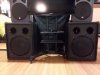
I've only owned one Class D amp, I used it with a pair of pro subwoofers I built on commission. The buyer and his customers remarked how the bass was un-flabby/un-boomy:

VBSS203106.jpg

Most bass response problems are the result of compromises in speaker design, integration with the room, and/or user error; not the amplification. You're not going to get 115dB +/-3dB at 20-80Hz out of a single 2 cubic foot subwoofer with a 12" driver arbitrarily placed in a 2500 cu ft room, using a 20W amp of *any* Class. Chances are, whatever approximation you end up with is going to be pretty "flabby" or "boomy". 1000W is a much more practical power budget if you're serious about low, even and loud response in the bottom two octaves, but most folks aren't going to spend what it would take to do that with tubes. Or they aren't willing to give up the space for the size of subwoofers that would let them do it for much less power. Most folks are willing to forego that octave from 20-40Hz, it's an easy one to live without for the vast majority of music.

If Class D/chip amps somehow made everything sound "tubeish", half the people on this site would be using factory car stereos in their living room...
 
This sentence may be a product of a good imagination, but it is utter horse-dookey.

OTOH ... if you get rid of the word sensing and change it to responding, it's essentially true that the amp is responding to EMF created by the speaker cone, and like
he said a good amp, controls and overcomes those EMF forces .. a lesser amp muddles and gets driven .. although this is mostly only a concern in the bass frequencies with longer throw drivers.
 
Wow. So many generalizations. If we can stop looking past our biases and pre-determined assertions (I know, that's what the internet is for, right?) we get closer to some answers.

1. Define 'chip amp'. There are a LOT of them. And not all of them 'sound like tubes'. Some of the ones mentioned that supposedly sound like tubes have issues such depending on the speaker, they may sound just plain awful. So we need to be more specific about what chips we're talking about.

2. The common ground we are looking for is Class A. When we say 'sounds like tubes' we are talking about the characteristics of Class A design. This includes crossover distortion. So when we are talking about 'chip amps' we should be thinking in terms of amps like Pass Amps, etc. Does his amps sound like tubes? What are the similarities and differences? These chip amps should be discussed similarly. Ultimately we are talking about the contrast to Class A/B.

3. Class D has come a LONG way in 10yrs. Even 5yrs. Even TWO years. Some sound like tubes, some don't. The old complaints and assumptions just aren't valid anymore.

For a time on diyaudio Earl Geddes was a big proponent of several Pioneer AVR amps from the late 90s, early 00s that used chip amps. You can still find them on ebay for pretty cheap. He explained at length that in the case of those particular chips that the lack of crossover distortion contributed to their smooth, high-end sound. I purchased one and agree. Did it sound like a tube amp? Yes, no, sorta, kinda, maybe. In some ways maybe better, in some ways maybe not. But it sounded GOOD.

I have found all chip amps to share this overall similar quality. It is very reminiscent of Class A. Depending on the implementation it sounds very much like tubes, sometimes solid state Class A, sometimes Class A/B Class A hybrid (TK2050 IMO, didn't like it or the Tripaths at all).
 
2. The common ground we are looking for is Class A. When we say 'sounds like tubes' we are talking about the characteristics of Class A design.

Are you saying non-Class A tube amps can't have "tube sound"?

Are you saying that all that is necessary to achieve "tube sound" is to go with a Class A design, regardless of device type?

"Tube sound" may be one or more of the following:

1. Audible distortion with a spectra of predominantly low orders

2. Excessive power supply impedance

3. Excessive output impedance

4. Excessive input impedance

5.. Limited power bandwidth

Amplifiers that exhibit "tube sound" because of these characteristics are either improperly specified, or are being used outside their specifications. It might sound better because it brings the overall system response closer to accuracy, or it may be adding a pleasant coloration.

Either way, an amp with "tube sound" is deviating from theoretical perfection. Chip amps are designed with high fidelity as a goal. No reason a properly specified and operated chip amp wouldn't sound like a properly specified and operated tube amp. But they might sound very different when driven beyond their limits.
 
Class D amps can be configured as either single ended [which produce 2nd order harmonics], or as "bridge tied" [which eliminates 2nd order harmonics via common mode rejection].
SE Class D configurations produce less power and overall have more distortion than bridge tied examples.

Btw, the first amp mentioned by the OP is a "gainclone"......ie, a Class A/B chip amp.
 
Back
Top Bottom