• The move to the new server is done. There are some software and database maintenance updates in process. This has us passing the hat around to help out. We appreciate any donations. Seriously, even a dollar helps. The payment page may be found here - https://www.audiokarma.org/support.html

Why are headshell wires thicker than tonearm wires?

Joe Nardy

AK Subscriber
Subscriber
I'm asking this question because I'm working on a Rek-O-Kut K-33H TT with S-120 tonearm and ran into an issue. I recently rewired the tonearm with KAB SuperFlex Litz wires. I also replaced the headshell wires. The headshell for this tonearm is not a typical setup. It doesn't have round male pins. Instead, it has flat pins to which the headshell wires soldered. I used regular headshell wires and cut the female pins off one end and soldered the wires to the headshell flat pins. When I tried to install a cartridge one of the flat pins broke off flush with the housing, leaving no material to solder the headshell wire onto. I believe the stiffness of the headshell wires had something to do with the pin breaking due to the force applied while trying to install the cartridge. I was able to pull the headshell pin and spring out of the headshell from the tonearm end and I was able to solder a piece of the KAB tonearm wire to the pin then pull it through the housing. There is no way I could have used a thicker headshell wire and fit it through the housing. I then soldered a female connector to the cartridge end of the wire. The SuperFlex wire is so much more flexible than the headshell wires that I'm considering using it for all the headshell wires. It would make cartridge swaps and adjustments so much easier and I wouldn't have to worry about breaking the other headshell pins when swapping or adjusting cartridges.

Is there some reason the headshell wires are thicker than the tonearm wires that would make using tonearm wire for the headshell a bad idea? I understand the tonearm wires are thinner to allow the tonearm to move with less restriction, which makes perfect sense. The only reason I can see for thicker headshell wires would be for signal conductivity but since the thinner wires are used for the rest of the signal path, isn't this a moot point?

Thanks in advance for any insight to this inquiry,
Joe
 
Register to hide this ad
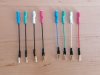
No reason why they should be thick. Many headshell wires are thin and flexible . I make some for my headshells using Cardas 33 awg wire which is also good for tonearm rewiring.
The ones on the right are made with Cardas 33 awg. On the left, some of my own, again with 33 awg single strand wire and teflon tube.


7N Cu & OFC Litz.jpg
 
Last edited:
No reason why they should be thick. Many headshell wires are thin and flexible . I make some for my headshells using Cardas 33 awg wire which is also good for tonearm rewiring.
The ones on the right are made with Cardas 33 awg. On the left, some of my own, again with 33 awg wire.


View attachment 2416277

Great info. Can you tell me where I can get pins?

Thanks,
Joe
 
No answer yet? The wires inside the tonearm are protected by the pipe which acts as a conduit. The manufactures don't need any more weight inside the tonearm than needed, so the light flexible cables work well and when they exit the tonearm so they don't hinder the travel of the tonearm. The cables exposed which connect to the cart need to be more robust due to customers need to access occasionally when connecting to carts. Small cable is more delicate and would be easy for users to break so the increased gauge it is for durability.

That is my conclusion.
 
No answer yet? The wires inside the tonearm are protected by the pipe which acts as a conduit. The manufactures don't need any more weight inside the tonearm than needed, so the light flexible cables work well and when they exit the tonearm so they don't hinder the travel of the tonearm. The cables exposed which connect to the cart need to be more robust due to customers need to access occasionally when connecting to carts. Small cable is more delicate and would be easy for users to break so the increased gauge it is for durability.

That is my conclusion.

Exactly!!!

nashou
 
Wires on my Well Tempered Classic tonearm are the same strands of super super thin wire all the way from the RCA jacks to the cartridge clips. As mentioned earlier, is part of the tonearm’s effective mass properties. I broke the wire off one of the cartridge clips on two separate occasions. Had to really brush up on my soldering skills to reattach. Makes changing carts a nerve wracking proposition. Be thankful the wires in your headshell are more robust.
 
No answer yet? The wires inside the tonearm are protected by the pipe which acts as a conduit. The manufactures don't need any more weight inside the tonearm than needed, so the light flexible cables work well and when they exit the tonearm so they don't hinder the travel of the tonearm. The cables exposed which connect to the cart need to be more robust due to customers need to access occasionally when connecting to carts. Small cable is more delicate and would be easy for users to break so the increased gauge it is for durability.

That is my conclusion.
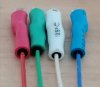
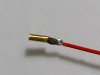
Durable does not necessarily mean thick or stiff. A wire like for example the cardas 33 awg (and others), with its litz strands and teflon insulation is durable and flexible enough for the job. A proper size shrinkable sleeve over the clip solderings will also help. Very often we see headshell wires , especially thin ones, being untouched by the "protective" sleeves.
Double sleeving with correct diameter sleeves (as seen in the picture) , will ensure durability of both the wire and clip .
After all, one has to learn to be a little careful with these things , especially if he changes cartridges often, on the same headshell or fixed headshell tonearm.

Double sleeving.jpg
 
Last edited:
I'm asking this question because I'm working on a Rek-O-Kut K-33H TT with S-120 tonearm and ran into an issue. I recently rewired the tonearm with KAB SuperFlex Litz wires. I also replaced the headshell wires. The headshell for this tonearm is not a typical setup. It doesn't have round male pins. Instead, it has flat pins to which the headshell wires soldered. I used regular headshell wires and cut the female pins off one end and soldered the wires to the headshell flat pins. When I tried to install a cartridge one of the flat pins broke off flush with the housing, leaving no material to solder the headshell wire onto. I believe the stiffness of the headshell wires had something to do with the pin breaking due to the force applied while trying to install the cartridge. I was able to pull the headshell pin and spring out of the headshell from the tonearm end and I was able to solder a piece of the KAB tonearm wire to the pin then pull it through the housing. There is no way I could have used a thicker headshell wire and fit it through the housing. I then soldered a female connector to the cartridge end of the wire. The SuperFlex wire is so much more flexible than the headshell wires that I'm considering using it for all the headshell wires. It would make cartridge swaps and adjustments so much easier and I wouldn't have to worry about breaking the other headshell pins when swapping or adjusting cartridges.

Is there some reason the headshell wires are thicker than the tonearm wires that would make using tonearm wire for the headshell a bad idea? I understand the tonearm wires are thinner to allow the tonearm to move with less restriction, which makes perfect sense. The only reason I can see for thicker headshell wires would be for signal conductivity but since the thinner wires are used for the rest of the signal path, isn't this a moot point?

Thanks in advance for any insight to this inquiry,
Joe
Early headshells had thinner leads, than new ones. I like the thinner leads. You are able to place them more easily.
 
From audio silente in Italy. (...)

And are you happy with these, if I may ask? I've found these as well (I've searched just a few days ago, as a guy over on the German Dual-Board was looking for a source, as he had a broken clip on a TK24 carrier), and the price seemed acceptable - but I couldn't judge the quality. I also found some offered by Tonar, which also look quite ok - as well as the really nice looking ones offered by van den Hul. But the latter already are almost as expensive as a complete TK24 remake of decent quality...

Greetings from Munich!

Manfred / lini

edit: I've just noticed that due to your edit my question has become superfluous. So thank for the further impressions and pics.
 
And are you happy with these, if I may ask? I've found these as well (I've searched just a few days ago, as a guy over on the German Dual-Board was looking for a source, as he had a broken clip on a TK24 carrier), and the price seemed acceptable - but I couldn't judge the quality. I also found some offered by Tonar, which also look quite ok - as well as the really nice looking ones offered by van den Hul. But the latter already are almost as expensive as a complete TK24 remake of decent quality...

Greetings from Munich!

Manfred / lini

edit: I've just noticed that due to your edit my question has become superfluous. So thank for the further impressions and pics.

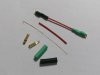
I'm very happy with them. I have tried the other two you mention but much prefer these. They have good springiness , and their dimensions especially inner diameter is perfect for most cartridges and headshells. For few headshells that have 1mm pins, just a little pressure and they close very easily. I find the tonar too long and the hole at the soldering part unnecessary. Those by vdh come in 1.0 & 1.2mm ,but they are primarily designed for crimping.Soldering on them is very tricky in order to avoid solder entering the internal part for the cartridge pins.
On the AS you just solder at the back of the soldering part without such risk.
 
Last edited:
I wish the headshell wires I use were more flexible. Sounds like they are available
 
You can also use the pins that are inside the old computer serial cables.
Can be found for much less cost than anything labeled 'Audio'
 
You can also use the pins that are inside the old computer serial cables.
Can be found for much less cost than anything labeled 'Audio'
Tried those too. Too long too.You cut them and they deform. Not tight on cartridge pins...............still, I've been using them for some time. Not any more.Many like them and use them.
 
Back
Top Bottom