• The move to the new server is done. There are some software and database maintenance updates in process. This has us passing the hat around to help out. We appreciate any donations. Seriously, even a dollar helps. The payment page may be found here - https://www.audiokarma.org/support.html

Why bookshelf rather than floor-standers??

Not always - Treatments and synergy are the key. I have heard some big speakers in small rooms that were jaw dropping. It does take work, but it can be done.

To your ear. I was speaking of my own perception, and experience, not on anyone else's behalf. However, there are many folks who have reached the same conclusion. Acknowledging that no Rule Of Thumb is ever 100% applicable, this particular ROT works for me, and given differences in personal preferences, experiences and hearing among enthusiasts, I don't expect to find a consensus. My experience in no way voids anyone else's, obviously.
 
Most bookshelf speakers are not capable of full Large Scale Sound at live performance levels due to lack of driver displacement.
 
I 'love the sound' of vintage speakers with AlNiCo magnets. They sound wonderful... like pre-CBS Fender guitar amplifiers with AlNiCos which are extremely high sought after and cost $$$ if you want one. I have one of those too - a '67 blackface. I wonder why that is that folks want them so badly?? Tube amps with AlNiCo magnet-ed speaker(s).
It's not the speakers themselves -- indeed, if I recall correctly the same speakers will still available in the slightly-less-desirable silverface era -- it's the Fender blackface amplifier circuitry. Indeed, some people convert their early silverface amps to blackface circuits.
 
The immediacy and intimacy of stand mounted speakers in near field really does it for me.

That's an excellent point. A larger speaker with more drivers and wider driver location will require more listening distance to integrate all the radiation patterns. Near field would be a mess. Full range drivers or coaxials would be best, but small 2-way bookshelves let you listen closer than you can with big multi-way towers.

Rule of thumb is listen no closer than twice the furthest center-to-center distance of the drivers. Of course, depends on the particular design...
 
Or semi-near field with floor standers :dunno:

Sounds great, but did do a lot work on the space. Everyone of my Audiophool friends are amazed how good this modest set-up sounds. Working some ADS 710's into it now. The silverfaced crap is gone now, this is the only pic I have that shows the whole thing.

Edit: My receivers are about 6.5' from the front of the speakers. This pic is exactly where my head would be. "downstairs" my Klipsch bookshelf's with a class d amp are about 7' across the room and actually dig down pretty deep, enough to be surprised and really do not need to bother with a sub :D

Loft.JPG
 
Last edited:
And true to Audiokarma standards this thread lands back on terra firma...
The closer your ears are to the drivers, the smaller the enclosures and drivers can be .. and the less important room effects will be..
Firmly within the laws of physics ..
(I still want to hear this driver/enclosure that has flat frequency response from 15-800hz)..
 
Long ago Cerwin Vega was doing their thing with drivers that could literally shake walls ..
Don't quote me, but I think that they even made a few 24" drivers ... but the thing couldn't accurately reproduce a slap bass note ..
 
And true to Audiokarma standards this thread lands back on terra firma...
The closer your ears are to the drivers, the smaller the enclosures and drivers can be .. and the less important room effects will be..
Firmly within the laws of physics ..
(I still want to hear this driver/enclosure that has flat frequency response from 15-800hz)..
Head phones.
 
And they can also, quite easily, do worse !!!
The done better is not easily achieved assuming that you're comparing them with truly high quality speaker systems .. (i.e. an Infinity IRS as an example)

the only way they can be worse is if you don't know what you're doing !

If you read and understood my post you would understand that the 'room' plays as much or more into the quality of the bass response than does that of the 'quality speaker system'
 
(I still want to hear this driver/enclosure that has flat frequency response from 15-800hz)

Now it's got to be "flat", too? If it's in an enclosure, it's part of a system, and presumably the designer has accounted for "flat" for the intended application via internal or external EQ. Besides, flat in the low bass is a function of the room and sub integration more than the particular sub(s). What's your criteria for "flat" and how you measure it?

The 800Hz end isn't a problem so much as the 15Hz part. Why 15Hz? Why not 18.276? Or 25? Things get rapidly more difficult the lower you go. Red Book CD allows for 0Hz reproduction, but you'll need a rotary sub to get that.

Besides, nobody is going to seriously expect a particular driver to cover 15-800Hz. The regions above and below the Schroeder frequency require optimal locations that are almost always very different. That one driver can't be in two places at the same time. If you were willing to throw enough money at the problem where you could design, build, and test different rooms until you got an acceptable solution, then maybe...

Again, almost *any* driver will do "15-800Hz clean and flat(anechoic?)" if you don't care about minor details like size, cost, directivity, max SPL, or power requirements:

Post #131

I see you have a dozen posts under your belt. Welcome to AK lol... :D:rolleyes:

:beerchug:
 
Most bookshelf speakers are not capable of full Large Scale Sound at live performance levels due to lack of driver displacement.

That's taking into account you always listen at "live performance levels".

Most large floor-standing speakers don't either. Large does not always equate to loud.

In a small room, that is set up correctly you can achieve good loud sound with bookshelf speakers.

I don't disagree with you, im just point out the fact that most large speakers don't either. And when they do, its really not often they are used at those levels of sound.

I ran some L-150s for a good while, they are known to hit "concert level sound" great, half the time they were played at a good volume, but not blasted.
 
Or semi-near field with floor standers :dunno:

Sounds great, but did do a lot work on the space. Everyone of my Audiophool friends are amazed how good this modest set-up sounds. Working some ADS 710's into it now. The silverfaced crap is gone now, this is the only pic I have that shows the whole thing.

Edit: My receivers are about 6.5' from the front of the speakers. This pic is exactly where my head would be. "downstairs" my Klipsch bookshelf's with a class d amp are about 7' across the room and actually dig down pretty deep, enough to be surprised and really do not need to bother with a sub :D

View attachment 1628990

Very nice, like the silk background I'm going to pinch that idea!! :)
 
Very few speaker will give in room 15 Hz. If you want that, go for it. But if you listen to any Advents, KLH, etc. you will only get to 40-50 Hz as that is how they were designed.

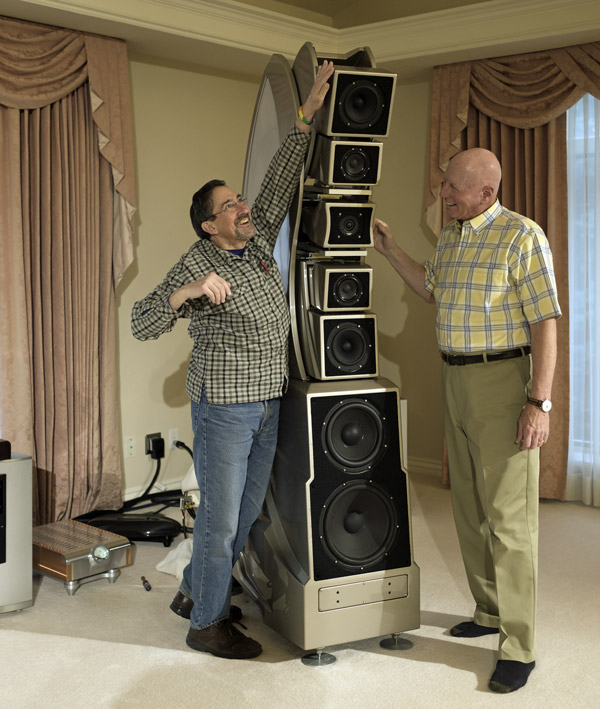
https://www.stereophile.com/content/wilson-audios-ultimate-loudspeaker-wamm-master-chronosonic

https://wilsonaudio.com/pdf/reviews/review-wamm.pdf

Got 695K laying around? That is just for the speakers. If you want Subs with them add another 250K.... Then you will need the electronics.....

122016-Wilson4-Giolas-600.jpg

Devil's always in the details Botrytis ..
What do they need the 12" and 8" drivers for, if their sub is 15-800hz flat .. well maybe keep the 8" but the 12" seems redundant ..
Seems clear that they're not intended for nearfield tho doesn't it ?? ..and it also looks like they mean SUB subwoofer .. as in low down..
I'm gonna google their subwoofer..
That man is serious about time alignment .. and fan of soft domes that I am, I like his explanations .. his breakup explanation would apply to metal drivers in general ..
He was shooting for the moon long ago ..only heard a pair of Wilson's once, but he's a prime sample of the argument against distributing the boxes about the room..
( amongst other things, like time smear and vibration control )
 
Last edited:
Now it's got to be "flat", too? If it's in an enclosure, it's part of a system, and presumably the designer has accounted for "flat" for the intended application via internal or external EQ. Besides, flat in the low bass is a function of the room and sub integration more than the particular sub(s). What's your criteria for "flat" and how you measure it?

The 800Hz end isn't a problem so much as the 15Hz part. Why 15Hz? Why not 18.276? Or 25? Things get rapidly more difficult the lower you go. Red Book CD allows for 0Hz reproduction, but you'll need a rotary sub to get that.

Besides, nobody is going to seriously expect a particular driver to cover 15-800Hz. The regions above and below the Schroeder frequency require optimal locations that are almost always very different. That one driver can't be in two places at the same time. If you were willing to throw enough money at the problem where you could design, build, and test different rooms until you got an acceptable solution, then maybe...

Again, almost *any* driver will do "15-800Hz clean and flat(anechoic?)" if you don't care about minor details like size, cost, directivity, max SPL, or power requirements:

Post #131


Flat frequency response would be a minimum,.. not a maximum standard since there are still issues of speed, timing, and transients if you're going to accurately
reproduce the the strike and harmonics of a note ...

Succinctly imples realism for me .. Realistic is probably a better word ...
Lots of drivers achieve flat frequency response (in fact just about everything seems to in an anechoic chamber) but they all sound different in subtle ways ..
 
Last edited:
I think this makes great case for owning quality Bookshelves. Not written by me.
Your little car gets in and out of traffic better than minivans or monster trucks. Your little dog runs rings around the other dogs at the park. Maybe it's time to get a couple of little loudspeakers, too?

Little speakers deserve consideration not because they sell for little prices—although some of them do—but because they're nimble, they're fast, and they get out of the way of the music they play. That last characteristic can be crucial to listeners for whom stereo imaging is important: A small speaker has less cabinetry to diffract and delay high-frequency spatial information, and a small box is better than a large one at approximating an acoustically ideal point source. But a small enclosure also stores less energy than a large one, which itself translates into cleaner, clearer sound.
 
Last edited:
Back
Top Bottom