• The move to the new server is done. There are some software and database maintenance updates in process. This has us passing the hat around to help out. We appreciate any donations. Seriously, even a dollar helps. The payment page may be found here - https://www.audiokarma.org/support.html

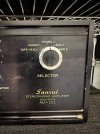
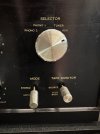
Why did some first generation integrated's push all inputs through the Phono stage?

JimEGR

AK Subscriber
Subscriber
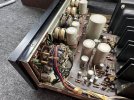
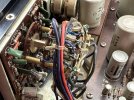
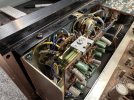
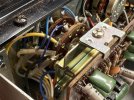
This came up in @Scott Muni AU-222 rebuild thread. Frank Speet modified the inputs in his very cool "minimalised" AU-222 rebuild.

So why did Sansui do this? Seems odd to RIAA correct anything other than vinyl. Just the learning curve for Sansui?

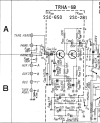
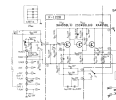
1965 AU-111(tube) - phono separated (identified by @Monicker1)
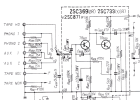
1967 AU-777 - phono separated
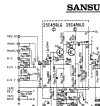
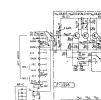
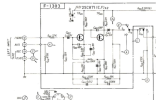
1968 AU-222 - all inputs phono
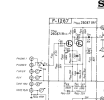
1968 AU-555 - all inputs phono
1969 AU-777D (JDM version of AU-777A) - same as AU-777?
1969 AU-777A - same as AU-777?
1970 AU-555A - phono separated
1970 AU-666 35 - phono separated
1970 AU-888 45 - phono separated
1970 AU-999 50 - phono separated
1971 AU-101 15 - phono separated
1972 AU-505 12 - phono separated

AU-111
AU-111.png

AU-777
AU-777.png

AU-222
AU-222.png

AU-555
AU-555.png

AU-555a
AU-555A.png

AU-666
AU-666.png

AU-888
AU-888.png

AU-999
AU-999.png

AU-101
AU-101.png

AU-505
AU-505.png
 
Last edited:
Register to hide this ad
So why did Sansui do this? Seems odd to RIAA correct anything other than vinyl. Just the learning curve for Sansui?
Yes it is questionable, particularly as the Phono input is 'RIAA equalised' - so you have to nullify that, or switch it out when other inputs are used - otherwise it would sound odd.

So overall it's a fair amount more complex if you do it, and the only reason I can think of is the 'advantage' of utilising the gain of the phono stage - which could be useful in the AU-777 (for example), to boost/buffer the input to the stepped tone controls that immediately follow the phono stage.
 
Last edited:
When they run non-RIAA inputs through the stage, they switch out the equalization parts with another deck of the switch. This give a flat amp so everything works fine. Is it a good idea? Not a clue, but I've never liked the method. It just seems like an extra stage that shouldn't be needed for non-RIAA stuff. OTOH, maybe there's some advantage in lowering the gain further down, and making up the difference with the front end. Or maybe it's more of a buffer- I haven't checked the gain in non-RIAA mode. Sansui made up a lot of their own rules for how to best design circuits, some of which probably weren't in the best interests of reliability or simplicity.
 
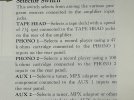
On the au222, the tape monitor goes directly to pre amp. But there is a "tape head" input that goes through the phono amp.
So strange.
 
(...) Seems odd to RIAA correct anything other than vinyl.

Doesn't quite appear to be the case (referring to AU-222 & -555), if one heeds the secondary input switch layers (not visible on your section of the schematic for the AU-222). So the more to the point question would appear to be: Why first voltage-divide the signals from the line-level inputs down, just to amp 'em up again immediately after that?

And indeed that woud appear somewhat stupid. Then again, as one can see, in the AU-111 & -777 not to do that required a six-layer input selector switch, whereas in the AU-222 & -555 they got away with four layers. So maybe they simply were willing to accept a bit of a performance penalty for the sake of cost cutting.

Greetings from Munich!

Manfred / lini
 
When they run non-RIAA inputs through the stage, they switch out the equalization parts with another deck of the switch. This give a flat amp so everything works fine. Is it a good idea? Not a clue, but I've never liked the method. It just seems like an extra stage that shouldn't be needed for non-RIAA stuff. OTOH, maybe there's some advantage in lowering the gain further down, and making up the difference with the front end. Or maybe it's more of a buffer- I haven't checked the gain in non-RIAA mode. Sansui made up a lot of their own rules for how to best design circuits, some of which probably weren't in the best interests of reliability or simplicity.

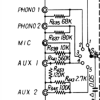
Any comments on the parallel resistors on AUX? I'm early in the learning curve but it looks like the design throttles down the non-phono inputs, if I am understanding that correctly. Happy to be corrected, and learn from it. And if you feel inclined to impart more of your knowledge, why the 68K on PHONO 1 and 180K on PHONO 2? Let me know where to send the check for tuition :).

AU-222

Screen Shot 2023-08-15 at 10.49.53 AM.png
AU-555

Screen Shot 2023-08-15 at 10.50.00 AM.png
 
Last edited:
My thoughts on the parallel resistors, is to drop down the signal. Only to amp them up, but I'm still rounding the first bend in the learning curve.
 
Doesn't quite appear to be the case (referring to AU-222 & -555), if one heeds the secondary input switch layers (not visible on your section of the schematic for the AU-222). So the more to the point question would appear to be: Why first voltage-divide the signals from the line-level inputs down, just to amp 'em up again immediately after that?

And indeed that woud appear somewhat stupid. Then again, as one can see, in the AU-111 & -777 not to do that required a six-layer input selector switch, whereas in the AU-222 & -555 they got away with four layers. So maybe they simply were willing to accept a bit of a performance penalty for the sake of cost cutting.

Greetings from Munich!

Manfred / lini

Guten Morgen! (USA Pacific Time here) I lived in a small Bavarian themed mountain town in the USA for awhile.
 
Last edited:
My thoughts on the parallel resistors, is to drop down the signal. Only to amp them up, but I'm still rounding the first bend in the learning curve.

My hunch too. Hopefully one of our more seasoned colleagues can confirm or deny.

And if this is the case, to address Frank Speet comment about modern digital inputs overdriving the phono stage those AUX input resistors could be theoretically tuned to accomadate for higher input values.
 
Last edited:
This comment possibly belongs in this new thread...

On the AU-222, Tape Head seems to go through the preamp phono correction but without initial signal reduction, whereas Tape Monitor bypasses the Phono Eq circuit but has some modification (R647). I am seeing Tape Head on these selectors (AU-222 and AU-555) for the first time. I would guess there is a difference between the sound of these two paths. Was Tape Head designed to monitor the audio signal coming to the tape head during recording? (As in 3 head tape decks.) Or from the audio coming from the playback head reading the tape? With the potential of Tape HD feeding directly into Tape Rec, was this a potential screaming feedback loop or at least an echo loop?
 
The use of the input resistors varies a bit in the posted schematic examples, with some apparently being used for attenuation, and others were I think, an attempt at input impedance matching.

The 1000X is another one that switches the RIAA equalisation for some reason, apparently for the tape monitor inputs? - very complicated. :dunno:
 
Last edited:
Tape Head selector setting was probably used when the recording source was plugged in directly to the tape deck itself, usually microphones. The amp would not be used for the selector of the source recording. But this was redundant perhaps if tape monitor could be used instead.. Possibly why it didn't appear in later amps past the 222 and 555.
 
Not to veer too far from the original topic of "Why did some first generation integrated's push all inputs through phono?"
 
Not to veer too far from the original topic of "Why did some first generation integrated's push all inputs through phono?"
As Bones would have said "They're all dead Jim." Unless these secrets have been preserved in files held the by the descendants of the early engineers, this is a paleontology dig. As a person trained in business, with secondary interests in the recording industry and acoustic equipment I find the discussion fascinating. The Sansui Corp of the 1950s through the 1980s would have been an interesting case study. I am so thankful the hands of administrators and bean counters were not overwhelmingly obvious in the early years!
 
Last edited:
Back
Top Bottom