• The move to the new server is done. There are some software and database maintenance updates in process. This has us passing the hat around to help out. We appreciate any donations. Seriously, even a dollar helps. The payment page may be found here - https://www.audiokarma.org/support.html

Why did some first generation integrated's push all inputs through the Phono stage?

As Bones would have said "They're all dead Jim." Unless these secrets have been preserved in files held the by the descendants of the early engineers, this is a paleontology dig. As a person trained in business, with secondary interests in the recording industry and acoustic equipment I find the discussion fascinating. The Sansui Corp of the 1950s through the 1980s would have been an interesting case study. I am so thankful the hands of administrators and bean counters were not overwhelmingly obvious in the early years!

Couldn't agree more! Not only is the company ethos (it's in the name) meaningful and Sansui Sound pure bliss, but the evolution of this gear (engineering AND design) delivers much fascination and intrigue!
 
Last edited:
i believe that the “tape head” input was used for direct connection to the playback tape head in a “tape deck” where there is no pre amplification to a line level output as provided in a “tape recorder”. In other words, in the early days of Tape players there may have been players with no pre amplification provided (tape deck) that would be used with pre recorded tapes, or tale players that had pre amplification inbuilt (and that had the ability to record and playback).

I hope that makes semse!

Cheers
John
 
i believe that the “tape head” input was used for direct connection to the playback tape head in a “tape deck” where there is no pre amplification to a line level output as provided in a “tape recorder”. In other words, in the early days of Tape players there may have been players with no pre amplification provided (tape deck) that would be used with pre recorded tapes, or tale players that had pre amplification inbuilt (and that had the ability to record and playback).

I hope that makes semse!

Cheers
John
Yes, that’s my understanding as well. While that type of tape deck was around in the late 60’s, they seem to have died out by the early 70’s, hence the “tape head” setting is found in early SS amps, but not after about 1970.
 
Ah, I posted this link in the AU-222 thread about tape head inputs. Good info

 
The Sansui 600L does this with the tuner inputs, feeds them thru phono with RIAA bypassed.

Interestingly, the AUX input which bypasses the phono section is labelled "low frequency amp" in the SM.

The phono section is labelled "equalizer amp" probably due to the RIAA
 
TAPE HEAD. As Skippy, KeithD, and Bolero alluded to there is a difference. Tape Head is used only with older tape decks that have NO Preamp (with equalization slightly modified from RIAA) and only 2 heads (REC & Play). It's a low level input similar to Phono but has it's own equalization (NAB or IEC) built in to the receiver or integrated amp. Good example would be a TEAC A-4000 without the preamp (which would make it a 4010). The 4000 would plug directly into TAPE HEAD, while the 4010 would plug in to Aux or Tape MON.

Tape Mon, on the other hand is a line level input with the Tape deck having a preamp and NAB or IEC equalization built in to the preamp. Looking at the schematics Tape Mon and AUX (both line levels) connect past the Phono eq board or circuit, directly at the tape monitor jacks (Tape Mon) or immediately before or After the jacks (AUX)depending on the manufacturer. For playback you can use either Tape Mon or Aux, depending on whether you want to monitor the recording as it's being done, or not.

Tape head being an anachronistic input any more, you CAN rip out the EQ components for the Tape Head and duplicate the PHONO EQ components in place and have a 2nd Phono.
 
IIRC the reason for the extra amplification was the DIN standards and plugs. The sensitivity of 150 mV requires more gain than some high-level inputs. And Sansui is not the only company that did so. It was very common before 1970, but had pretty much disappeared by the mid 70s.
 
I know Frank Speet personally, and after reading this topic he asked me to reply this:

In the 1960's it was possible to buy a tape deck, just a mechanical deck with just playback heads. The tape head inputs of the AU222, AU555 and AU777 would allow these decks to be connected and have corect equalisation. For the Aux inputs the phono stage feedback circuit is set to lineair and input level is reduced by a resistor network. Since it is much more relevant to have more line inputs and just one phono input, I re-wire the input selector switch to work at line level instead of phono level. The phono 1 input connectors are wired directly to the phono preamp inputs and the phono preamp outputs are wired to the phono 1 lugs of the switch. All resistor networks are removed and all inputs exept phono 1 are line level, directly routed to the volume control through the input selector switch. On the AU555 the Mic inputs are no longer in use, since they were originally combined with the Aux 1 input.
 
The tape head inputs of the AU222, AU555 and AU777 would allow these decks to be connected and have corect equalisation. For the Aux inputs the phono stage feedback circuit is set to lineair and input level is reduced by a resistor network.
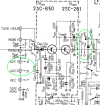
Looking at the schematics of the three units, this is true of the 222 and 555, but not the 777. The both AUX inputs bypass the phono stage on the 777.

Screenshot 2024-02-19 at 6.40.45 PM.png
 
I know Frank Speet personally, and after reading this topic he asked me to reply this:

In the 1960's it was possible to buy a tape deck, just a mechanical deck with just playback heads. The tape head inputs of the AU222, AU555 and AU777 would allow these decks to be connected and have corect equalisation. For the Aux inputs the phono stage feedback circuit is set to lineair and input level is reduced by a resistor network. Since it is much more relevant to have more line inputs and just one phono input, I re-wire the input selector switch to work at line level instead of phono level. The phono 1 input connectors are wired directly to the phono preamp inputs and the phono preamp outputs are wired to the phono 1 lugs of the switch. All resistor networks are removed and all inputs exept phono 1 are line level, directly routed to the volume control through the input selector switch. On the AU555 the Mic inputs are no longer in use, since they were originally combined with the Aux 1 input.

Thank you for the post! Appreciate the generous knowledge share. And to Frank as well. I know Frank was also quite helpful and responsive with another member here regarding his AU-222. Such an excellent and global Sansui community!
 
Agree, I enjoy reading different people's input on various technical aspects, theories, and unravelling Sansui lore.

I include our esteemed AK forum members in that statement!
 
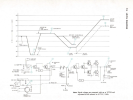
As mentioned above, this was common practice with many Japanese makers in the late 60's early 70's. I've always found this chart from a Sony service manual interesting. You can see the AUX is attenuated down with an L-pad by 10db only to be amplified again by the phono preamp (RIAA switched out). Seems silly but it worked and certainly doesn't sound bad to my ears.

1708535167740.png
 
Back
Top Bottom