

You are using an out of date browser. It may not display this or other websites correctly.
You should upgrade or use an alternative browser.
You should upgrade or use an alternative browser.
why do you need a machine to clean records?
- Thread starter Mid-Fi
- Start date

slate1
Well-Known Member
um, I don't get the vinyl/carpet analogy but i think that if i were to take a power washer to my carpet and be able to drain away the H20 that I could do at least as good a job as method 3 and my money is on a cascade of dirt flowing away after your method 3.
What's not to get? Dirt gets stuck in the grooves of records, dirt gets stuck in the pile of the carpet. You can clean the surface of either all day long and you're not going to get that deep dirt out without a combination of loosening it with a solution and vacuuming it ALL up, leaving no residue.
This isn't a philisophical debate about gear ownership or defending a "method" - it's just a simple fact, a RCM is 100% of the time going to do a better and more efficient job of getting the dirt and residue off the surface and, more importantly, from within the deep grooves than hand washing.
If hand washing is working for you - do it! Owning a record cleaning machine allows me to restore many records that would otherwise be less than satisfactory in just a couple minutes, that's why I own one. There are many records I have that, prior to owning the VPI, no manner of hand washing could restore. One round with the VPI and many of them were good to go as permanent additions to the collection.

js1138
Super Member
like I said in my last post...but I disagree that detritus loaded H2o sucked away from the surface works better than detritus soaked H2O washed away by more clean H20.
The carpet analogy isn't exactly correct. If you rinse with distilled water, or mineral free clean water, you should get better results than just rinsing in the sink.
slate1
Well-Known Member
I don't know what to say, nor am I defending my analogy nor my method, other than to say get back to me when you can compare the two methods side by side as many of us have. 
You asked a question, I gave my answer - it's not about "gear" etc. - it's about getting the most joy out of the LP listening experience. An RCM helps me do that with cheap used records. It's kind of seeming like it's becoming more about defending ones method. Like I said - if handwashing works for you, do it, that's cool!
You asked a question, I gave my answer - it's not about "gear" etc. - it's about getting the most joy out of the LP listening experience. An RCM helps me do that with cheap used records. It's kind of seeming like it's becoming more about defending ones method. Like I said - if handwashing works for you, do it, that's cool!
Last edited:
js1138
Super Member
I don't know what to say, nor am I defending my analogy although it makes perfect sense to me, other than get back to me when you can compare the two methods side by side.
That's the problem. Can't do. I'm just looking for second best.

JBL GUY
Addicted Member
It's mostly about posession of gear, not about cleaning.
we could wash dishes by hand, but we own dishwashers... :scratch2:
Just to be picky

I can build a brick wall and set the brick by hand and check for level by sight, but I will have a much more level top to my wall if a use a simple device called a level.
For some people it may in fact be just having the gear...but just be cause something that we us a machine (device) for, can be done by hand does not make for a logical argument that the machine is not better.
None this has anything to do with the efficacy of any particular record cleaning method.
OK....
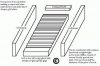
Now to the issue of running water. Think back if you can, to one of the ways gold was extracted from streams back in the day. The miners built a sluice box, basically a wooden tube with groves in it to catch the heaver gold as the material from the creek bed was shoveled into the sluice box. Water from the creek was continually flowing in the sluice box. The turbulence set up by the grooves and in some instances bars across the sluice box caused the gold to be dropped out of the running water.
See my picture of a simple sluice box...Anything look familiar? The horizontal grooves in the sluice box and the grooves in a record look a lot alike.:scratch2::scratch2:
Any questions?
Edit: In continuing to think about this...If one held the record horizontally and squirted a stream of water on the underside of the record and could cover the entire underside for long enough amount of time, it might be possible to achieve a fairly good rinse if one did not use tap water. But you would have to have a method of squirting the water on the record. That would be some kind of a machine even if it was a squirt bottle. And it would be a lot of work to squirt enough water on a record with a squirt bottle to achieve an affective rinse.
A vacuum seems to be a lot easier.
And truth be told, one can achieve good results with manual cleaning with enough time and elbow grease. Maybe not quite as good a a vacuum RCM, especially on very dirty records. But definitely much quicker and easier.
Attachments
Last edited:

kidding. but seriously one nagging thought I always have as I use my disc washer dust pad is that even though i feel I am very thorough in cleaning the surface of the pad before i pull it across my record I wonder how much micro grit and therefore micro scratches I'm potentially leaving in my records. Is this not the same idea with the fiber brushes used to create the vacuum seal to the record?
JBL GUY
Addicted Member
kidding. but seriously one nagging thought I always have as I use my disc washer dust pad is that even though i feel I am very thorough in cleaning the surface of the pad before i pull it across my record I wonder how much micro grit and therefore micro scratches I'm potentially leaving in my records. Is this not the same idea with the fiber brushes used to create the vacuum seal to the record?
That may be concern, but unless your wet cleaning method is just to squirt your cleaning solution on the record and then rinse, you are using some kind of brush in the cleaning process.
And with sufficient vacuum the water and any dirt should be lifted before it becomes an issue.
And on my DIY RCM the material that covers the vacuum wand rotates at the same speed as the record, to fresh material is always in contact with the record.
And it does not actually make a "Seal". If it did there would not be any air motion and the vacuum would be ineffectual. On mine it is just to protect the top of the record grooves from the vacuum wand.
Edit: Actually on mine I have tried several things, the cover rotating with the record, rotating opposite, and just having a slit in it.
Last edited:

kidding. but seriously one nagging thought I always have as I use my disc washer dust pad is that even though i feel I am very thorough in cleaning the surface of the pad before i pull it across my record I wonder how much micro grit and therefore micro scratches I'm potentially leaving in my records. Is this not the same idea with the fiber brushes used to create the vacuum seal to the record?
The micro fiber strips on my VPI wand stay clean. I use a lot of distilled water for the rinse cycle and it pretty much flushes out the strips. It doesn't hurt that the vacuum motor in my DIY RCM came out of a 2.0 peak HP rated Shopvac. Since my RCM rotates the opposite direction I like to think it cleans even better.

guiller
Toscaninichus Australis
I started collecting records in 1970. I cleaned them throughout the years using several kinds of methods, including the one used by the OP. Two years ago I finally bought a Clearaudio RCM and I consider this one of the best investments I´ve ever made on my system because it cleans the records in a way that is far superior to all the previous ones I had experience with.
Simple answer is the RCM gets superior results. If I was new to turntables/records as the OP might possibly be I'd be wondering also reading all the posts on the subject of cleaning records. Only a few turntable/record upgrades make any noticable improvement in sound quality and the RCM makes for the biggest of them all. You will always hear from a few that no matter how many positive testimonials they read re RCMs they are going to stick to their old methods till the day they die, long live the sink, running water, dish soap and the misses dish towel and dish rack.

clydeselsor
Lunatic Member
Oh goody! Another RCM debate!
clydeselsor
Lunatic Member
It's mostly about posession of gear, not about cleaning.
we could wash dishes by hand, but we own dishwashers... :scratch2:
Bullshit!