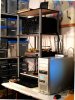
Okay, after a year or more of planning and intending to do it, I finally made my RCM. I was going to take an old vacuum motor, which I have, and build it into a box to make it look very professional, but I could never seem to find the time to do that what with all my other projects. So I finally just set up an old turntable on a workbench, then went to Sears and bought their $30 Shop Vac. It works great! It has plenty of suction power to dry 98% of the record in a single pass. Another pass or two and it's done.
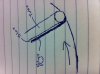
The most time consuming part was making the wand (took about half an hour -- not counting the time for the epoxy to dry). Following the ideas of a DIY RCM website I found, I took the crevice tool and cut off the end, then filled the opening with a piece of scrap. I epoxied that in place, which formed a completely tight seal on the end. Next I put my Dremel tool in a stand (for stability) and, using a cutoff wheel, fed the crevice tool sideways to cut the slot. The slot is about a sixteenth of an inch wide. I made it a little longer than necessary for airflow -- otherwise it forms a seal and just sticks to the record.
Finally, I took an extra pad that came with my hand held MoFi record cleaner thing (kind of like a DiscWasher, but much better -- it's that black thing to the left in the first picture), and I trimmed off some thin strips to line the sides of the slit. I put my slit on the narrow surface of the wand, to minimize surface contact with the record. Maybe because of the rapid airflow, the velvet material doesn't seem to retain much water, if any.
Before modifying the crevice tool, I tried just covering the original opening with microfiber cloth, held in place with a rubber band. I cut a slit in the fabric to improve airflow. That didn't work too well -- even though the vacuum sucked up most of the liquid, the fabric soaked up a lot of liquid too, which just got smeared around the surface of the record. I was looking to avoid the work of modifying the crevice tool, but this lazy version didn't work for me.
Here are some pix of the homemade wand:
This is a shot of the end, capped with epoxy:
Here is the tool, showing the side slit:
For fluids, I'm using MoFi Record Wash, which is made for RCMs (no alcohol, as you don't need an evaporating agent, obviously). I apply the fluid in a small puddle directly on the record surface, then spread it and wash with my MoFi record brush. For very dirty thrift store finds, I add a step with MoFi's Super Deep Clean Record Wash, which I apply with my old DiscWasher brush. Sometimes I finish with a distilled water rinse/vacuum. I'm not sure that's necessary though.
So, how does it work?
I wish I had taken the time to do this years ago. The difference is, as others have stated, no less than astounding. Albums that were unlistenable due to surface noise, including a couple of very expensive reissues that I never got around to returning but could never listen to because of the crackling -- those albums are now dead silent. How brand new albums arrive in that state, I don't know, but the vacuum RCM fixes them.
I even had one album that I bought yesterday where the stylus would jump the groove at the beginning of the record. I thought it was a groove defect, and I was about to return it when I took a closer look at it. It looked like a scuff or some crud was on the edge of the album. I figured it was worth a try, so I vacuum cleaned it, and it played perfectly. No more groove jumping.
I have lots of thrift store records that are in good shape, groove wise, but filthy. Even after sink washing with high pressure water and lots of elbow grease, they would still be crackly, and the stylus would dig out all kinds of crud. After vacuum cleaning, they are amazingly quiet.
Not only are the records quiet, but they sound better in every way. I'm really glad I finally did this.