• The move to the new server is done. There are some software and database maintenance updates in process. This has us passing the hat around to help out. We appreciate any donations. Seriously, even a dollar helps. The payment page may be found here - https://www.audiokarma.org/support.html

Why pull and redo power transistors on the heatsink

Mike Sweeney

Well-Known Member
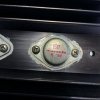
I'm working on my 2285B getting through various bits and now it's the main amp. The transistors all work but the mounting was pretty sloppy. I pulled two (PNP and NPN) and saw that the silly putty was starting to dry out and get cake-like. So scrub and cleaning I go. I also put cleaner into the contacts of the mounts. New silicone free grease and new mica insulators and off we go. I did measure the HFE.. should be >20 according to the spec sheet and the PNPs are 60 +- 2 and the NPNs are 45 +- 2 So they look to be in fine shape which saves me 6 bucks a transistor.

yes, that lock ring washer is falling out from the transistor mounting screw. Having that come loose in this section would have been "exciting" So there is so much silicon compound smeared around, I think they applied it to the mica without regard to how much it extended past the transistor. The end result is there was compound all down the legs to the mounting connector. Not that hurts anything but it can migrate can cause connectivity issues.

People talk about the 70s as this mythical awesome era but this units were mass produced and have all the inherent issues of something mass produced or more because of how much hand work went into them at the time. Its best to take it apart and check it out before you have an issue.

I measure each one to make sure I didn't short something out in the disassembly and re-assembly.

IMG_3150.jpg IMG_3149.jpg
 
Register to hide this ad
Really? Come on these things are 45 years old.... Or more.

The aluminum heat sink and steel outputs/screws experience a large difference in thermal expansion rates.

The grease migrates and the volatile compounds of the grease will disipate over time....leaving the solids behind...

Spring lock washers crack from the heat cycles creating higher and lower tensions....

None of this a surprise or unexpected.... Your cell phone barely lasts 2 years....

Jk
 
Yeah.. really ;) You would be amazed at the push back I've gotten when I say I'm pulling good working transistors to check and clean the mounting up
 
I admit, I don't know 1\100th of what you guys know.
So, I measured temps before and after cleaning\new goop. On two diff units, a marantz and a Vector Research.
What I saw was the goop didn't look dried out. Tested with run time about an hour, with same power output before\after cleanup.
I found no differences in temp. Measured both transistor and heatsink with thermocouple (taped to surface, this is my fav temp measuring method) and Thermal Imaging (this is mostly for fun, but can show issues with differences between outputs that should be running the same).
Maybe I wasn't running them hard enough (running at 3\4 rated power in dummy loads).

That all being said, seems like it can't do any harm, it's easy to do and might advert problems years down the road, so this next 2270 I'm on will get the cleanup.

That is wild that the lockring has come out that far? I've never seen that! Crazy! it doesn't look broken, but how can the gap get THAT large to slip past the screw?
 
What I saw was the goop didn't look dried out.

If there is "goop" being used...get it out of there...and replace it with proper "dielectric heat sink compound". Not computer CPU heat sink compound which tends to be electrically conductive.

"Goop" .... Really?

A thermal couple taped to the heat sink? Where? The heat being generated is at the transistor's semiconductor junction which is located at the transistor case's base between the leads.... Did you use any "goop" to mount the thermal couple to the heat sink?

If your amps are running so 100% cool, check the bias....or try running them without the thermal mass provided by the heat sink....and see what happens to them.

I don't mean to be overly harsh, but this a fundamental requirement to prevent thermal runaway of the output drivers....this really should not warrant any serious debate..... Should it?

Johnk
 
Last edited:
...
I don't mean to be overly harsh, but this a fundamental requirement to prevent thermal runaway of the output drivers....this really should not warrant any serious debate..... Should it?

Johnk


Depends if what seems obvious actually is.

Anyone have any hard data on what percentage of the overall thermal conduction is provided by the carrier vs. the solids?

If, for example, the solids provide 99.8% of the thermal transfer I'd opine it's not necessary to regrease them, provided they were not disturbed. If the outputs are removed then of course they need to be cleaned and fresh grease applied as the old stuff will not reflow properly when the devices are remounted.
 
I know "goop" ( love the word) will migrate with heat and time. We had a hellva time with it in the mid 70s with the military stuff I worked on. To the point the DOD banned silicon based thermal compound, at least the formulation that was used then. It would migrate and cause issues. We spent months testing this pink bubble gum **** that was hard to get on right ( had to be super thin coating) and harder to get off since the normal alcohol cleaning didn't touch it. MEK did take it off but that was not a good cleaner for daily use :o

The stuff on the Marantz had turned "chunky" with parts that seemed to have dried out. The layer directly under the transistor seemed OK until I peeled off the mica insulator and saw there was a thin film of silicon between the white (zinc oxide?) and the heatsink. I also had silicon that had migrated down the leads and into the socket assembly.

I'm using a non-silicon based "goop" Wakefield - digikey PN 345-1011-ND

This made interesting reading and followed what I saw at Hughes in our testing
http://www.timtronics.com/PDF/nonsilicone/SILICONE VS NON-SILICONE.pdf
 
...

If your amps are running so 100% cool, check the bias....or try running them without the thermal mass provided by the heat sink....and see what happens to them.

...

That's quite a leap from what was said.

The test was relative temperature at the same test output before and after "regreasing". There was no difference before and after on two different units.
 
I think the leap is that the thermal couple was measuring temp correctly....

Was the thermal couple mounted with any thermal paste? Or just taped onto the surface? If just taped, I would bet the thermal couple was measuring the temperature of the tape more than the heat sink.... Where on the heat sink was it mounted.... What kind of transistor case was it mounted to.... On & on....

Also note that tester stated the original "Goop" did not seem dried out.... I have seen totally dried out heat sink grease and old grease that seem reasonably good.... You mileage may vary depending on how hard the unit has been run....

I have seen failed mica insulators, poorly machined heat sinks, poor transistor sockets, cracked spring lock washers, loose screws, miss mounted transistors, crushed nylon insulators....on & on.... When it dries out, air voids form and deceases thermal conductivity.... If you are into a unit this deep...why would you ignore this straight forward maintenance step for a 45 year old unit....

Johnk

That's quite a leap from what was said.

The test was relative temperature at the same test output before and after "regreasing". There was no difference before and after on two different units.
 
I think the leap is that the thermal couple was measuring temp correctly....

...

It was a relative measurement.

As long as it was done the same before and after, getting the same reading before and after means no change regardless of the absolute accuracy of the reading.
 
As an ex test/measurement engineer... I say bah humbug to it was relative.... Unless well implemented , it's relatively inaccurate....

It was a relative measurement.

As long as it was done the same before and after, getting the same reading before and after means no change regardless of the absolute accuracy of the reading.
 
Last edited:
That is wild that the lockring has come out that far? I've never seen that! Crazy! it doesn't look broken, but how can the gap get THAT large to slip past the screw?

I'll let y'all know tonight when I pull it apart. I'm pretty curious myself. All the locking washers are crushed and zero spring for locking anything. I need to get some new ones. I'm also considering some blue lock tight on the threads. They had the "paint" on the threads when I took it apart. Looks like blue fingernail polish
 
As an ex test/measurement engineer... I say bah humbug to it was relative.... Unless well implemented , it's relatively inaccurate....

Bah humbug. LOL.

It ain't that hard to do a relative measurment. Absolute accuracy, yeah, that's a bit more tricky but still ain't that hard.

Back to my question, do you have any source for empirical data that shows the effect of old/dried out heat sink compound vs. new? I've browsed around a lot and found plenty of anecdotes and theories but no hard info.

I have some older amps and may do my own experiment just to see, since I keep thin film thermocouples and other sorts thermocouples and gadgets (accelerometers, pressure transducers, etc.) on hand for work purposes, not unlike what you used to do.

If changing the compound improves the thermal conductivity, one would expect the transistor junction temp and possibly the case temp would come down a bit but the heat sink temp actually may go up a bit, yeah?
 
Last edited:
I'll let y'all know tonight when I pull it apart. I'm pretty curious myself. All the locking washers are crushed and zero spring for locking anything. I need to get some new ones. I'm also considering some blue lock tight on the threads. They had the "paint" on the threads when I took it apart. Looks like blue fingernail polish

Bear in mind there is a right torque for this stuff too. Too loose is sorta a no-brainer, but too tight actually reduces the thermal transfer as well.
 
If the outputs are soldered in place, it's a lot more work than if they're socketed.
So its a judgement call as to whether it's worth removing them just to refresh the
heat sink compound.
 
Back
Top Bottom