• The move to the new server is done. There are some software and database maintenance updates in process. This has us passing the hat around to help out. We appreciate any donations. Seriously, even a dollar helps. The payment page may be found here - https://www.audiokarma.org/support.html

Williamson power and distortion measurements

zackthedog

AK Subscriber
Subscriber
I'm still following the phase shift/tuning thread, thanks everyone for broadening the discussion! Now I want to take power and distortion measurements and would like advice. According to the Picoscope, this amp puts out 23 wpc before clipping, at 1.73% THD. The THD measurement flickers around 1.7 to 2%, screengrab notwithstanding. Does this look about right?

IMG_0390.jpeg

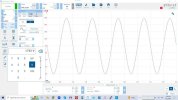
Next I wanted to check the output of the driver stage, so I set the probe to 10X, adjusted the scope accordingly, and this is what I got before clipping set in:
IMG_0391.jpeg

27.74 v RMS, 79.6 v P-P. The tubes are cathode-biased at 42vdc. So what's the critical number, here? 80 volts peak-to-peak? If so, that would be sufficient, yes?
 
Register to hide this ad
For cathode bias of output stage, the drive voltage pk level will get close to the cathode voltage bias dc level, as Vgk is getting close to 0V - at which point grid current is starting to become significant and affect waveforms. So that aligns with your rms and peak magnitude measurements and observation of waveform clipping on-set, and hopefully a visible rise in software reported harmonic levels as clipping is approached.

You would need to keep in mind if global feedback is active when probing within the amp stages, as that feedback will pre-distort internal waveforms, so a distortion measurement of an 'internal' waveform could be misleading. Removing feedback is then relevant, but you then have to be aware that internal signal levels will be much larger, and so again when taking internal distortion measurements the signal level perhaps needs to be made consistent with the signal level being imposed when feedback is reconnected. Also be aware that distortion components can add and subtract going through the amp, so minimising a particular harmonic for an internal stage may not benefit the amp if the other stages are already counteracting that distortion. But that said, I sorted a large batch of 6SN7's and 12AU7's for their balance and distortion by using a Williamson up to the driver stage (ie no feedback, and with balanced loading to represent the output stage), and identified lots of variation (given all the valves were 'used'), and then selected the better valves for use.

I haven't used the Spectrum/THD menu yet in PicoScope 7 T&M, perhaps as I might find it a bit disappointing compared to REW (but I'll try to get some experience on that soon). One issue will be the bit-depth of your scope, which I believe is 8-bit ? That could be fine for coarse levels of distortion greater than say 1%, but at some point could become misleading, especially if noise floor is included or trying to use numbers beyond the decimal point for %.
 
Thanks for all that, Tim. At this point I was just interested in whether the input and driver stages were capable of driving the output tubes to full power before the onset of clipping, and it looks like they can. Harmonic distortion is another issue, I guess, but I'm trying to get a handle on these sorts of measurements.

I have a Focusrite Scarlett and a Motu M2, which I believe are pretty low distortion interfaces, so I might try REW and see how that works.
 
if you want to see what the driver is really capable of, lift the coupling caps from the output tubes and see what you get. Fair bet its going to be a whole lot more than you're seeing with it connected.
 
Looks to me like it's already clipping a little bit on the bottom of the wave in that top screengrab. Of course, I'm not aware of a strict definition of when something is or isn't clipping. But I bet your THD with no visible clipping whatsoever is substantially lower
 
if you want to see what the driver is really capable of, lift the coupling caps from the output tubes and see what you get. Fair bet its going to be a whole lot more than you're seeing with it connected.

Oh, I didn't realize that! Why would that make a difference? The driver plate being loaded down by the grid resistance, or the output grids approaching "0" or grid current conditions? I'm curious!
 
Looks to me like it's already clipping a little bit on the bottom of the wave in that top screengrab. Of course, I'm not aware of a strict definition of when something is or isn't clipping. But I bet your THD with no visible clipping whatsoever is substantially lower

Yes, actually it is. At less than full power the THD drops considerably--assuming the Picoscope is to be trusted in that regard. ;-) I'll post some different screenshots.
 
Curious if it hits the famous .1% distortion spec for the Williamson and, if so, at what power level. Don't know much about the picoscope, so perhaps that's beyond its measurement capabilities.
 
Oh, I didn't realize that! Why would that make a difference? The driver plate being loaded down by the grid resistance, or the output grids approaching "0" or grid current conditions? I'm curious!
The grids hitting zero volts makes them a much lower impedance load than the driver is able to supply. If you remove that it will end up being limited only by the voltages available to the driver circuitry.
 
Curious if it hits the famous .1% distortion spec for the Williamson and, if so, at what power level. Don't know much about the picoscope, so perhaps that's beyond its measurement capabilities.

Yes, well, I'm not sure how low the distortion is in the built-in generator, probably not as good as a dedicated device. Distortion at full output would not appear to be as low as the Heathkit W5, if Dave's recent thread is any indication. There may be something working against this amp--the Heyboer OPT, the ultralinear operation (and the issues with a 50% screen tap as Dave documents). Also, the modern KT66's may produce higher distortion figures than the originals. Hard to say without some originals on hand. ;-) I've seen measurements indicating that some of the newer tubes can produce higher THD than NOS ones. However, I could try it in triode mode and see what the difference is.
 
Okay, check this out. This is with slightly lower B+ to accommodate the 807s.

807's at 20 watts, .17% THD:

IMG_0393.jpeg

Gold Lion KT66's at 20 watts, .48% THD:

IMG_0392.jpeg
 
I suspect that for a number of reasons, this particular amp performs better at 20 wpc than trying to push it harder.
 
For my Picoscope 4224A, I had measured about 0.023% H2 at 1Vpk, reducing for lower signal level, from 10Hz to 30kHz using my EMU 0404. The 4224A is 12-bit, so there may be differences in sig gen circuitry/performance. Perhaps do a loopback :)
 
20 watts at .17% is quite good with the 807s. The amp seems to like them. What's the distortion at 15 watts? I think most Williamsons only hit their .1% spec at 15 watts, not 20.
 
Back
Top Bottom