• The move to the new server is done. There are some software and database maintenance updates in process. This has us passing the hat around to help out. We appreciate any donations. Seriously, even a dollar helps. The payment page may be found here - https://www.audiokarma.org/support.html

Wood Glue as Vinyl Cleaner

I've found a couple of YouTube videos on cleaning LPs with glue.

This one is short (1:24 min.) and only shows application of the glue.

And this one is a little longer (4:34 min.) with a comment.

I clicked on the first one and cracked up. I think it is The Ventures playing Telstar. My early teen years came flooding back. If I don't own a copy of this I'll have to buy it. I had a dozen Ventures albums that disappeared. I don't know where.

Thanks for the link for purely musical enjoyment.

Velouria, are you using a fan to shorten the drying time?

LPMike, tell the truth, how many times did you try before you got a perfect ring at the inside and outside grooves to post. I'm impressed. I use my VPI 16.5 which moves much slower, then I'm older and move much slower. But the clamp at the center of the 16.5 is great for pulling the dried glue off.
 
Last edited:
Last night I cleaned my first LP with glue and with outstanding results! For the guinea pig I chose something I could afford to ruin: Grease soundtrack that cost me 50 cents at a thrift store.

The method works great. I used what I had at hand: Emelr's Glue-All. Each side of a record takes about half of the 4 oz. bottle. The biggest challenge for me, a first-timer, was to spread the glue evenly on the surface. Credit card works great, and pushing the platter with hand helps too. Glue-All peels off and cleans very nicely.

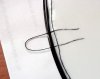
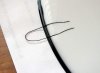
For my second record I used a couple of pieces of thread for a peel off starter. 2-inch long piece of thread shaped in U was placed over the edge first and then covered across with another 2-inch piece very close along the edge.

===================
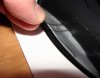
Edit: Picture of dry peel-off added. It appears that a single piece of thread set over the edge in wet glue will do just fine as a peel-off starter. Elmer's Glue-All works well for me.
 

Attachments

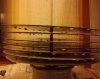
  • Step 1.JPG
    Step 1.JPG
    17.6 KB · Views: 64
  • Step 2.JPG
    Step 2.JPG
    20 KB · Views: 52
  • Step 3.JPG
    Step 3.JPG
    15.3 KB · Views: 61
  • Step 4.JPG
    Step 4.JPG
    21.4 KB · Views: 77
Last edited:
LPMike, tell the truth, how many times did you try before you got a perfect ring at the inside and outside grooves to post. I'm impressed. I use my VPI 16.5 which moves much slower, then I'm older and move much slower. But the clamp at the center of the 16.5 is great for pulling the dried glue off.

That was a first take...its easy to do, every time. But i have good hand-eye coordination i guess.. Also, watch my video and youll closely notice that the LP is running under the SL1300s power when i am applying the glue, but once i stop the flow i quickly move the arm to its stop which cuts the power... at that point i keep the platter turning with my one hand while spreading with card with other hand... its all very subtle (and a smooth transition)... i dont like applying any force to the TT when its running... so u turn by hand when spreading... even though the SL is DD i try to treat it kindly...

And this is a very clean technique... no mess, no risk to the TT!

(as far as age... im 40... and i think id do a much better job if i was 20 again)
 
After plowing through glue cleanings on 40 records over the last two weekends – a lot of the earlier glitches have been left in the dust. 80 quick single peels – no orphan islands of glue – tamed static. I’m getting this down. With all crafts, set-up is pretty important for success – that is, if you want to bang ‘em out without a lot of fiddling.

Set-Up-1.jpg


The set-up includes: two clean towels that have been dampened with a hand sprayer; 2 mil anti-static record sleeves at the ready; a lint-free anti static cloth; packing tape; and plastic “picnic” knives.
In applying the glue, I’ve been taking the flow out to completely cover the run-in grooves. This area is notorious for little flecks of dried glue left behind. Once the record is covered, I use my thumbnail on the very edge as it’s spinning to remove excess overflow.

Trim.jpg


My trusty assistant demonstrating “breaking the seal” on the edge with the plastic knife. Don’t use a metal knife or you’ll start trimming the vinyl. As it is, the record’s vinyl is harder than the plastic knife, so you’ll dull the knife after about 7 or eight records.
Once you gone around the edge on both sides, take the anti-static cloth and wipe the glue flakes off the edges and then each face of the records. It’s a good ideal to have a small square of plastic sheeting to catch the flakes. Once done, dump the flakes in a garbage bag, wipe the plastic sheet and set aside.

EdgeClean.jpg


FaceClean.jpg


Place the record on a new anti-static record sleeve and apply a small strip of packing tape to the glue on a radial plane extending over the record edge by about an inch and press it down.
Then Peel the glue away.

Tape.jpg


Peel-1.jpg


Peel-2.jpg


Once one side is peeled, take a second anti-static sleeve and place it over the freshly peeled face. Insert your hand under the bottom sleeve and flip the record with both sleeves. Peel off the antistatic-bag from 2nd side and repeat the tape & peel. If you see some stray glue flakes adhering to the record, let them go for now. The record is so highly charged at this point that it’ll just suck more dust and dirt from anything brought to clean it off than was on the surface after the peel. Take a third sleeve and begin sliding it on the cleaned record. If you’re using Titebond II and your furnace is going, you’ll be fighting quite a charge – but it’ll eventually go on like a tight sock.

Half-slide.jpg


FullSlide.jpg


Give the towels another spritzing of water and lay out the records within their sleeves.

Dozen.jpg


After a few hours, the static charge will have dissipated enough so that the records can be transferred into their original sleeves. If there’s a stray glue flake, you can be safely deal with it by using a carbon fiber brush. (I’d hold off using a Discwasher or other felt brush for 24 hours.)

Skins.jpg


$10 worth of premium wood glue is pretty cheap for the phenomenal restoration and clean quiet running of 40 lps. Total prep time for both set-ups (Gluing & Peeling) is probably 20-30 minutes. The process has gotten streamlined enough, that I probably handle each record for about 5 minutes. Fan dry time (low) is running at about 2 ½ hours per side.
- Mario
 
Last edited:
Nice pictorial Mario!

I've been thinking something about applying the glue.

Since the idea is to have the glue penetrate the grooves (so it picks up grit from down there) how about thinning the glue adequately and then applying it with an airbrush?

That should certainly ensure penetration. I am not sure how thin PVA should become before it can be sprayed (with a normal laquer spraygun at 8-10 bar). The label certainly needs protection and if penetration is that good, removal then might become an issue.

Has anyone tried this? If not, I have a triplicate Charlie Daniels LP that is also cracked on the edge that I am using for trying new glues and experimentation. I might give that a try over the coming weekend.
 
Hi SaSi & thanks!
An ingredient in Titebond and I believe in most PVA wood glues is vinyl acetate copolymer – more commonly know as vinyl alcohol. Like the “wetting factor” of regular isopropyl alcohol, I strongly suspect that vinyl acetate copolymer is the agent that allows for a departure from what seems like the high surface tension of wood glue (viscosity of Titebond @ 3200 cps straight out of the container) to penetrate deeply into record grooves. When you think about it, a wood glue is going to need to leech into some very tight tree grains – like maple for it to do its intended job.
From our own experience, we see that undiluted PVA wood glue can penetrate and remove dirt, dust and debris left on the floor or record grooves, which has been left behind by traditional RCMs with various liquid cleaning recipes that often have “wetting” additives. This pretty much seals the deal for me that no water or any other additive is needed.
Since water by itself has a prohibitive surface tension for going deep into grooves (modern “microgrooves”, anyway), I’ve seen no advantage in adding it to PVA glue for penetration purposes.
Sasi, I know that you’ve had some success with diluting PVA glue, and for you in your application environment that’s great. It certainly can dilute your costs at hardware store.
My concern is that diluting certain PVA glues in other environments can lead to difficult peels. As always, PVA glues and applications environments can vary widely - so there could well be different ways on how “to float your boat”, here. But let’s also be clear - water will not aid PVA wood glue in penetrating into the groove.
All best,
Mario
 
Great Pics Mario. And I agree about the water. Ive tried it and it made zero difference in quality and made application WAY more difficult. The wood glue is highly formulated to get DEEP into tiny microscopic places. The more specialized wood glues (titebond II for example) are even better at this. Thats why they work so great on records. IMHO, far better than any plain white glue or generic basic wood glues.
 
Hi SaSi & thanks!
...My concern is that diluting certain PVA glues in other environments can lead to difficult peels. As always, PVA glues and applications environments can vary widely - so there could well be different ways on how “to float your boat”, here. But let’s also be clear - water will not aid PVA wood glue in penetrating into the groove.
You are probably right. BTW, I have found that "wetting" the LP with alcohol prior to applying PVA increases effectiveness. Perhaps diluting the PVA with alcohol?

I discussed the idea of spraying PVA with a friend who is pretty experienced with spray painting and his comment - after a loud laugh - was: Sure, if you want to through the vaporiser away... He believes that no matter how thin the glue is diluted, it will glog the nozzle and render it useless after a few moments. Said he had similar experience with poorly diluted laquer, so PVA should be even more ... effective in doing so.
 
Well, I've done yet more records, just straight glue ... Mixed results ;-)

It's clear that, as some have said, a good (I mean, gentle... :D ) scrubbing first would probably have helped. I'm perhaps faced with a problem of greasy vinyl in some cases, and the dirt trapped in the grease isn't getting lifted.

The glue I am using ... I've found that most PVAs say 'fully set in 24 hours' .. and it does indeed seem that the longer I leave them, the better the results.

Oh joy! To have saved myself the expense of a Moth RCM! (If I won the lottery I'd get a Keith Monks :D)

Tomorrow I'm going to the local hardware store to see if I can get:
- a thin metal pole.
- lots of plastic spacers
and then bodge up a vertical 'drying rack' so I can get a good 20-30 records cleaning at a time.

Plus ... time to buy the 2.5 litre container of glue. I've run out!

edit to add: I just had a thought. Now, I can coat one side with glue at a time. But have to wait for side 1 to dry out before coating side 2. But ... what if I coat one side ... then put, say, a spindle adaptor on the platter ... which would raise the record off the platter ...? Then I could do both sides at once if the glue is viscous enough to stay on side 1...? Hmm

I willl try this tomorrow ;)
 
Last edited:
Mike,
I'm late in responding - holidays have been a crash on my sched.
Great presentation! I kept expecting "$19.99" to pop-up and flash in the corner of the screen :) Looks like you've done that a few times ... Bravo!
No argument here, with a slave turntable that you care little about and some dexterious hand action, you have displayed a very sound and effective method to cleaning LP's.
My use of a spray gun was never based upon the principle of "forcing" the glue into the grooves. My venture was to create a way to glue-clean a couple dozen albums or more in an efficient, effective manner. My idea was propagated by the fact I was painting my house. I had my motoskills warmed up and the tools available so I conducted an unorthidox exercise to cleaning some of my precious vinyls.
I enjoyed reading further into this exchange. I'll jump back in when I have something to say noteworthy (or at least think I might)

Thomas (spidder) on the wall
 
. . . I'm perhaps faced with a problem of greasy vinyl in some cases, and the dirt trapped in the grease isn't getting lifted.

The glue I am using ... I've found that most PVAs say 'fully set in 24 hours' ... and it does indeed seem that the longer I leave them, the better the results.

Oh joy! To have saved myself the expense of a Moth RCM! (If I won the lottery I'd get a Keith Monks :D)

Tomorrow I'm going to the local hardware store to see if I can get:

- a thin metal pole.
- lots of plastic spacers

and then bodge up a vertical 'drying rack' so I can get a good 20-30 records cleaning at a time.

Plus ... time to buy the 2.5 litre container of glue. I've run out!

edit to add: I just had a thought. Now, I can coat one side with glue at a time. But have to wait for side 1 to dry out before coating side 2. But ... what if I coat one side ... then put, say, a spindle adaptor on the platter ... which would raise the record off the platter ...? Then I could do both sides at once if the glue is viscous enough to stay on side 1...? Hmm

I will try this tomorrow ;)
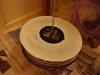
Velouria, I'm getting a picture of a vetical bar with spacers to keep the LPs from touching each other. How about buying a "stick" of plastic pipe and cutting into short pieces?

Just sharing different results, the LPs I have cleaned have had greasy finger prints on them that disappeared after the glue dried. I have allowed the glue to become clear, in a few hours with a fan, and it peeled easily. The longer I let it sit, 12-18 hours the harder it was for me to peel. That may be a factor of temperature and humidity.

And finally, I like the spindle adaptor idea. I have wondered about the posters who coat both sides. This leaves me with the mental picture of the first side gluing to the platter.

And Mario, I hope your assistant is wearing the traditional Magician's Assistant outfit. Make work seem like play!
 
Last edited:
Hmm.
Although the theory seems sound:

stack1.jpg

... in practice, the very low viscosity of this batch of PVA may make this a bit of a mess ...

stack2.jpg

I wonder how I can thicken up PVA glue ...?

(Yes the record on the bottom is a strange size. It's Alien Sex Fiend's E.S.T/Trip to The Moon, which claims to be the 'world's first 11 inch record' :D )
 
Hmm.
Although the theory seems sound:

... in practice, the very low viscosity of this batch of PVA may make this a bit of a mess ...

I wonder how I can thicken up PVA glue ...?
My trusty assistant suggested flour or corn starch :D
Seriously... Nice try, but I'd go back to the "tried and true" method - one side at a time. My trusty assistant also advises that you can't microwave batter and expect a cake out of it. Sometimes, things just take time.
 
Last edited:
Back
Top Bottom