• The move to the new server is done. There are some software and database maintenance updates in process. This has us passing the hat around to help out. We appreciate any donations. Seriously, even a dollar helps. The payment page may be found here - https://www.audiokarma.org/support.html

WTH is inside my AU-X111 MOS?

Hunleyj

Active Member
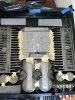
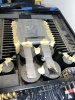
In a recent post, I shared how my poorly-packaged X111 arrived damaged. After removing as much of the broken glass shards/dust, I opened it up, only to find another mess. For a split second, I thought the caps exploded, then I realized this scene was created purposefully. Those are strips of semi-flexible metal tape, with a black putty-like substance underneath. I’ll let the pictures do the rest of the talking. Any ideas what is going on here? Some kind of alien-technology inspired heat-sink scheme? :dunno:125CD737-B0D4-4CC1-B7C5-6B65C278B34B.jpegE8C614F4-BA14-4044-870F-F06CD28196A2.jpeg
 
Register to hide this ad
Now there's something you don't see everyday. Not sure what's going on there, or why it was done. The only thing I can compare it to personally is an old Denon CD player I picked up that someone installed a bunch of foil faced rubber like damping material, almost like dynamat, to the underside of the bonnet and in several other apparently strategic locations inside the unit.

Stuff was virtually impossible to remove, and so I left most of it. I would guess in my case a previous owner applied all that material as some kind of a snake oil "improvement". Not sure the rationale behind it (probably for added EMI/RFI shielding and damping is my guess), but this mess you've discovered strikes me as maybe a similar sort of rather questionable "upgrade".

The fact the big capacitor cans are held captive with what appears to be giant blobs of silicone sealant makes me think some sort of half assed attempt at vibration damping, but who really knows. Obsessive audiophiles are an odd bunch, IMHO.
 
Yup. I'm definately never buying anything from Japan...lol
Looks mostly like a vibration/damping effort.
We all thought Sansui glue was a pain to remove. Can't imagine how fun thats going to be to remove. Worse part is, the fancy looking transformer cover looks like it might be missing or might get damaged removing that crap.
 
Yup. I'm definately never buying anything from Japan...lol
Looks mostly like a vibration/damping effort.
We all thought Sansui glue was a pain to remove. Can't imagine how fun thats going to be to remove. Worse part is, the fancy looking transformer cover looks like it might be missing or might get damaged removing that crap.

I can’t even tell what that crap IS, in order to know how to best remove it w/ minimal damage. Maybe this is karma/luck reverting to the mean after I found the NIB AU-111 last week?
 
@DB-7, don't let this discourage you from buying from Japan. Granted, I have had limited experience (5 total transactions so far) buying from sellers located in Japan, but all have gone smoothly and I received the gear I purchased in good shape. You could get screwed just as badly by a seller in the US or Canada with poor shipping and an item being misrepresented as regards it's actual condition.

The major downsides to buying from Japan are shipping costs (though sometimes that is still free) and at times the communication is a bit challenged due to the language barrier. Japanese sellers I've dealt with this far have had acceptable written English, and therefore misunderstandings were thankfully avoided. But I can see where that isn't always the case.

Getting back to this mess of an amp, is the glue like materials semi-soft and flexible, are is it rock hard? If the latter, I almost think it looks like construction adhesive (Liquid Nails being the common well known trade name in the US). If that's what it is, removing it will be possible only through mechanical means (scraping, cutting, sanding) as the stuff is mostly impervious to solvents once cured. Acetone may take off small, thin layers of it, bit that is about it, to my knowledge.

If it is flexible, it could be silicone/RTV type sealant (plumbers caulk, or automotive "gasket maker"). This too is mostly unaffected by solvents, though once the heavy portions are removed, denatured alcohol will aid somewhat in rubbing the rest off fairly cleanly.

 
The glue-like stuff is really hard, and strong. I took a pair of wire cutters/snippers to it, they did superficial damage only, although with about six months of work, I could probably free up a cap or two.
 
That's pretty nuts!

Maybe a heat gun would soften it up?

Caps can be replaced, but getting that crap off the heatsinks & transformer might be awkward. Good luck!!
 
@DB-7, don't let this discourage you from buying from Japan. Granted, I have had limited experience (5 total transactions so far) buying from sellers located in Japan, but all have gone smoothly and I received the gear I purchased in good shape. You could get screwed just as badly by a seller in the US or Canada with poor shipping and an item being misrepresented as regards it's actual condition.

The major downsides to buying from Japan are shipping costs (though sometimes that is still free) and at times the communication is a bit challenged due to the language barrier. Japanese sellers I've dealt with this far have had acceptable written English, and therefore misunderstandings were thankfully avoided. But I can see where that isn't always the case.

Getting back to this mess of an amp, is the glue like materials semi-soft and flexible, are is it rock hard? If the latter, I almost think it looks like construction adhesive (Liquid Nails being the common well known trade name in the US). If that's what it is, removing it will be possible only through mechanical means (scraping, cutting, sanding) as the stuff is mostly impervious to solvents once cured. Acetone may take off small, thin layers of it, bit that is about it, to my knowledge.

If it is flexible, it could be silicone/RTV type sealant (plumbers caulk, or automotive "gasket maker"). This too is mostly unaffected by solvents, though once the heavy portions are removed, denatured alcohol will aid somewhat in rubbing the rest off fairly cleanly.

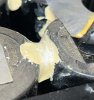
Is the what liquid nails looks like? Almost like plaster, if plaster had the strength of concrete.
D973C5AD-4D15-4130-9D22-0C71007C08B0.jpeg
 
What the f was this person thinking? You can’t tell in the compressed AK images, but in real life I can see their fingerings clear as day in this stuff. Anybody have a friend who works in a crime lab? :rflmao:
 
What the f was this person thinking? You can’t tell in the compressed AK images, but in real life I can see their fingerings clear as day in this stuff. Anybody have a friend who works in a crime lab? :rflmao:

Fingerprints suggest an epoxy putty. I bet this is the stuff. Japanese. Correct color.

Milliput Standard 2-Part Self Hardening Putty, Yellow/Grey https://a.co/d/6BZK7b5

4AA60193-4408-49F1-AE79-D5164B659E2E.jpeg

A0059203-5726-4B1B-8534-A18A6C1D3254.jpeg

B8177846-C915-40A7-950B-2F30ED4403B0.jpeg
 
Last edited:
I’ll research how to remove that crap, thanks Jim!
Edit - just saw the acetone note - I have that handy so will try it.
 
I’ll research how to remove that crap, thanks Jim!
Edit - just saw the acetone note - I have that handy so will try it.

Yeah sorry edited that acetone tip in after I originally posted. Some other removal tips online too - looks like Milliput is popular with modelers.

Keep us posted on your AU-X111 MOS adventure! Quite the saga. Hope it can sing again.
 
Last edited:
Well, tried the heat gun idea (figured I’d try that BEFORE acetone ). It did soften up a little bit, was able to get a little deeper. But still a nightmare.

43FA2683-E49B-42CC-B7AD-C3F6185A161C.jpeg
 
Well, tried the heat gun idea (figured I’d try that BEFORE acetone ). It did soften up a little bit, was able to get a little deeper. But still a nightmare.

View attachment 2877316

Once back to room temp, can you carve it out with a Exacto knife? I think I read that as a removal method on one of the modeler forums. Precision mechanical extraction.
 
Back
Top Bottom