• The move to the new server is done. There are some software and database maintenance updates in process. This has us passing the hat around to help out. We appreciate any donations. Seriously, even a dollar helps. The payment page may be found here - https://www.audiokarma.org/support.html

Wurlitzer 660. I got the Wurlitzer bug.

Carbsandcaps

Super Member
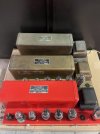
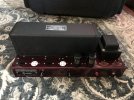
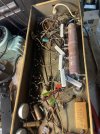
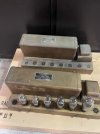
I recently got my hands on a Wurlitzer 771 from a jukebox that I got on eBay for a decent price. I rebuilt it and thought it sounded fantastic. It had a bad interstage transformer which bummed me out since that was basically the whole reason I wanted to attempt the rebuild but I threw a Hammond replacement in and it sounded great so I was on the prowl for another for a stereo setup. There was a few on eBay overpriced as usual (which is why they’re still there), so I messaged the guy I got the first one IMG_7542.jpegIMG_7543.jpegfrom to see if he had another, which he thought he might. After some back and forth he found out he didn’t but he did have 2 660’s that he would let go at a decent price (basically the same price they wanted on eBay for one). So I went ahead with it and they came in yesterday and he was nice enough to throw in a full set of tubes for one of them. The 660 is very similar to the 771 accept it uses a different preamp tube and a totally different bias technique. I’m excited to have these up and running. Unfortunately I’m going to have to steal some parts from the 771 for the project but I’ll still have it in case another pops up.
 
Register to hide this ad
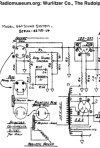
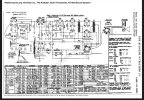
Maybe someone can help me with this bias circuit. It looks like it lifts the center tap off of ground in order to make a voltage difference for the bias voltage? I’ve been starting at it for a few days and I haven’t gotten it yet. IMG_7514.jpeg
 
Cool thing. I wonder how they sound and what the frequency response is on those.

On the 771, it looks like the bias it taken from one of the HV side, and rectified by the single diode, then 2 R/C decoupling stages.

On the 660, I failed to see a bias supply.
 
Ya the 771 uses a 45 tube as a rectifier for the tube bias. The bias on these is fed into the center tap of the interstage transformer to the grids of the output 45’s. But I can’t tell haw it gets its dc voltage.
 
The 660 uses what is called back bias. There is resistance between the transformer center tap and ground. The CT is negative relative to ground at that point.


this one is using a couple of chokes, the speaker field, and some resistors to develop the voltage across but its the same idea.


Its basically cathode bias but turned inside-out. Instead of using current flow to make the cathode positive relative to ground while the grid stays at ground potential, it uses current flow from all tubes to make the center tap negative relative to ground. Grids would be fed from the center tap to produce the bias voltage. This was fairly common pre-war, but you don't see it much post-war.
 
Ok that’s the general idea that I was thinking. It also explains the 900v ac output of the transformer. The 771 was closer to 800vac. Obviously with 120v input though. It only uses a 16uf bypass cap at the center tap, probably all that was available but ill probably bump that up.
 
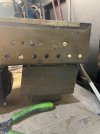
First step is to straighten out this transformer and chassis. I think someone hit it with a hammer
 

Attachments

  • IMG_7556.jpeg
    IMG_7556.jpeg
    109.4 KB · Views: 24
Mind that value and how much the rectifier can actually deal with. It might not want much over the stock value
 
The ones I tested pretty much had Nothing over 10,000 hz.

Owned an RCA theater amplifier about the same age that was push parallel 2A3's and it was down 7 DB at 10K.

But they both sounded amazing... Same deal interstage driver transformers were open.

Had a box with three 1950's driver transformers, But one was bad out of the box. :(
 
Were they potted in tar by chance? May have been acidic if so. I had a pair of dead interstage transformers in a mid 20s Atwater Kent, when I cooked the tar out to re-stuff the transformer cans what came out was a bunch of green corroded wire crumbs. The tar had dissolved the copper to nothing.
 
Speaking of windings. Is it possible the center tap for the output tube heater to ground through the transformer case? I’ve got a lead coming out of the transformer that goes to ground but it doesn’t show resistance to any of the other taps. However when it’s disconnected I still have continuity from ground to the heater windings and 1.25vac on each leg to ground. This is on both amps.
 
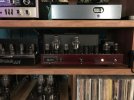
I've only had it for about a week or so, so too early to be 100% sure but I think I like the 2A3s better than the 45s which seem a touch under powered even for the Cornwalls.
I don't think it's a great amp for rock and roll but is super nice for jazz, folk (or folk-rock), old Italian soundtracks, stuff like that.
 
Speaking of windings. Is it possible the center tap for the output tube heater to ground through the transformer case? I’ve got a lead coming out of the transformer that goes to ground but it doesn’t show resistance to any of the other taps. However when it’s disconnected I still have continuity from ground to the heater windings and 1.25vac on each leg to ground. This is on both amps.

Possible, but that would be a strange way of doing it. Normally they don't just internally connect the CT in case the amp is cathode biased. The cathode resistor would sit between the CT and ground. Its obviously connected to ground somewhere though. Also just relying on the mounting hardware seems less than optimal. I'd figure they would want a wire soldered to a known good point rather than hoping the screws don't work loose.

Any time I've had a flying lead on a transformer that didn't connect to anything else, it was for an electrostatic shield in the transformer.
 
Ya I’m guessing it’s a flying lead. Once I get it all wired up I’ll run ground wires all over the place. Something bad happened in here almost all of the larger resistors are burnt and open, I’m in for some fun. I can’t tell if the field coil is a part of the bias circuit or not.
 
Back
Top Bottom