• The move to the new server is done. There are some software and database maintenance updates in process. This has us passing the hat around to help out. We appreciate any donations. Seriously, even a dollar helps. The payment page may be found here - https://www.audiokarma.org/support.html

Wurth brand capacitors seem to be good value for the money

I have been using Wurth capacitors for a few years now, but I have known the brand since 1979, when they were making great tools for the mechanical industry to specifications; I don't know if the brand is even older.
But back to the Wurth capacitors, it seems that they are made to strict specifications in China by some not so well known Chinese capacitor manufacturer (but that's just idea) ... too bad the choice is a bit limited in terms of voltage for the same capacitance compared to the larger capacitor manufacturers.
So far on the electronics I have recapped I have had no negative feedback.
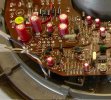
DSCN6126.JPG
 
Last edited:
I have been using Wurth capacitors for a few years now, but I have known the brand since 1979, when they were making great tools for the mechanical industry to specifications; I don't know if the brand is even older.
But back to the Wurth capacitors, it seems that they are made to strict specifications in China by some not so well known Chinese capacitor manufacturer (but that's just idea) ... too bad the choice is a bit limited in terms of voltage for the same capacitance compared to the larger capacitor manufacturers.
So far on the electronics I have recapped I have had no negative feedback.

View attachment 3392652
I do not think the connection to CapXon is "just an idea", the very last graph in this application note apparently is about a certain CapXon cap....

https://www.we-online.com/components/media/o763278v410 ANP125b Audio Capacitor THD_EN.pdf
 
My go-to has been Nichicon, Panasonic, and Kemet, (and CDE for some big stuff) roughly in that order, and only from reputable suppliers. Absolutely no eBay (potentially) counterfeit parts from no-name offshore sellers, and no "Who?" brands!
 
Both have their place, but for audio signal paths, low distortion (BP) is generally more critical than low leakage for preserving signal integrity, waveforms and overall fidelity. LL could better for DC offset, DC bias, DC blocking, AC coupling or feeding active devices like opamps. A good electrolytic would have low distortion and low leakage, but it's typically a trade-off between the two with one value being higher or lower at the expense of the other until you go up the material hierarchy (for instance) where an mkp cap would exhibit much lower distortion and lower leakage than any e'lytic, i.e. bi-polar vs. UKL polarized. I try and use bp types more often than not where both types could be used and don't notice a higher noisefloor or other aberrations or penalty of having slightly higher leakage -but I suppose it is possible in certain instances. If I had to choose between lower distortion and lower leakage, the benefits of lower distortion have outweighed the benefits of lower leakage (for me).
 
Last edited:
As the CapXon caps displayed "VENT"on the sleeve, I still wonder why it is also on the Wurth caps. If I have excess time, maybe I will check if datasheets are alike or the same.

If people would say "it is to warn you it can vent", you could also print a "hot" warning on resistors, or a "fasten clockwise" message on a bolt.:p
 
Last edited:
For the signal path, I guess the best series

Low Leakage​


I was comparing some of those to equivalent values in the (now discontinued) Nichicon UKL series. Leakage looked good, but still much higher than Nichicon. Probably of no consequence :)
 
Back
Top Bottom