• The move to the new server is done. There are some software and database maintenance updates in process. This has us passing the hat around to help out. We appreciate any donations. Seriously, even a dollar helps. The payment page may be found here - https://www.audiokarma.org/support.html

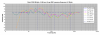
XR6 Frequency Response

c_dk is on the money for how they sound. I had my XR6s set up 16ft apart on center, with the mq104 in place. They sounded fantastic. Room was 26'x18' I had them on the long wall. They sounded amazing!! one of the biggest sound stages I have ever heard. They really need a good size room. I'm sure they could play a room twice what I had them in.

Sitting right in front of a speaker with a front baffle that big isn't going to get it.They were never intended to be set up for up close in front of you critical listening. They can & DO fill a room to the level of a nice concert hall.


I'm waiting to hear what Gregory thinks of them after he installs the upper mids I sent. Then I think he might think about real world placement. There is no way they sound good with the pads missing from his drivers.
 
Lots of activity today... and some RESULTS. :banana:


Test #1 - Broadband Noise

Four UM drivers were laid on the carpet and clip-leaded to zip cord running behind the video rack to the LEFT channel barrier strip terminals. Drivers were fed with average of 1 Watt noise power. Mic is 18" from driver.

The AudioControl C-101 Spectrum Analyzer with its Pink Noise generator and RTA were used for test equipment.
UM_noise_test.jpg


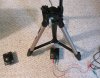
Test #2 - Stepped CW SPL

Same connection as above. Drivers were fed with ~0.2 Watts of CW power. Mic is 16" from driver.

The B&K 3050 Audio Signal Generator and Realistic 33-2050 SLM were used for test equipment.
UM_driver_test.jpg


Test #3 - Subjective driver tests

The UM drivers were subjectively tested by ranging the Audio Gen UP and DN over their operating range to check for response anomalies. It's recommend that ANY driver that's been rebuilt be tested like this for continuous and PURE sine wave reproduction as an acceptance test while there's still time to return the units if necessary. You will quickly hear any "twang", buzzing or other distortion which means the driver is defective.

This was not done by either Clay of myself, having blind faith in McIntosh quality and as a result, two years have gone by. How many hours of time have been wasted?.. and for what? We're STILL trying to figure out what's going on with these speakers!! :deal:


The B&K 3050 Audio Sig Gen model was made in Japan for B&K.

The piece below was extensively restored in 2009 with new connectors, hardware and a repaint.

BK_SigGen.jpg


Test #4 - Broadband Noise w/o UM Drivers in XR6

Two UM drivers (belonging to Clay) were removed from the XR6 cabinets and replaced with 10 ohm, 25 Watt, 1% loads. Mic is 1 meter from speaker baffle.

The AudioControl C-101 Spectrum Analyzer with its Pink Noise generator and RTA were used for test equipment.
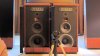
UMs_removed.jpg


10 ohm loads in place of UM drivers.

10ohm_loads.jpg


RESULTS

Even though the tests are still being developed (procedure, data sheets and Excel format) and will be run again the next day, I can report TWO UM drivers are defective or blown, and the other two are relatively well matched.
  • Clay's XR16 UM (#1) -- RA 30947 driver is DEFECTIVE has greatly reduced output (ave -10 dB, max -23 dB)
  • Clay's XR16 UM (#2) -- RA 30947 driver is WORKING *
  • Greg's XR6 UM (1634) -- RA 30985/33697 driver is DEFECTIVE with twang, buzzing, and crackling distortion
  • Greg's XR6 UM (1635) -- RA 30985/33697 driver is WORKING *

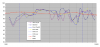
First-cut CW Test Data

I'll go ahead and post the prelim chart if you don't make too much fuss. :no:

4x_UM_driver_01.png


The Dark Blue and Yellow traces above are from BLOWN drivers!!

Issues are.. Low Output or Severe Distortion. More results and a better test set-up coming soon!


Test #5 - Install best two UM drivers in XR6s

Later in the evening the best two drivers* Clay (#2) and Greg (#1635) were installed in the XR6's, #2 in the 1634 cabinet and #1635 in the 1635 cabinet. These two UMs were a pleasant overall IMPROVEMENT in the sound of the speakers. The grill doors are now becoming a prominent issue. The metal screens rattle with just the slightest "tap" and that means they'll be excited by sound energy. The doors are left OPEN for listening at this time.


What Next

Absorber will be added above the "laid on floor" setup so the Driver Under Test (DUT) will no longer directly radiate the ceiling.. and more test frequencies will be added.


-Greg

 
Last edited:
Another installment of the XR6 driver test and restoration project.


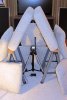
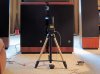
Home brew Test Camber

Well if you haven't been laughing, this one ought to do it. I've though up and put together a home-brew acoustic test chamber for small drivers. It cost NOTHING and all components were no farther away than the garage. Yep.. crawl up and stick your head in there to change the sensor (from Mic to SLM) and it's quiet all right! .. deadened is a better description. Most important feature is the ceiling bounce will be greatly reduced.

View below with SLM on the tripod. There's a 25 Watt spotlight off to the LEFT to light-up the SLM gauge.

homebrew_chamber_36.jpg


Results - Best two drivers

The makeshift chamber might have suppressed a reflection from the ceiling but introduced other errors from close-in reflections. So it's not recommended to attempt this setup.


The chart below compares driver SPL in the makeshift chamber (dark blue & violet) with SPL from the open room yesterday (in light blue & yellow).

They are overlaid and compared to RR website UM graph in the following chart:

2x_UM_driver_2.png
Measured UM driver SPL on carpet with absorber (ABS), and on carpet in the open (Room). The perforated driver screens may or may not be resonating.


Arbitrary scale or OFFSET factors were applied to all the traces. There's no reference power provided by RR.


Another bad driver found

It was reported that Clay's (-2) UM driver was "WORKING" but a definite "TWANG" develops when driving it below 910 Hz and on down. Since the lower X-over is 1400 Hz, distorted sound will be radiated before the frequency drops one octave.. or 700 Hz. Each driver should play smoothly well beyond it's crossover frequencies. This basic check was apparently not done by the repairman, or QA'd by McIntosh. In contrast, Thiel rebuilt my mids and tested them no charge, even after I purchased the speakers from the the original owner 20+ years after they were built.

The best (or easiest) way to check a driver after rebuilding is to connect it to an amp, range through the operating frequencies manually using a Sig Gen and listen for anomalies. Even better would be to view the "received" audio from your Mic on a wideband scope for waveform purity.


I won't be spending any more time with this SPL rigamarole.. and I'm not sure if McIntosh or it's vendor can make these drivers right!

Is it time to tell people these UMs are NLA?


-Greg
 
Last edited:

Equalizing the XR6s


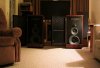
Earlier this week while we were partying before the holiday, I had the XR6s playing with grill-doors open through the 2205 and 7007 as source.

last_EQ_cabinets.jpg
XR6s cranking with doors open on the evening of Dec 23rd during pre-holiday cocktail hour.


EQ Slider settings

The AudioControl EQ sliders were set and tweaked over a half dozen songs until the speakers sounded the most natural. The Spec An Mic is attached to the top of the rack facing down-room. EQ slider positions are seen as follows:

last_EQ_2.jpg
10-band Graphic EQ settings for XR6s adjusted by ear (no measurement!)


Since Clay was asking.. I decided to jot down the EQ slider settings on the C-101. It didn't take long to pop them into a worksheet and plot.


Table of EQ sliders from photo above. Max range is +/-15dB.
Code:
index   Freq (Hz)   EQ (dB)
-----   --------    ------
  1          32       0
  2          60      -6
  3         120     -10.5
  4         240     -15
  5         480      -8
  6         960      -2
  7       1,920      -3
  8       3,840      -4.5
  9       7,680      -6
 10      15,500       0


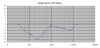
Chart of C-101 sliders in table and photo. They are all negative except for the endpoints.

C-101_EQ.png


It took another 20 or 30 mins to paste in the MQ-104 response which was plotted years ago. Oops legend of switch positions is upside down!

MQ-104_Response.png


Contours Overlaid

Let's look at the response contours all at once. The MQ-104 and C-101 have arbitrary offsets (or Gains?) :scratch2:

C-101_EQ_02.png


Only thing to do now is interpolate and ADD dB!


These worksheets are tools that will be useful going forward.


-Greg
 
Last edited:

Major breakthrough


All of these months getting to the bottom of XR6 performance. The time spent is paying off, and especially in collaboration with Clay who is enthusiastic about "not seeing the old speaker line relegated to thrift stores." He's been working on replacement UM drivers and I agreed NOT to divulge too much. He gave the ok to post a chart of Saturdays tests for the purpose of making a point!


Replacement UM driver test data

Clay sent measured SLM data yesterday and I went to work plotting over previous numbers. The replacement driver overlays ORIGINAL UM data (before Mc driver rebuild) amazingly!!

Replacement_UM_overlay_2.png
Replacement UM driver overlaid on original XR16 UM driver. The correlation is incredible, especially considering the basic measurement techniques used. 0 / 1 column switches used to turn columns ON / OFF.


With a new and modern UM driver the upper mid-band response is essentially the same as the original #035 dome. That is the the best (and toughest won) piece of of evidence yet. EDIT: today Clay is reporting the driver is smooth and all but "disappears."


Conclusion

What it says, and fell free to comment.. is the overall speaker response or presumed UM deficiency is due to the CROSSOVER and other cone drivers instead of a faulty midrange driver or rebuild. Does this imply crossover mods are necessary? The XR6 and XR16 are bottom heavy according to our measurements and I've shown in the past week that a graphic EQ would be needed to enjoy these speakers.


-Greg
 
Last edited:
Why don't you measure the Theils from the listening postion and then rotate the Macs into the same place. Would shed light on how much your room and speaker location are affecting the sound.

I did the same thing betwen a pair of ADS M15s and a pair of XR14s.
 
Why don't you measure the Theils from the listening position and then rotate the Macs into the same place. Would shed light on how much your room and speaker location are affecting the sound. I did the same thing between a pair of ADS M15s and a pair of XR14s.

That could be done but the graph above is Clay's XR16 speaker.

Our XRs are very similar.. they have the same mid-to-top end driver compliment (IIRC) but the XR16 had a refined woofer. Look carefully at the chart below and you'll see the smoother BASS response. The midrange on up is very similar.

Clay-vs-Greg_XRs.png


If you tempt me to do that, I may unplug the XRs and go back to the Thiels. It's just they're so damn forward.


Now I see you're trying to pull us back into the "room correction" camp which is what you've been doing from the onset, when the whole GROUP of topics is about XR frequency and driver response! Steering the discussion back to Environment EQ is continuing to bury the McIntosh tradition of hiding speaker response. :smoke:


-Greg
 
Last edited:
If I was listening at 1 meter I would wear headphones....I listen at 3 to 4 meters as I suspect most do. Whether you chose to use the capabilities Mac built into their speaker systems back in the 70s, is up to you.

Do your Theils at one meter then to give you other input.....
 
Since we are off topic yet again. In circles we go.

c_dk has been rather persistent in wanting to know if the upper mids Gregory & I had rebuilt are ok. Correct me if I am wrong Gregory sent his mids back because they seemed to play at lower than what seemed normal & they didn't match in SLP from left to right. After the second go round his drivers came back with missing parts (pads). I'm going to call them BAD.

Gregory has a pair of my upper mids that I tested & Gregory has now tested. Mine test BAD the first pair I had tested the same,BAD. They are not even close in output from one driver to another. BAD?

Gregory has asked you over & over if this is the normal response of these speakers.... well?????

The response curve of these speakers DOESN'T HAVE TO BE FLAT. There are newer speakers that cost north of $10K with worse curves. B&W builds it into their speakers... It's their sound. I own speakers that play much more flat than my XR16s. I like the 16s better.

Sorry if I seem short but really??? really???
 
Since we are off topic yet again. In circles we go.

c_dk has been rather persistent in wanting to know if the upper mids Gregory & I had rebuilt are ok. Correct me if I am wrong Gregory sent his mids back because they seemed to play at lower than what seemed normal & they didn't match in SLP from left to right. After the second go round his drivers came back with missing parts (pads). I'm going to call them BAD.

Gregory has a pair of my upper mids that I tested & Gregory has now tested. Mine test BAD the first pair I had tested the same, BAD. They are not even close in output from one driver to another. BAD?

Gregory has asked you over & over if this is the normal response of these speakers.... well?????

The response curve of these speakers DOESN'T HAVE TO BE FLAT. There are newer speakers that cost north of $10K with worse curves. B&W builds it into their speakers... It's their sound. I own speakers that play much more flat than my XR16s. I like the 16s better.

Sorry if I seem short but really??? really???

Yep.. the trite replies and misadvice that Clay describes have been a constant undertow and discouragement.. and that on top of a lot of wasted time and money. It's one thing to blow money, but having your time wasted is another, so I had to take a break... like for a year! If anyone would like to provide quality test gear or a facility, I will produce highly accurate speaker test data. Nearly anything can be achieved.. so long as you have the right tools.. and budget. :yes:


-Gregory
 
XR6 frequency response thread RESTORED. This was probably the biggest project ever taken-on and posted here.

As of today, I have the C26 set to basically CUT OFF frequencies to the UM and tweets.


-Greg
 
Still bass ackwards testing.

Speaker systems are designed to perform at a distance, whether 3-4 meters or 100 meters in a auditorium.

Now for Q/C function once you have a speaker designed to sound the way you want it too you can then build a fixture to either test each driver or completed speaker the same way.

Since we do not know the factories fixture that they used to test a driver we can not comment how each driver performs in our "improper" fixture.

Let alone the amateur test gear used.

If the speaker however functions in it expected location in a way we expect the designer wanted it to work then a new fixture could be created to test a driver that is known to be "right". Then other drivers could be compared to the sample for uniformity even though the measurement data looks awful; In the fixture not the true listening location.
 
In any case I still have two NOS 035 domes as well as one of a Mac sourced rebuilt ML dome if any speaker rebuilder is interested in setting up rebuilding these.

I think I also I have three burnt/open ones if any rebuilder wants to practice....
 
Back
Top Bottom