• The move to the new server is done. There are some software and database maintenance updates in process. This has us passing the hat around to help out. We appreciate any donations. Seriously, even a dollar helps. The payment page may be found here - https://www.audiokarma.org/support.html

Yamaha A-1000 Resoration Recommendation Needed

Jeff1111

New Member
Hello everyone,

First post here. I have been reading some posts here & elsewhere about who to send my good condition A-1000 to have it serviced & restored.

I had a local "service shop" work on it, they said they replaced some outputs, but when they stress tested the unit, they immediately blew again. They returned it to me still dead & stated "it must be something wrong in the board itself, and there's nothing we can do about that."

Thanks in advance
 
Last edited:
Register to hide this ad
Welcome aboard Jeff.

Pop open the unit . Take some photos of anything that looks like its cobbled up. Photos of the solder connections of all the output transistors that are fastened to the large aluminum heatsinks.
 
When Yamaha's have shorted outputs. Usually a handful of other components permanently " check out "...C-H -E-R-N-O B-Y-L'D....:D
 
Last edited:
They returned it to me still dead & stated "it must be something wrong in the board itself, and there's nothing we can do about that."
Find a different tech.....;) Read between the lines.:D The tech doesn't know how to trouble shoot and was just looking for that quick buck.:idea:
 
Sounds like the tech isn’t very much of one. At least it sounds like they gave up before mangling it beyond repair, hopefully they didn’t charge you much.

Definitely worth fixing IMO. I’ve restored a few myself and currently use one as my main amplifier.
 
The shop just cut their loses.

I saw on once that blew an output or two.
A “tech” took a shot at it, dropped in some replacement outputs, still broken.

I found about 13 torn up resistors before the owner called it dead. It seemed to be fried front to back.

So yes, there was something wrong with the board. It was full of dead parts.

Good luck though.
 
Hi guys. Thank you for the replies.

Avionic... Is there a short list of parts that permanently check out when shorted?

I had mentioned that I needed to hook it up to see if the unit worked across all channels. My nephew (who was trying to help me) was "testing" the unit when I wasn't there by activating all sets of speakers outputs and then proceeded to take a cable from one speaker and was sticking it into the speaker outputs one after another while it was playing at low volume to see if all the channels worked. He said he did is a few times in each one, & all channels were working, but that as he kept doing it, he heard a noise and the unit went dead.
 
You can download the service manual from hifiengine.com. You’ll have to make an account but they won’t bother you after that.
Once you get the schematic you’ll have to work your way from the outputs back and do some testing. There are a couple of other areas that need to be addressed while you are in there but first things first.
 
Is there a short list of parts that permanently check out when shorted?

Each amp is a little different
Start checking all parts -- transistors ,fusible resistors, diodes/zener diodes,electrolytic capacitors up stream of the shorted outputs. And check the outputs emitter resistors.
 
Sounds like the tech isn’t very much of one. At least it sounds like they gave up before mangling it beyond repair, hopefully they didn’t charge you much.

Definitely worth fixing IMO. I’ve restored a few myself and currently use one as my main amplifier.

Hello, I'm a new member looking for advice on an A1000. When I turn on power sometimes the speaker relay clicks and the system works. Sometimes the relay clicks, I start to play music then there is a POP through the speakers and the relay lets go. Sometimes I press the power button, indicator lights come on but the relay doesn't ever click. On occasion I can jiggle the entire unit and the relay will finally click.

I've opened it up and nothing looks bad inside. Just dusty. I cleaned the relay and it didn't help. The relay coil doesn't seem to be getting power.

Any ideas on what to try to get the relay working as it should? Im a tech novice so simple language would be appreciated. dp
 
Hello, I'm a new member looking for advice on an A1000. When I turn on power sometimes the speaker relay clicks and the system works. Sometimes the relay clicks, I start to play music then there is a POP through the speakers and the relay lets go. Sometimes I press the power button, indicator lights come on but the relay doesn't ever click. On occasion I can jiggle the entire unit and the relay will finally click.

I've opened it up and nothing looks bad inside. Just dusty. I cleaned the relay and it didn't help. The relay coil doesn't seem to be getting power.

Any ideas on what to try to get the relay working as it should? Im a tech novice so simple language would be appreciated. dp

Lots of A-1000 threads lately. Usually when these amps get flaky and start popping/getting stuck in protection, it's due to glue damage to components. It can also be due to cold solder joints or a combination of both.

While you have the lid off your unit you can try gently poking around the board with a chopstick (or other non conductive poking device) and see if it comes out of protection. If it does it may just have a bad joint under one of the components near where you poked.

As for the glue, if you look at your amp you will likely see brown goo sticking out from under some of the capacitors. This eventually turns corrosive and will eat up components that it's in contact with.
On the A-1000 I've seen the most damage near that row of 4 capacitors by the input board. Depending on how much glue was used you can have quite a few resistors, film caps and jumpers damaged. On the input board itself you'll have 4 capacitors that are glued. There is a film capacitor and (I think) a jumper or two in between them that will likely be damaged as well.

Luckily these amps seem to noisily stop working when the glue does it's thing. Others will die in a bad way making repairs quite a bit more difficult.
 
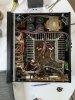
Thanks for the fast reply! I looked all around the areas I could see with the top off and don't see anything that looks like glue. I've attached a photo.
Are all of the capacitors round or are some the white rectangular blocks?
 

Attachments

  • IMG_1415.JPG
    IMG_1415.JPG
    136.4 KB · Views: 22
The white rectangular blocks are power resistors. One group of the glued caps is directly under them. The others are in that row at about 5 o'clock in your picture. Look in between the caps and the vertical board and see if there are any components with fuzzy green legs.
 
Back
Top Bottom