• The move to the new server is done. There are some software and database maintenance updates in process. This has us passing the hat around to help out. We appreciate any donations. Seriously, even a dollar helps. The payment page may be found here - https://www.audiokarma.org/support.html

Yamaha Amplifier

looks brand new from where I am sitting!
Not the same amplifier. Posted photo was a snagged photo off of the net. But my unit does look pretty good considering. I had acquired some custom made curly black cherry side panels.I'll post some photos later.I'm away from my home computer right now.
 
Not the same amplifier. Posted photo was a snagged photo off of the net.

well, knowing your skills and knowledge, I bet your unit is at least a “runner” :bigok:.

I’ve recently completed a project that involved major cosmetic issues. Luckily I am good with wood, and built a custom case to conceal the evidence :rflmao:
 
Agreed, that’s the unit I’d most like..
Probably best to ask Avionic, do old P2200’s have a tendency to blow speakers? And is there anything I can easily fit that would safeguard against this without diminishing sound quality..?
 
do old P2200’s have a tendency to blow speakers?

It's not a common failure for these amps. It's rare for the amp to fail in such a way that it will blow your speakers - but it's not impossible.

Think of it like a safe driver driving a safe car, but not using a seat-belt. The risk of having an accident would be very low, but if it did happen...

Some simple common-sense steps you can take to decrease the already unlikely possibility of damaging your speakers would be to test the DC offset first and see what those numbers look like. Hook the amp up to cheap speakers that you don't care about the first time you use the amp. Use it with those speakers for at least an hour or so. Measure the temperatures on both heatsinks to see if heat is excessive and/or if one side is noticeably warmer than the other side (may indicate bias issues, etc). If at any point something starts to sound bad, power off the amp immediately.
 
Hey Chris, thanks for the kindly assurance and perspective. Does a fuse of some sort between amp and speaker offer any effective protection, and would such an option reduce sound quality audibly?
 
It has been several years ago. It had some major shipping damage and a dead channel. Wood side panels were totally trashed. Cracked circuit boards were also mended.

A milestone amp that was well worth your artful attention!
 
Thanks Avionic.

For power amp duties, the P2200 would be replacing the power section of my current amp, a Rotel RA1412.
Would you expect the P2200 to be a definite upgrade?
 
Cheers..! Feeling reassured.
And for pre-amp duties, can the likes of a Kenwood Basic C2 or Sanyo C55 compare to a Yamaha C4 or are they definitely a shelf below?
 
I'm with Chris on the PC2002M and Avionic on the PC5002M (101M in civilian clothing). Because of weight, I'd go with the PC2002M. 240w per channel is adequate for most people.

Unfortunately, the PC2002M does have the corrosive glue issue. It should be removed. It does have the built in speaker protection missing in the P2200.
 
Thanks.
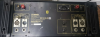
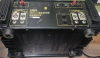
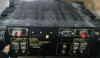
Well here’s first sight of the shiny new P2200..
I’ve only ever used RCA interconnects, for this amp do I just require 1/4 inch adapters?
Any recommendations for setting up with the best connectivity to a preamp with RCA's?

Also, before switching it on for the first time, is there any benefit to plugging in a mains circuit breaker at the wall socket?
Previous owner says it worked fine and played music last week..

Screenshot 2021-01-18 at 12.06.59.png

Screenshot 2021-01-18 at 12.06.52.png

Screenshot 2021-01-18 at 12.07.06.png

Screenshot 2021-01-18 at 12.07.27.png

Screenshot 2021-01-18 at 12.07.45.png
 
Start with the little things. Make sure the fuses are there and not replaced with a jumper. Make sure fuses are right value. Pop the top and look for any signs of trauma, leaking caps, over heated resisters and such. Plug it in and measure DC offset at the speaker terminals with no input (under 50mv). Buy some quality XLR to RCA adapters and enjoy.
 
Yeah, 1/4" TS/mono adapters will work but I hacked the ends off some twisted pair RCA cables and put XLR connectors on them. Other than the XLR connector being a bit more positive, it's the same audio wise since this amp doesn't actually have balanced input despite having XLR jacks.

No benefit to plugging in a breaker unless it's smaller than the one feeding the circuit and smaller than the fuses in the amp. If you don't trust it then a dim bulb tester might be in order but you'll need a fairly healthy bulb, non-LED and non-CFL.

Far as protection system, I built one of these diyAudio protection boards. Unfortunately, can't buy just the protector board by itself. The price includes the soft start and protector boards, then you have to source the parts. But, there are BOMs available on that website.

I didn't mount mine internally, it's external, in its own project box. Has a pair of input and output binding posts to connect in line between the amp and speakers. It's powered by a small wall wart from switched power.
 
Last edited:
Hey guys, thank you!
Great advice.
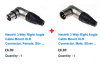
So, for the XLR/RCA interconnects do I need male or female XLR plugs to fit in to this amp (I can see two sockets)?
Are right angle ones ok? I probably won't have much space at the back of the shelf..
Screenshot 2021-01-18 at 13.39.50.png
 
Back
Top Bottom