

Greetings all,
I have a question regarding a Yamaha CR620 that is showing a short. It blows the main fuses when turned on.
The first thing i read is that it is a bad power transistor.
I have tested them and they all they have acceptable voltage drops on them all.
I looked at them more closely and one channel has an original transistor pair and one has a replacement pair.
Original:
TR723 - NPN: 2SD371
TR725 -PNP: 2SB531
Replacement:
TR724 -NPN: MJ21194G
TR726 -PNP: MJ21193G
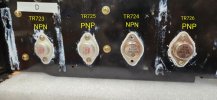
Screws are out or TR724 b/c I just tested it.
In another thread: https://audiokarma.org/forums/threa...sest-outputs-to-use-for-2sb531-2sd371.325670/
The replacement combination is discussed as an acceptable replacement.
When asking Copilot: "2sd371 transistor is mj21194 equivalent"
My question is whether mixing the two sets can be causing my problem?
Thank you for your assistance,
Tom
I have a question regarding a Yamaha CR620 that is showing a short. It blows the main fuses when turned on.
The first thing i read is that it is a bad power transistor.
I have tested them and they all they have acceptable voltage drops on them all.
I looked at them more closely and one channel has an original transistor pair and one has a replacement pair.
Original:
TR723 - NPN: 2SD371
TR725 -PNP: 2SB531
Replacement:
TR724 -NPN: MJ21194G
TR726 -PNP: MJ21193G
Screws are out or TR724 b/c I just tested it.
In another thread: https://audiokarma.org/forums/threa...sest-outputs-to-use-for-2sb531-2sd371.325670/
The replacement combination is discussed as an acceptable replacement.
When asking Copilot: "2sd371 transistor is mj21194 equivalent"
The MJ21194 is not a direct drop-in equivalent for the 2SD371. While it can often serve as a heavier-duty, high-performance substitute in vintage audio amplifiers, its electrical limits are vastly higher, which can cause circuit instability if used carelessly. [1, 2]
Key Differences
- Voltage Rating (\(V_{CEO}\)): The 2SD371 is rated for 80 V, while the MJ21194 handles up to 250 V.
- Current & Power: The MJ21194 is a 16 A, 250 W device, whereas the 2SD371 is only an 8 A, 50 W device.
- Frequency Response (\(F_{T}\)): The MJ21194 has a significantly higher frequency cutoff, which can lead to high-frequency oscillation (parasitic oscillation) in amplifier circuits designed for the slower 2SD371. [1, 2]
Usage & Sourcing
- When upgrading: If used as an upgrade, resistors and capacitors in the bias and driver circuits may need to be adjusted to prevent oscillation and handle the higher gain. [1]
- Repairs: If replacing a blown 2SD371 in one channel of a stereo, it is highly recommended to replace both the NPN and PNP pair (the 2SB531 is the original 2SD371 PNP complement) with modern equivalents to prevent channel imbalances. [1, 2]
My question is whether mixing the two sets can be causing my problem?
Thank you for your assistance,
Tom


