• The move to the new server is done. There are some software and database maintenance updates in process. This has us passing the hat around to help out. We appreciate any donations. Seriously, even a dollar helps. The payment page may be found here - https://www.audiokarma.org/support.html

Yamaha or Pioneer? Who do you think makes the better receivers?

Look at that look at that owner's manual!
https://usa.yamaha.com/files/downlo...b_ZX95350_R-N803_R-N803D_om_URL_EnFrEs_A0.pdf

Yamaha has gotten so cheap that the power supply Strangulation Switch is now implemented in software
, as part of the "advanced set-up menu". They can't even provide a hard-wired manual switch. If your speakers are 8-ohm nominal, that's maybe not a problem. Mine were advertised as 4-ohm, but modifications I've made since then will have reduced the impedance somewhat.

The thing is going to suck into a 4-ohm load. Whether that's due to an undersized power supply, undersized heat sinks, or underengineered output transistors (or some combination) I can't tell you. I can guarantee that Yamaha cut corners to improve profit margins, and the result is compromised "low"-impedance drive capacity. (To me, a nominal 4-ohm load doesn't really qualify as "low impedance", when 4-ohm nominal impedance has become hugely popular in the speaker world. <2 ohm nominal is "low" impedance.)

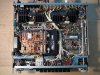
Nah, looks are deceiving. Yamaha uses good components. If you want to see something that looks cheap, look at the wiring inside this McIntosh amp.....looks about the same as the wiring inside a $5 radio in the 60s. But....they have always been a super reputable company and I'm sure it's fine for the intended purpose also. Mcintosh amp.jpg
 
Nah, looks are deceiving. Yamaha uses good components.
Obviously not, if their products can't get past the FTC testing at 4-ohms.

If you want to see something that looks cheap, look at the wiring inside this McIntosh amp.....looks about the same as the wiring inside a $5 radio in the 60s. But....they have always been a super reputable company and I'm sure it's fine for the intended purpose also. View attachment 1331217
Is the Mac rated for more, or for fewer watts-per-channel into 4-ohms compared to the 8-ohm rating?

The Yammie doesn't even HAVE an FTC 4-ohm rating. It's pathetic. The owner's manual lists a "cheat" "dynamic power" rating for 8--6--4--2 ohms, but there's no real, FTC rating except for 8 ohm loads.
 
That's a lot of stuff crammed in there.
Yeah, and shouldn't have singled out McIntosh since they have always made superb products. I believe that Yamaha uses a disclaimer on a couple of their cheaper products telling you you cant use speaker A and B together. On the rest you can which infers they can handle 4 ohm loads or lower. I have owned several and have never experienced protect with multiple speakers and have not heard tales of that problem on any forum.
 
Yamaha uses a disclaimer on a couple of their cheaper products telling you you cant use speaker A and B together. On the rest you can which infers they can handle 4 ohm loads or lower.
4-ohm MINIMUM, and then only with the Strangulation Switch engaged, which chokes the power supply input voltage, which dramatically reduces the watts-per-channel. At least some models need the Strangulation Switch engaged for anything less than 8-ohms nominal--so you're supposed to suffocate the power supply even with 6-ohm nominal speakers.

Last time I looked you had to pay serious money to get a Yamaha that had an FTC 4-ohm load rating without starving the power supply. (I think it was $1800+, but I'm not going to look it up again.)

I really believe that there was a time when Yamaha made good stuff. Just like Sony, those days are largely over. Now it's all about Profit Enhancement at the expense of utility.
I don't own one but I'm sure that owners of this unit or other well priced Yamaha receivers and amps (even those with inefficient speakers) will tell you that they power their speakers to more than adequate sound levels. And, they do so producing distortion levels well below what human hearing can detect. I believe that they satisfy the needs and desires of the vast majority of those looking for a reliable product to produce sound in their home.
 
Printed circuits instead of point to point wiring don't always relate to quality. Check out Nakamichi cassette decks. I work with both Nakamichi and Tascam cassette decks. Both good quality players. The Tascams are much better organized with only two or three daughter boards and easier to repair. The Nakamichi require removing most of the outside case and removing at least six cables going to daughter boards just to get the transport out. All point to point wiring going all over the unit. Very difficult to work on. To me, the Nakamichis fall short in reliability/repairability, but playback is so much better you can almost excuse it. I believe this is the same with the McIntosh. Looks can be deceiving.
 
Obviously not, if their products can't get past the FTC testing at 4-ohms.


Is the Mac rated for more, or for fewer watts-per-channel into 4-ohms compared to the 8-ohm rating?

The Yammie doesn't even HAVE an FTC 4-ohm rating. It's pathetic. The owner's manual lists a "cheat" "dynamic power" rating for 8--6--4--2 ohms, but there's no real, FTC rating except for 8 ohm loads.

Most McIntosh amps have the same power rating into either 4 or 8 ohms. This is because they use output Autoformers, a type of output transformer, to match the output of the amp to the speaker load. These amps will have separate output terminals for 4 ohm and 8 ohms loads, just like a tube amp.

The Mac amp's I've seen have very healthy power supplies, not at all like the skimpy power supplies in a typical home theater receiver - McIntosh design tends to be very old school. But I certainly haven't examined every Mac product, or the newer models.
Like my Technics SA 800 great Heavy Duty Design and Components
The same watt ratings at any ohms
 
Back
Top Bottom