• The move to the new server is done. There are some software and database maintenance updates in process. This has us passing the hat around to help out. We appreciate any donations. Seriously, even a dollar helps. The payment page may be found here - https://www.audiokarma.org/support.html

Yamaha PX2 arm not balancing properly

AndrewL

Member
Hi,

I have two Yamaha PX2 tables and one PX3. One of them has a problem with the tonearm, and my buddy dropped by his table for adjustment and it has the same 'problem'. On these 2 tables when I try to balance the cart in the arm by moving the counterweight back and forth I noticed very odd behavior. The arm balances up and down very quickly, rather than a slow gradual balancing motion as in every other tonearm I have tried and on my other PX2 without this problem. I noticed the arm has a very narrow range in which is swings up and down and settles very quickly, it does not want to to go to extreme top and extreme bottom. On the other 'normal' PX2 the arm swings gently and slowly up and down, hitting both upper and lower stops if need be before settling in the center. On the problematic tonearms I notice even unbalancing the arm by putting too much or too little weight does not cause it to bottom out, rather it swings up or down and then holds unless I am very drastic and add way too much or too little weight. This leads me to conclude that there is some kind of force pushing the arm back towards the center and opposing large deviations from center.

This is causing a problem because when I set the VTF using the sliding weight, the actual weight can be way off. Since the arm wants to balance close to center regardless of the counterweight being a little off to the heavy or light side, then the arm appears to be balanced when actually it is not. This then causes the sliding weight to not be accurate. A second problem is that if the VTA is moved up or down then the VTF changes drastically too. When the VTA is set higher the VTF decreases, when it is set lower the VTF increases.

I have thought about it and believe something is wrong, but maybe it's by design. If something were wrong I believe the resistance would be at all points of travel, not just off center. If it is by design, I can imagine some kind of magnetic force acting on the arm to bring it back to center. Possible but not likely, since I have not read anything about it and my other tables do not behave like this, although it's possible a change was made at some point and newer or older tables behave differently.

I was wondering if anyone on the forum has any ideas or knowledge about this odd behavior? I would love to fix it, but this arm seems so hard to take apart. I have previously taken apart Rega, SME and Nottingham arms, and it's pretty straightforward, but this arm is near impossible to decipher.


Andrew
 
Last edited:
Register to hide this ad
That arm is motorized and driven with a belt for the automatic up/down functions. I suspect it's stuck in the up position. Can you raise and lower the tonearm with the buttons?

BillWojo
 
That arm is motorized and driven with a belt for the automatic up/down functions. I suspect it's stuck in the up position. Can you raise and lower the tonearm with the buttons?

I believe the belts are only used to move the arm left and right. The tonearm cueing function does work, and I can raise and lower the tonearm using the buttons.
 
I'm probably thinking of the Pioneer PL-L1000 that uses the motor and belt to raise and lower the tonearm.
Have you zero balanced the tonearm with the arm in the down position? It must use a solenoid to raise and lower the arm if no motor. Doing the balance with the tonearm in the up position will have you fighting the solenoid.
It's been a while since I had this deck on board. Actually mine is the PX3 model.

BillWojo
 
Have you zero balanced the tonearm with the arm in the down position?

Good observation, Bill! I'm guessing that the OP has done this, but with my PX-3 this is essential to get the arm to behave properly when balancing to get the arm to float horizontally. In my case, I hit the <</< UP button and allow the tonearm to travel about half way between the rest position and the edge of the platter. Then, press the DOWN button and wait until it has traveled to the downward/most point. Then, one can begin to move the counterweight back and forth after setting the arm weight to zero to achieve the balanced position. From the balanced position, it then is possible to use the arm weight to dial in the desired amount of VTF.
 
Yes, definitely doing all adjustments in the 'down' position, and the mechanism is definitely working, when I hit down, the piston lowers and completely clears the arm to move freely. The think is the arm seems to have some force or resistance holding it close to the middle of it's travel range, it is not free to move up and down to the extremes, there is a 'centering' force of some sort.

This is causing a problem because when I set the VTF using the sliding weight, the actual weight can be way off. Since the arm wants to balance close to center regardless of the counterweight being a little off to the heavy or light side, then the arm appears to be balanced when actually it is not. This then causes the sliding weight to not be accurate. A second problem is that if the VTA is moved up or down then the VTF changes drastically too. When the VTA is set higher the VTF decreases, when it is set lower the VTF decreases.
 
Last edited:
Very strange indeed.....I just walked over to my PX-3 and performed the described operation. After pressing the DOWN button, the arm then is free to travel up and down full-range and can be "balanced" without issues.....would seem yours does have a problem of some sort.

Sorry 'bout that, I was hoping this simple procedure would have you balancing in no time! I guess I'm still not understanding, though, when you say "when I hit down, the piston lowers and completely clears the arm to move freely." That suggests the arm moves freely up and down, no? Do you have the counterweight positioned so that it will otherwise cause the arm to "float?" That should happen if you move it inward towards the platter as I've suggested and then press the DOWN button, having first set the weight on the arm to "0." If that does not cause it to float, then something else is up but I'm not sure what.....
 
Fishead, following the procedure you indicate (which is what I have been doing) does cause the arm to float, BUT it does not float freely or as freely as it should. It floats, but if I turn the thumbscrew on the counterweight to move it slightly in our out, the arm still 'floats' very close to the center. When I do the same thing on the other 'good' PX2 the outcome is different. On that table when I slightly adjust the counterweight, the tonearm then no longer floats in the center, it moves up or down until it eventually with a very slight change tops out or bottoms out. I also have a Rega RB600, an SME IV and a Nottingham space-arm, and they also are much more sensitive to adjustments and float at the center only when the counterweight is just right, the also float slowly up and down like the 'good' PX2, whereas the 'bad' PX2 bobs up and down very quickly before flowing in the center regardless of the counterweight not being spot on.
I hope this serves to better explain the behavior.
 
Andrew, yes I understand how it is behaving and unfortunately have no idea why that is happening. Have you tried just using a digital scale and setting the VTF that way? This would eliminate having to float the arm. Just move it to the position I've described, hit DOWN and see what you get. You will need to make a "platform" of sorts so that you digital scale will be at the proper height, record height, but that is easily accomplished using a small block of wood upon which you will place the scale. I know this is not a "fix" for the problem, but will tell us if the arm can be set to proper VTF and how it behaves afterward.....
 
Using a scale is precisely the workaround I have been using, however it still annoys me for two reasons; 1)something is wrong, and I cannot figure out what it is, and for example when the needle hits a warp the arm is behaving in a non-linear way 2)It renders the VTA adjustment useless without having to re-adjust the VTF. But your solution is definitely the best for now!!!
 
Sounds like either dirt in the pivot area or possibly the tonearm wires are hanging up.
If your handy, the entire arm assembly comes out pretty easy. Makes it much easier to work on.

BillWojo
 
I was thinking along those lines. The wires that go into the tonearm don't appear to be hanging up, but I can only see so far because I don't know how to take the arm off the pivots. As to dirt, I thought maybe there is old grease that is hardening? Also I thought maybe the wiring has gotten old and is stiffer than when new? Now these ideas seem grasping for answers in my attempt to come up with an explanation. I keep going back to the idea that perhaps there is an extra mechanism at play here that I don't know about, some kind of magnetic damping or some solenoid that must be deactivated during play?? I am just finding zero information on these YA-27 and YA-32 tonearms, I have the service manual for the PX2 and PX3 tables, but very little is said about the arms.
 
Andrew, it might be good at this point to contact Professor Bizzt, who specializes in the repair of these tables and you might be able to contact him for a chat about the problem you are experiencing:

https://www.webstore.com/store,pgr,225332,user_id,shop

Click on the Yamaha PX-2 and PX-3 repair, then click on contact seller. You will need to register but I think that's free....

He was once active here but has not been for quite some time. That's the best person I know to consult about the PX models.
 
Andrew, it might be good at this point to contact Professor Bizzt, who specializes in the repair of these tables and you might be able to contact him for a chat about the problem you are experiencing:

https://www.webstore.com/store,pgr,225332,user_id,shop

Click on the Yamaha PX-2 and PX-3 repair, then click on contact seller. You will need to register but I think that's free....

He was once active here but has not been for quite some time. That's the best person I know to consult about the PX models.


I talked to him recently, I own a PX-3 and have to get it calibrated and fix a start up issue. He told me to contact him in 2 months. He is still active and is the finest of the finest for these TTs. Just contact him and go.

He's on YouTube with a few vids as well.
 
Last edited:
Hi,

I have two Yamaha PX2 tables and one PX3. One of them has a problem with the tonearm, and my buddy dropped by his table for adjustment and it has the same 'problem'. On these 2 tables when I try to balance the cart in the arm by moving the counterweight back and forth I noticed very odd behavior. The arm balances up and down very quickly, rather than a slow gradual balancing motion as in every other tonearm I have tried and on my other PX2 without this problem. I noticed the arm has a very narrow range in which is swings up and down and settles very quickly, it does not want to to go to extreme top and extreme bottom. On the other 'normal' PX2 the arm swings gently and slowly up and down, hitting both upper and lower stops if need be before settling in the center. On the problematic tonearms I notice even unbalancing the arm by putting too much or too little weight does not cause it to bottom out, rather it swings up or down and then holds unless I am very drastic and add way too much or too little weight. This leads me to conclude that there is some kind of force pushing the arm back towards the center and opposing large deviations from center.

This is causing a problem because when I set the VTF using the sliding weight, the actual weight can be way off. Since the arm wants to balance close to center regardless of the counterweight being a little off to the heavy or light side, then the arm appears to be balanced when actually it is not. This then causes the sliding weight to not be accurate. A second problem is that if the VTA is moved up or down then the VTF changes drastically too. When the VTA is set higher the VTF decreases, when it is set lower the VTF increases.

I have thought about it and believe something is wrong, but maybe it's by design. If something were wrong I believe the resistance would be at all points of travel, not just off center. If it is by design, I can imagine some kind of magnetic force acting on the arm to bring it back to center. Possible but not likely, since I have not read anything about it and my other tables do not behave like this, although it's possible a change was made at some point and newer or older tables behave differently.

I was wondering if anyone on the forum has any ideas or knowledge about this odd behavior? I would love to fix it, but this arm seems so hard to take apart. I have previously taken apart Rega, SME and Nottingham arms, and it's pretty straightforward, but this arm is near impossible to decipher.


Andrew
There is a problem with the vertical bearings, either too tight or damaged.
Try adjusting the bearings by removing one of the caps at the side (these caps are held in place by glue). With a proper set of tools loosen one bearing just a little bit.
 
There is a problem with the vertical bearings, either too tight or damaged.
Try adjusting the bearings by removing one of the caps at the side (these caps are held in place by glue). With a proper set of tools loosen one bearing just a little bit.

I hunch that's the most likely fault. And there is no magnetic type force excepting the lifting solenoid. Also, when lowered, once the lift mechanism has fully retracted, the arm should be very free in both axis.
 
There is a problem with the vertical bearings, either too tight or damaged.
Try adjusting the bearings by removing one of the caps at the side (these caps are held in place by glue). With a proper set of tools loosen one bearing just a little bit.

Dr. Ear, thanks so much for the suggestion, that makes sense. Are you sure the caps are held in place by glue? I don't want to damage anything, from looking at them, it looks like there is a screw driven into them from the inside. I don't want to take pliers to the caps and start forcing things only to break something.
 
Anyone have a PX-2 Dustcover for sale?

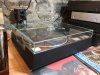
Tough order! One of mine has a fabricated cover; it will be the last one I'll sell. I like it; I can put the album cover on it while playing it.
IMG_3232.JPG IMG_1445.JPG

Well, on second thought, I suppose I could put an album on either! Somehow I was thinking the top was bulbous; is the PX3 like that or is it also flat? CRS!
I posted the first photo accidentally but I'll leave it. One nice thing about the fabricated cover (which came with the deck-don't know how it was sourced) is that if fully protected everything from dust and other such fallout.
 
Back
Top Bottom