• The move to the new server is done. There are some software and database maintenance updates in process. This has us passing the hat around to help out. We appreciate any donations. Seriously, even a dollar helps. The payment page may be found here - https://www.audiokarma.org/support.html

Zilch's AK Design Collaborative - Econowave Speaker

What advantage is there to time alignment if the waveguide is on top of the box?

Unless the woofer is very close to the top edge of the box like the DQ-10 I would still recommend placing the waveguide in the box for permanent installations to reduce the center to center distance. The discussion of crossover nulls clearly shows the advantages of a compact configuration.

It can obviously be slid forwards and backwards, big help with the QSC which is considerably longer than the standard waveguide. In the discussions about the QSC both here and on Augerpros build, the delay which occurs because of the physical displacement of the drivers due to the longer length is a problem...it can be adjusted for by letting the waveguide hang over the edge out front a little.
Jack is trying to cure same problem via the LR crossover.

Basically the same thing Altec did with the A7's horn on top, sliding it back to align the AC of the HF driver with the LF driver, unless it was mounted inside the box, then Altec just suggested reversing the phase on the HF driver, similar to what has happened here.

When afixed to the front baffle, unless delayed electrically or, as some have done, putting the waveguide on the outside of the baffle, and the woofer mounted from the inside....(just another way of shortening the difference in distance) there is a time delay problem due to lack of alignment. Top mounting allows a little "adjustment" by physically moving the waveguide/driver assembly while the plane of the woofer stays still....couldnt be done when mounted to the face plate.

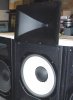
The other advantage you are not thinking of IS with the "overhang" as both I and Zilch have done, it puts the horn much closer to the woofer, again something that cant be done with it mounted to the face plate. I have been doing this awhile, and wouldnt have said it if it wasnt true! A pic will make this more clear, I'll attach one when I get home, and you'll see what I mean. Allows the horn edge to stick out past the plane of the baffle, which places it closer than baffle mounting will allow, due to the large physical size of the QSC horn. Have you aquired one yet? Yes there is an improvement in the nulls by placing the horn closer to the woofer, this is precisely why I did it, I think it will be more clear to you when you see a pic of the arrangement. Mounting the QSC in the face plate has it FURTHER from the woofer, due to the size of the QSC guide.

The length problem could be addressed (to some extent) like JBL did the 4430, putting a 1 inch spacer on the front baffle underneath the horn, but this wouldnt get the QSC any closer to the woofer.

Also, one can always replace the baffle as many here are doing, and move the woofer to the top. fortunately, my JBL 4507 boxes position the woofer high already! Or turn the box on its side, for that matter.

Russellc
 
Last edited:
I have been playing with the standard EconoWave crossover on one channel of the B&C/PE trapezoid cabinets pair to A/B that against the LR4 Xover. Zilch has been worried about the DE250 causing a rise in crossover frequency to 1.8 KHz rather than the 1.6 KHz we like. As long as it was hooked up, it seemed like a good time to tackle the frequency problem.

With the B&C woofer, the low pass of the EconoWave was also off frequency, so I substituted the Dayton DC300 12 inch Classic that was on hand. It performs great with the EconoWave, but the DE250 with it's higher impedance crossed over too high to hit the 1.6 KHz. The .7 mH inductor and 7.5 Ohm resistor in series across the DE250 took much of the 2 KHz overshoot off, as it did in the LR4 circuit. Raising the value of C1 to 6.8 uf moved the crossover back to the desired frequency.

The FR's show the crossover frequency, and the performance of the speaker using the EconoWave Xover with the following exceptions. C1= 6.8 uF, woofer Zobel = 20 uF and 20 Ohms, and .7 mH and 7.5 Ohms in series across the DE250.

Time for Zilch to try these changes and see if the performance is up to snuff. :yes:

Great job Jack, its really getting close, very flat. Thank you for taking this on
the B&C DE 250 really has some promise. Thanks for fleshing that out!

Russellc
 
I started to do that, but then remembered that the highpass is up at 3 kHz; it's performing part of the HF comp function. I'm about to kerfutz more with it, now that Jack has defined a specific approach from his experience. I'll see how much can be done with just the inductor.

No schematic, but reverse engineering from the photographs, it's three series notch filters after a single-pole highpass, bypassed for HF comp. Unfortunately, he pays zero attention to the vertical nulls, though he suggests they may be adjusted via the conjugate in the lowpass:

Anyone know where one can get those nifty molex connectors being used in the crossover pi?

Russellc
 
No schematic, but reverse engineering from the photographs, it's three series notch filters after a single-pole highpass, plus a bypassed cap for HF comp. Unfortunately, he pays zero attention to the vertical nulls, though he suggests they may be adjusted via the conjugate in the lowpass:

Wow, that is hardly efficient. But then, he isn't doing Econo, is he? Of course, without electrical EQ, that is probably the best way to get absolute flat response.

If you can figure out something with the inductor, that might simplify both the EconoWave and the LR4 for the DE250. Let's hope something is in there for us to gain.

I haven't measured the vertical nulls with the EconoWave Xover yet, but will get that done in the next few days. Now, it is simply listening and enjoying a glass or two of black ale. I love my job. :beer:
 
I calculated the HP parts using the 16 Ohm impedance of the DE250 at that frequency, and if my memory is good, it was like 2.5 uF and 1 mH, and got pretty much the same results. Some additional parts were necessary to knock down the overshoot of the De250. I didn't play in that neighborhood all that long, since I was looking for a simple answer not a complete circuit redesign. Maybe I should have stayed longer.

Edit: I remember someone saying Geddes uses the DE250 at lower frequencies than we do. How does he flatten it's response? Anybody have a schematic of his circuit?

Has anyone measured the Qes/Qms of the DE250? I wonder if it's just very under-damped near resonance or something?

And Zilch... if you increase the inductor size and reduce the cap, the crossover point should stay about where it was (around 3Khz)... it'll just have lower Q (less output AT resonance and just below/above, and more output one octave below resonance). That's why I was thinking it might fix the problem. Maybe even try inductor/cap values for a "theoretical" 24 ohms? Like maybe 1.5mh and 1.6uf or so?

It's possible, that the driver needs more than just this, due to a big peak in its impedance down there... but IME, this kind of thing can work, in many cases where the driver isn't totally crazy-acting in impedance...

Regards,
Gordon.
 
"Euro"

Anyone know where one can get those nifty molex connectors being used in the crossover pi?

Russellc

Not Molex. I used to get them at Rat Shack, 12 position Euro barrier strips. Has a hole between each set of contacts, that's why you see some with two contacts, but only one used.
 
Not Molex. I used to get them at Rat Shack, 12 position Euro barrier strips. Has a hole between each set of contacts, that's why you see some with two contacts, but only one used.

I'll have to drop in to one and see what they have. Havent been to a Radio Shack in a while. Seems like I bookmarked a place that had them in a strip of several pairs, and they could be cut off to length/number of connectors. I first saw those over on LH forum is some really nice crossovers someone had built.
Always thought they looked very handy for crossover construction. Anything to dress up my "birds nest" crossovers.:D

Russellc
 
The other advantage you are not thinking of IS with the "overhang" as both I and Zilch have done, it puts the horn much closer to the woofer, again something that cant be done with it mounted to the face plate. I have been doing this awhile, and wouldnt have said it if it wasnt true! A pic will make this more clear, I'll attach one when I get home, and you'll see what I mean. Allows the horn edge to stick out past the plane of the baffle, which places it closer than baffle mounting will allow, due to the large physical size of the QSC horn. Have you aquired one yet? Yes there is an improvement in the nulls by placing the horn closer to the woofer, this is precisely why I did it, I think it will be more clear to you when you see a pic of the arrangement. Mounting the QSC in the face plate has it FURTHER from the woofer, due to the size of the QSC guide.


Russellc

Actually, after looking and measuring, I'll have to correct what is said here. With my "overhang" method, center to center on the 4507 box was 13 inches. Measuring the baffle available on the 4507 shows that if bracing didnt prevent mounting and I could snug it up right against the woofer it would actually be almost an inch closer. This still wouldnt allow the slide back in forth deal, but I'll have to stand corrected, I really thought the over hang method got it closer than measurement shows it does. Putting on the baffle as Bauhausler said is closer on the center to center... I really like this guide, but its larger size has caused both delay and C to C problems on E'wave but, it is a really nice sounding piece that I am glad to see get put through its paces with the DE 250. I do have my eye on those out there who have cut off the threads of the JBL waveguide and glued the wooden bolt-on mount to it. Wonder if that would generate any response weirdness like the adapter throats did?

Standing corrected,

Russellc
 
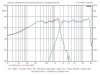
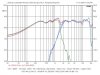
Drivers in-phase, on QSC waveguide axis, 1.75" ahead of woofer baffle plane:

attachment.php


attachment.php

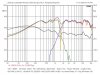
Mic 3" lower:

attachment.php


attachment.php

Notes:

1) As previously, eWave XO slightly overcompensates this DE250 on freestanding QSC waveguide.

2) QSC w/eWave highpass rolls off both DE250 and D220Ti at ~20 - 22 dB/Octave acoustic slope.

3) With LE14A lowpass, acoustic crossover occurs at 1.53 and 1.56 kHz, respectively.

4) Drivers in-phase, with the waveguide 1.75" forward, the system acoustic center is 3" below the waveguide axis at 44" mic distance from baffle.

5) In-box next.... :yes:
 

Attachments

  • DE250 eWave.jpg
    DE250 eWave.jpg
    58.1 KB · Views: 203
  • D220Ti-OMF eWave.jpg
    D220Ti-OMF eWave.jpg
    61 KB · Views: 200
  • D220Ti-OMF eWave Phase.jpg
    D220Ti-OMF eWave Phase.jpg
    65.1 KB · Views: 191
  • On LE14A Pic.jpg
    On LE14A Pic.jpg
    52.9 KB · Views: 189
Last edited:
Re: Zilch's response curves

I gotta say when it comes down to a couple of Dbs up there where decades of motorcycles, airplanes, power tools, handguns and Techno have taken a toll on my hearing hardware, it's gonna be subjective judgments and not any kind of accuracy that seal the deal for me.

I have DE250s, D220Tis, D210's, PH612s on hand and QSC WGs on the way. I'll try them all out and as much as I trust Zilch's measurements I don't expect to be able to hear the small differences these graphs show.
 
I have DE250s, D220Tis, D210's, PH612s on hand and QSC WGs on the way. I'll try them all out and as much as I trust Zilch's measurements I don't expect to be able to hear the small differences these graphs show.
Skywave earlier observed that we're giving DE250/QSC446 far more detailed scrutiny than we did D220Ti/JBL PT. We've learned a bunch in the meantime, is what.... :thmbsp:
 
What advantage is there to time alignment if the waveguide is on top of the box?

Unless the woofer is very close to the top edge of the box like the DQ-10 I would still recommend placing the waveguide in the box for permanent installations to reduce the center to center distance. The discussion of crossover nulls clearly shows the advantages of a compact configuration.

I am sure this has been discussed - what is the optimum distance between the center of the waveguide and the center of a 12" woofer?
 
Skywave earlier observed that we're giving DE250/QSC446 far more detailed scrutiny than we did D220Ti/JBL PT. We've learned a bunch in the meantime, is what.... :thmbsp:

I think it also underscores the neat little package that the original E'wave is.
All its parts seemed to go together and work as if designed for each other.
Even the 220's need to be crossed at 3k worked out. the QSC and DE 250
seem to require a lot more to get right....again, it should be worth the effort in the end. I know I'm all ears at this point!

Russellc
 
So for a newbie, without test equipment, what is the best solution?
I am sure this has been discussed - what is the optimum distance between the center of the waveguide and the center of a 12" woofer?

Stick with the "standard" eWave solution and try to ignore the geekfest, I mean optimization testing, of the more expensive DE250/QSC combination. I'm sure the final results of the DE250/QSC tweaking will be outstanding if you wanted to wait and spend the extra $. Watching the response curves flying back and forth is educational and entertaining, for me anyway.

0" is the best distance center to center - think coaxial drivers. Most folks seem to simply mount the waveguide as close to the woofer as practical.
 
So for a newbie, without test equipment, what is the best solution?

Welcome to the thread. I live within a 10 mile radius of five eWaves and I built a pair myself. Go with the original. It really works great. All the new development is getting beyond the ECONO part of eWave.
 
Welcome to the thread. I live within a 10 mile radius of five eWaves and I built a pair myself. Go with the original. It really works great. All the new development is getting beyond the ECONO part of eWave.

Naw, its just a continuation of the lesson learned from the original. Still Econo relatively speaking, the original is just a super bargain.

Part of "Econowave" is the lesson taught, and as several original posts stated, there is a lesson here, once learned it can be applied to other parts
and projects. That's basically what's going on here. Long live Econowave!:banana:
The original, is a super bargain as well as super performer. The QSC and DE 250 are head and shoulders better. Not a condemnation of E'wave, that's just how good these new parts are. As shocked as I was when Zilch first got me to compare E'wave with Altec hornage, I was just as shocked at how much of an improvement these slightly more expensive parts are. Admitted, the DE 250 is more expensive, but still quite reasonable. The QSC is basically the same money as the JBL guide. For an inbetween thats the same price, Zilch is playing around with the bolt on 220ti and the QSC, exactly the same money.

There's more than just good speakers on this thread, it is becoming a "book" on 2-way wave guide implementation. This is also why reading this entire thread is important, minus the goofing around, there is scads of information here. The inexpensive nature of the original E'wave sure does get them here, for a variety of reasons. Some want to begin playing with high efficiency. Some want to resussitate a vintage system. me, I was already into horns. What I was interested in is how a 2-way horn system works, especially the compensation aspects of the HF. This thread is becoming a text on the subject.

Happy E'waving everyone!


Russellc
 
Last edited:
Didn't mean to slight the new stuff, I am just in a VERY cost consciencious mode now. The original is SUCH a GREAT DEAL. And of course the performance is amazing.
 
Back
Top Bottom