• The move to the new server is done. There are some software and database maintenance updates in process. This has us passing the hat around to help out. We appreciate any donations. Seriously, even a dollar helps. The payment page may be found here - https://www.audiokarma.org/support.html

Class G amps. Pros, cons, Class A?

Is this true? I would guess you're speaking of the Power Envelope models. I'm very curious. So far the NAD PE models I've heard so far have less than stellar sound stage. Someone mentioned it is due to the architecture of the PE system and the slight smearing of mids that necessarily takes place. Are NAD PE models class G?
Bearing in mind, any effect of rail switching or rail modulation should only be conceivable if the amp is pushed hard enough to force the switch.
 
My NAD 2200 is a class G amp. It did indeed have smearing in the mids and lack of bass. Also had a large glitch when switching to high power mode. However I cured all these problems and the sound is now second to none. Search this forum for the mods I had to make if you're interested.
 
(thread revival)

Recently bought two vintage receivers, a Hitachi SR-804 and a Sansui G4500. The Sansui is 'rated' 40 wpc, the Hitachi 50 wpc.

When I turn things up, they both sound great, but the class G Hitachi definitely has more headroom, and the sound just jumps into the room.

The Hitachi had something going with their class G, and I never would have known until I tried one. They might be a best - kept secret for those who like vintage receivers, and they don't have the 'PMS tax' which is nice on the wallet

View attachment 3316126

I agree with you. I'm also very curious if your SR 804 images well. Does it have a good soundstage? I have a NAD that is technically class G, 7240 PE and the soundstage is very flat. Thanks!
 
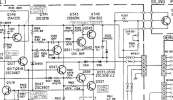
The Luxman R-117 receiver is class G and this is how they explain the switching in the SM. It has a 74v rail it runs on until it reaches a point then it switches on a 102v rail. But I'm not a tech so thats all I can give you.

View attachment 3046748

EDIT: Reread OP's question and this may not answer it as far as what class the 74v rail is operating on.
I don't think R-117 has class A.
Just completed recapping mine and noticed the transistor Q545 C, E shorted and left channel +rail is always at 102v. So fortunate I have a pair of spare 2SA1302/2SC3281. Bought R-117 a couple of month ago...
1780609536892.png
 
This is an incredibly impressive stack of gear, by any measure.

The power amp, in addition to being high-efficiency Class G, utilizes 95v rails and contains totally separate supplies for the rail switching. It is also not a furnace and is quite reliable.

Hitachi gear is bar-none my favorite of the classic Japanese equipment. The caliber of their mosfets and other semis during this time is pretty much unparalleled.
Quite reliable, but an absolute mofo to work on . . . (I had to repair one once back in the early 80's . . . ).
 
Last edited:
I understand the concept of having the output rail voltages track the output signal.

What I don't get is why? What is the benefit in doing this rather than just keeping the rails at the higher voltage?
 
I understand the concept of having the output rail voltages track the output signal.

What I don't get is why? What is the benefit in doing this rather than just keeping the rails at the higher voltage?

Higher efficiency primarily. The higher the rail voltage would result in more waste, so to speak, mainly as heat dissipation at lower outputs where the amps likely spend most of their time. Yet, can switch to "high gear" as necessary to cover peaks.
 
Last edited:
I understand the concept of having the output rail voltages track the output signal.

What I don't get is why? What is the benefit in doing this rather than just keeping the rails at the higher voltage?
Far less heat dissipation in the output devices, as well as greater efficiency.
 
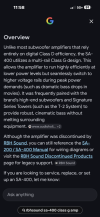
RBH Sound designed an outstanding sub amp that is class G. The SA-200 and SA-400. I’ve three of the sa-400 amps. They drive my RBH reference subs beautifully.
 

Attachments

  • IMG_2494.png
    IMG_2494.png
    177 KB · Views: 7
I have a couple of mono-blocks that are something close to Class H, which is directionality similar with Class G.

These suckers have a Class A amp section rated at 600wpc@8ohm and double that into 4ohm. Imagine the electron juice that would have been required if they did not have the linear tracking power-supply.

 
I wonder if those are really a Class H or G design or more likely a sliding bias arrangement, which is a different thing.

Krell, for example, did that with some of their big "Class A" amps.

When the music is soft, the bias drops to conserve power and reduce the massive heat usually generated by Class A designs. When a loud transient hits, the bias increases to keep the transistors in their linear operating region, preventing crossover distortion.
 
Last edited:
I wonder if those are really a Class H or G design or more likely a sliding bias arrangement, which is a different thing.

Krell, for example, did that with some of their big "Class A" amps.

When the music is soft, the bias drops to conserve power and reduce the massive heat usually generated by Class A designs. When a loud transient hits, the bias increases to keep the transistors in their linear operating region, preventing crossover distortion.
Yamaha MX-10000 is likely the most performant implementation of a sliding bias / HCA design. This is another beast that has performance of a laboratory instrument rather than that of a power amp. You can see mine playing nice with a recently rebuilt C1 and some nice Sony speakers (you can skip the first few minuted to get to see the MX-10000:


But No, the STAX monoblocks are not sliding bias. They are fully balanced, pure Class A design amps with zero global feedback, 5 x SEPP buffer stage with a mosfet voltage amp, for each monoblock.
The power supply is actually itself a Class AB amp with zero global feedback. The supply rails at the positive and negative outputs swing synchronously with the audio signal envelope. The rails modulate continuously rather than in discrete steps, maintaining near-minimum dissipation across the full output range. The transformer and heeatsinks are huge and then there are 4 x fans per monoblock, so when pushed hard, they will eat a lot of electron juice.
This is more or less a Class H power supply design. STAX called it SDPP: Super Dynamic Push-Pull.
 
Amps like Arcam are Class G.
“Switching rail” style.

Do they run a few watts in Class A?
(Saw that statement made in a site. True or false?)

What are your opinions?
My old Carver TFM-35x is a G and sounds pretty good!
Class G does not run in Class A at any time. A note: Class G is peak power for milliseconds, not continuous power full time beyond it's continuous power rating.
 
Last edited:
Kenwood Basic series is a good example…
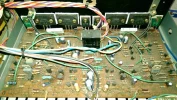
Here you can see 2 sets of outputs per channel
It’ll use the smaller transistors and switch to the larger ones for higher power/signal level

IMG_6507.webp

A schematic view…

IMG_6508.png
 
Back
Top Bottom