• The move to the new server is done. There are some software and database maintenance updates in process. This has us passing the hat around to help out. We appreciate any donations. Seriously, even a dollar helps. The payment page may be found here - https://www.audiokarma.org/support.html

Class G amps. Pros, cons, Class A?

Class G does not run in Class A at any time. A note: Class G is peak power for milliseconds, not continuous power full time beyond it's continuous power rating.
Class G and H have everything to do with how the PSU is designed, not how the output stage operates. You can have a Class AB or a Class A output stage.

The SATX amps in the link above are pure Class A output stage, 600wpc @ 8R. The power rails are Class H, which is conceptually similar to class G (dynamic modulation of the power rails in class H vs fixed steps in Class G).
 
The big Crests are truly rail switchers, with one set of outputs. The key to things is keeping the C th E drop as low as possible. This is the output of the beast that will drop 6000 watts RMS into 4 ohm bridged (or 1200 into 8 dual channel). . .
1000016512.jpg
 
Class G and H have everything to do with how the PSU is designed, not how the output stage operates. You can have a Class AB or a Class A output stage.

The SATX amps in the link above are pure Class A output stage, 600wpc @ 8R. The power rails are Class H, which is conceptually similar to class G (dynamic modulation of the power rails in class H vs fixed steps in Class G).
Thanks for clarification.
 
1781557176280.png
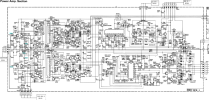
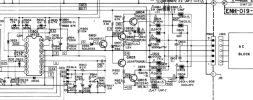
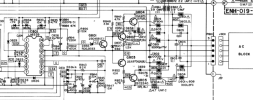
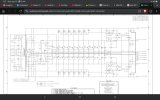
JVC A-X500V. Google AI called it Class G. Output transistors Q661/663, 662/664 always connected to +/-60.2v high rails. +/-40.7v low rails are directly connected to +/- 60.2v through D809/810 thyristors. Don't understand the design.
1781557474762.png
 

Attachments

  • 1781557464392.png
    1781557464392.png
    271.2 KB · Views: 3
Everything I have ever read says that G and H are basically the same - vendors just name them differently, since there is no formal definition for those classes . . .
I see that the distinction to be actually quite clear. Class G has fixed rails. For Class H, the rails are dynamic.
 
I see that the distinction to be actually quite clear. Class G has fixed rails. For Class H, the rails are dynamic.
Both have variable voltage rails presented to the outputs. How is largely irrelevant, since the same thing happens in terms of how the actual output stage runs. . . .

(Kinda like claiming that a car with throttle body injection vs port injection are not darn near the same . . . suck-squish-bang-blow in both of 'em)
 
Both have variable voltage rails presented to the outputs. How is largely irrelevant, since the same thing happens in terms of how the actual output stage runs. . . .

(Kinda like claiming that a car with throttle body injection vs port injection are not darn near the same . . . suck-squish-bang-blow in both of 'em)
Oh I see what you are saying. Yes then, from that outcome stand point we can say that variable power rails is the commonality.

But that is where the commonality ends. The means to get there and the efficiency of providing power, do differ quite a bit. I was speaking from the technical means, so your carb vs fuel injection analogy applies.

I also would see any manufacturer using the names interchangeably, as disingenuous. Delivering on a design with dynamic rails for class H is a lot more difficult and costly than having predefined steps for class G.
 
It was back when the 200wpc Hitachi beasts in H came out that all the reviewers and tech articles denied any significant distinction. My take is technological as well - whether fixed voltage rail switching, modulated rails, or something like Carver's magnetic field supply, it's still typically an AB output stage with a modulated supply. The main goal of the supply switching (at least what I have seen over the decades) is to reduce thermal dissipation, and nothing more.

Yes, the supply/rail control circuit differs radically . . . it's what it does that does not.
 
It was back when the 200wpc Hitachi beasts in H came out that all the reviewers and tech articles denied any significant distinction. My take is technological as well - whether fixed voltage rail switching, modulated rails, or something like Carver's magnetic field supply, it's still typically an AB output stage with a modulated supply. The main goal of the supply switching (at least what I have seen over the decades) is to reduce thermal dissipation, and nothing more.

Yes, the supply/rail control circuit differs radically . . . it's what it does that does not.
Nearly 100% accurate except the marginal efficiency of class H, with a higher margin on the monster KWatt amps. Worth the complexity? These days where Class D is the de-facto for KWatt range PA amps, likely not. For house Hi-Fi when powering monster Class A output stage, maybe.
 
Yet have never found a Class D that sounds as good as my Crests on subs. Far too much bull$h1t in the ratings on D . . .
 
Yet have never found a Class D that sounds as good as my Crests on subs. Far too much bull$h1t in the ratings on D . . .
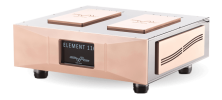
I am not surprised. Most class D amps I heard sound cold and not engaging. However, not all class D amps are created equal. I have a Merrill Element from Merrill Audio that is one of the best sounding amps I heard....so it is part of my "team"
 
Last edited:
It was back when the 200wpc Hitachi beasts in H came out that all the reviewers and tech articles denied any significant distinction. My take is technological as well - whether fixed voltage rail switching, modulated rails, or something like Carver's magnetic field supply, it's still typically an AB output stage with a modulated supply. The main goal of the supply switching (at least what I have seen over the decades) is to reduce thermal dissipation, and nothing more.

Yes, the supply/rail control circuit differs radically . . . it's what it does that does not.
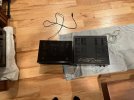
It is a beast for sure! Think it's 68lbs, side by side of a 7500 MKII and 8500, makes the 7500 looks like a toy, in it;s own right is a serious amp.
 

Attachments

  • IMG_0228.jpg
    IMG_0228.jpg
    140.2 KB · Views: 18
  • IMG_0227.jpg
    IMG_0227.jpg
    112.3 KB · Views: 19
Kind of a bastard to service though . . . worked on one in the 80's after a couple of dealers/shops gave up. (I did get it running again!)

(And my back seems to recall the 68lbs . . . )
 
I am not surprised. Most class D amps I heard sound cold and not engaging. However, not all class D amps are created equal. I have a Merrill Element from Merrill Audio that is one of the best sounding amps I heard....so it is part of my "team"
Now if the FTC can just get all the ratings back to a standard (actually, I think something did pass recently . . . ) since the class D lies rival the car stereo BS ratings of the 70's ("2500 watts with 2amps at 12v in!") If it puts out more than it takes in, the rating is pure BS . . .

And (and I don't intend to start a $h1tstorm here) I want an amp that is *ACCURATE* beyond all else. I can "color" things elsewhere, but I want the core path clean.
 
then THIS is all you need ;)
Maybe there's a parallel universe in which a version of me buys $24,000 Class D amps!

Seriously though, lots of folks speak well of those Merrill amps but I'd rather stick with the 68 lb / ea type :)

I do agree that power amplification isn't the place to color the sound.
 
Back
Top Bottom