• The move to the new server is done. There are some software and database maintenance updates in process. This has us passing the hat around to help out. We appreciate any donations. Seriously, even a dollar helps. The payment page may be found here - https://www.audiokarma.org/support.html

3D Wallpaper - Good for Diffusion?

Register to hide this ad
There are some similar panels from other companies that have more exaggerated, deeper shapes, and I know at least one architect has used them for diffusion. These don't have much depth and a lot of flat surfaces, so I don't think they'd be very good.
 
I like kites!

3D-Wallpanel-Wallart-Kites-01.jpg


That stuff would certainly be a nice topping for absorption panels. Way better looking than most fabric and batts.

Thanx for the link ...

I'd go straight to the top with your question and see what the mfg has to say and if they'd recommend any particular pattern. Heck, they might come up with a whole line of acoustical designs, and name them after you! <G>
 
3D-Wallpanel-Wallart-Kites-01.jpg


That stuff would certainly be a nice topping for absorption panels. Way better looking than most fabric and batts.

Only if it's acoustically transparent...which if they're calling it "board" I have doubts it is.

Cool looking stuff and great concept. Looks like they have the technology to produce board that would actually diffuse sufficiently to affect acoustics.....but I'm with RevMen on this one.
 
Interesting stuff.
(and proof positive that old threads never really die) <G>

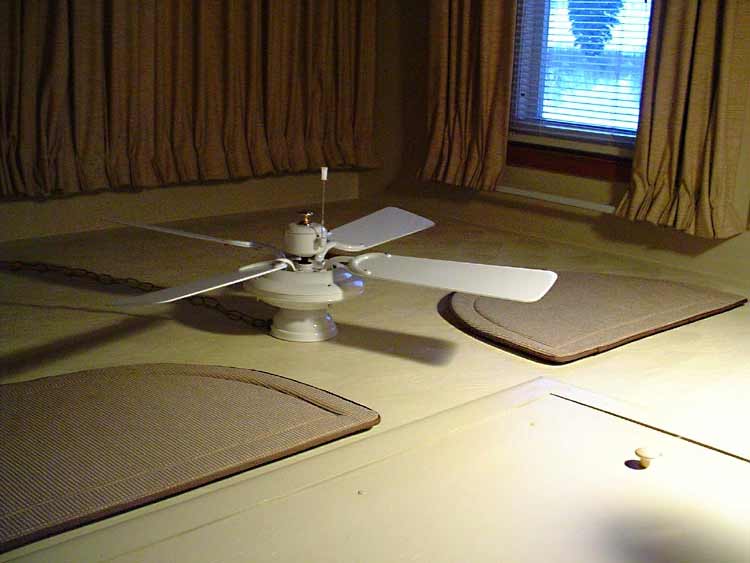
My biggest problem was ceiling reflections. I fixed that by tacking some memory foam carpets to the primary reflection points ...

ceiling-carpets-001.jpg


They really kill the shrill. I've since been able to use a few driver tubes that would have cracked plaster before adding them.

And it's fun telling people to wipe their feet when they come in ... and pointing up ...

Also went with full length insulated fiberglass curtains on the back wall. That got rid of the bass bounce and a mean peak at 160hz.
 
Interesting stuff.
(and proof positive that old threads never really die) <G>

My biggest problem was ceiling reflections. I fixed that by tacking some memory foam carpets to the primary reflection points ...

ceiling-carpets-001.jpg


They really kill the shrill. I've since been able to use a few driver tubes that would have cracked plaster before adding them.

And it's fun telling people to wipe their feet when they come in ... and pointing up ...

Also went with full length insulated fiberglass curtains on the back wall. That got rid of the bass bounce and a mean peak at 160hz.

How did you get them up there? Any trouble with them falling down?
 
Gravity!

ceiling-carpets-002.jpg


There it got interesting. I used some of those Command picture strips, but they kept separating from the carpets. Ended up stitching those on and no problems since.

The have sagged a bit in the middle over the year they've been up there, but that's more in keeping with the 3D motif of the thread, right? <G>

Price was right ... I think I paid $8 each at the local big box.
 
Only if it's acoustically transparent...which if they're calling it "board" I have doubts it is.

Cool looking stuff and great concept. Looks like they have the technology to produce board that would actually diffuse sufficiently to affect acoustics.....but I'm with RevMen on this one.

I always thought diffusion worked by breaking up a wave front and scattering it about the room, thereby weakening the reflection, not by absorbing it.......:scratch2:

Just tossing that out there for conversation.

Dave
 
He was responding to the idea of using the panels as a covering for an absorber. Since it's a board, it would make a very poor covering for an absorber since it wouldn't let much sound into the absorber to be absorbed.
 
You're correct, they are different. These panels are good for neither.

But they make the room look good!!!

I guess I missed it, but when did this thread get resurrected? lol

I thort it was determined the depth of the forms would not be enough to create a noticeable difference as far as diffusion goes. Correct?
 
I see. And, I agree, that would not work. However, I believe absorption and diffusion are two different things.

They very much are, with the fundamental difference being absorption removes sonic energy from the room and diffusion returns sonic energy back into the room.

For diffusion, an uneven surface should give you a degree of diffusion.

If one really wants to get persnickety about it an uneven surface is technically not acoustically diffuse. To be acoustically diffuse, sonic energy has to be returned uniformly in the space and time domains and just any randomly shaped/uneven/irregular surface can't do this....it can only "scatter" sonic energy. True acoustic diffusion can only be achieved with a device that has been designed and constructed based on specific mathematic calculations (quadratic).

Why does it matter? Because scattering is a non-uniform return of sonic energy, specific frequencies may get directed toward the listening position with other frequencies being directed away from it....so some frequencies in the sonic content could be perceived as stronger than others.
 
Last edited:
But they make the room look good!!!

I guess I missed it, but when did this thread get resurrected? lol

I thort it was determined the depth of the forms would not be enough to create a noticeable difference as far as diffusion goes. Correct?

More to it than just depth....shape and configuration matter as well.
 
I should probably add that well-type QRD diffusers are actually absorptive also, but only in a region of content that is below the lowest frequency where the device is diffuse.
 
Back
Top Bottom