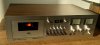
The Akai GXC-730d I have here

Looks&feels
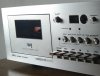
This one came out nicely when cleaned up as well. Although not as minty as the '710. At first glance this model looks like a '710 with a black tray slapped under it. But for instance the nobs and VU meters are also enlarged to fit the scale of it. Because this deck is huge! To give you an idea: the VU meters are exactly as wide as a cassette box. I do like those big, half sunken meters though.. I'm not so sure about the black-under-flap-with-chrome-sides design. It definitely has a unique look to it. And of course there is the wood case again, piano keys on the side (but now lower). Plus an additional autoreverse mode switch. Yes good people, this is an actual autoreverse cassettedeck, from 1976. Unlike the '710 it has a damper in the push-tilt door mechanism. That it nice. Operating the piano keys however is a bit of a weird sensation. Because the rewind and fast forward keys push the same mechanical system as in the '710. But the play keys, in both directions, are electronic. So they feel and operate a bit different. The stop key is a sort of hybride, that does the mechanical thing if pushed when the deck is winding, and the electronic thing when the deck is playing.
features
It is the autoreverse version, that is of course its great trick. It plays
and records in both directions. It can be set to run each side once, or continually. Changing tape direction can be done at any point, with just one push of a button (no need to stop the deck first). And it plays the other side pretty much instantly. It is an early common reverse deck, but Akai dabbled with the idea of contineus tape-play before the concept had matured. May I present you: The utter eccentric Akai GXC-65 invert-o-matic.

I brought this one back from the dead. It was the top model of all invert-o-matic adaptations, with GX head and internal amplifier. Which actually, after full refurbishment, sounded pretty impressive for a 7 WPC amp, with the befitting 12 WPC jetstream speakers. But the coolest thing about it is, that it actually flips the tape around at the end, jacks it back in and plays the other side. I sold it for a good price, but it was still pretty hard to let go of her..
Back to the '730 then. So besides the autoreverse we have the same common functions as on the '710. Except the MPX filter, which has been replaced by a record level limiter. At the back we find holes leading up to "record level" trimpots. It turns out, they adjust the recording level relative to the vu meter readings. So they are used tot make sure the meters properly represent te actual recording levels. The tape type selector is a more common and convenient system, that has one button for each type. Unlike all other versions in the series, that have the Fe-Cr selection switched in with two buttons pushend simultaneously. Overall it appears to me that this installment of the gxc-700 series was made with a specific target group in mind. Aimed at luxury, and particularly for those that want a machine that is easy to use.
Inside the machine
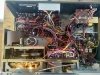
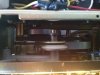
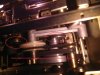
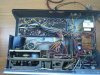
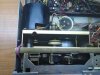
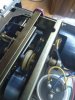
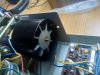
Some of it is familiair, some of it new. The op amp is adapted to accommodate an extra slider switch, that flips the left and right connections between the head and the amp, when the deck runs in the other direction. Normally the tape gets flipped when played on the other side. But not when it just runs the other way around. This deck just slides the head over a tiny bit, leaving it in the same direction to a now reverse running tape. Hense the requirement to electronically flip the signals left and right. Of course the capstan also has to run the other way for reverse play. Unless you have two capstans, and just push the other ones pinch roller up when changing direction. To that end you see here two (of course massive) flywheels in the transport. One for each capstan. Rather brilliantly, it utilizes the same wheel mechanics as the actual double capstan models higher up in the series. Except that the belt is not run around both flywheels, to form a closed loop double capstan setup. No, the belt runs over the one, and around the other flywheel, which as a result now run in opposite directions. I bet a silence fel over the room when one of the engineers came up with that. I also wonder: would it be possible to turn this in to a double capstan, non autoreverse deck? I mean just by rerouting the belt, and whirring up the pinch-roller plungers in parallel. Should you want to.. Because indeed the headblock comes up and the pinch-rollers (or should we say course rollers?) are controlled by relais and plungers. The mechanics for rewind and fast forward are the same as on the '710, driven by that snare running from the far end of the motor pulley. But the take up reel(s) are now simply driven by a rubber wheel running over a ridge on the flywheel. The appropriatie one for the chosen direction comes up with it's corresponding pinch-roller. A nice and clean design. Although there could be a bit more "feedback" from the take-up reel on to the pinch-roller. Making it more prone to vibrations in the sound. I have replaced the electrolytic and solid aluminium capacitors in the power supply and the amp of this one. Snares, bubs, the Dolby LED and low noise transistors where also replaced.

 Performance
Fast forward and rewind work just fine. The plunger operated play/reverse system works great! I haven't seen the smallest hiccup in the operation of the whole system once. It works quick, smooth and makes these highly satisfying "klink-kloink-klink!" sounds. Playback is as expected about as good as with the '710, and really above what an average deck of that time would do. It would seem to have a slightly bit more 'wow' then the '710 but noting bad, and like its counterpart no flutter at all. Tape speed is really dependent on the belt. Mine runs just below 1% fast in forward direction, and pretty well close to perfect in reverse. Replacement belts where all to thin, and therefore ran slow. So the original is back in, for now. Which might also explain a pinch of wow.
I was a bit skeptical about it's recording capabilities, but was pleasantly surprised. Operation for recording is slightly different then normal. It's press pause, then press record, and then press the desired direction (and then release pause). The record key will remain down, while the electronic play/direction key never "hooks in". However the green operation direction indicator will let you know what mode the deck is in right now. The large meters and the clipping indicators combined make for a surprisingly adequate level indicator, given the sloppy 'ballast' of the meters. I recorded in both directions continually on a TDK SA-X tape, and it sounds remarkably clear.
Overall it's just another one of those Akai machines that seems a bit quirky at first. But when you use it for a while, you will find it is all very well thought thru and worked out and it just grows on ya. If you are looking for something compact, or a real 3-head recorder, this might not be the one for you. The more minimalist inclined would probably feel better about the '710, as it's no-nonsens counterpart. Otherwise.. This deck is eccentric, intriguing, convenient and sounds pretty decent to any standard. I thought recording would be it's weakness, but it is actually pleasant to operate and really holds up in terms of sound quality. It is easy to see why this is a wanted model.










 .
.