• The move to the new server is done. There are some software and database maintenance updates in process. This has us passing the hat around to help out. We appreciate any donations. Seriously, even a dollar helps. The payment page may be found here - https://www.audiokarma.org/support.html

4-way comparison: The Akai GXC-700 series unveiled!

so I thought I had replied, but apparently that glitched out or something..

Anyway: the pinch roller of the 740 has the same part number as the rollers of the 760. So that should be the same. I would assume the GXC-570 mk1 has the same as well. The 710 and the 730 share a different part number roller. You can always downloads schematics and compare part numbers in the parts-list. It's a nice exercise if you're interested in getting to know tapedecks, as you have to puzzel a bit to find out what is what;)
 
Last edited:
so I thought I had replied, but apparently that glitched out or something..

Anyway: the pinch roller of the 740 has the same part number as the rollers of the 760. So that should be the same. I would assume the GXC-570 mk1 has the same as well. The 710 and the 730 share a different part number roller. You can always downloads schematics and compare part numbers in the parts-list. It's a nice exercise if you're interested in getting to know tapedecks, as you have to puzzel a bit to find out what is what;)

Thank you okke for replying back.
I went ahead and started a thread because i did not want to hijack this one with to many questions, I will check the parts lists for the decks you mentioned.
Hopefully the person that will do the job has the other decks in his data base.
I would hate to throw this deck in the trash for lack of pinch rollers.

Rob
 
My first 3 head was a GX-M50(?) And that got me into the 3 head recording experience. Ie. "This is so simple! Just turn this little bias know and flip between source and tape until they sound the same!" Made a few great recordings off CDs with only a hint of a sense of depth. Then I found recording over old stuff wasn't cutting it (bias trimmer out of whack?) and moved on to another 3 head as they were $20-$30 a pop back then at thrift stores and on craigslist. My Hitachi D-777 auto reverse deck had the same 4 track head that just shifted over when the direction changed. Seemed a bit simplistic compared to the Sony TC-K96Rs flip head.
 
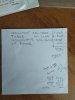
Ah the GX-M50, the first 3-head in the M-series I believe. I never had the pleasure, but would estimate it makes decent recordings. Yes, basic-to-midfi decks where almost free at around the turn of the century. But there was always that rather steep price jump to negotiate if you wanted a really good recorder. When I bought the Akai AM-2800 amplifier to go with the '760 I got the whole paperwork with the amp. Including this little note
IMG_20230203_140825.jpg

These are prices in "guldens" the Dutch currency untill the Euro was introduced in 2003. I see a CD player in there for less then the mid-level AT-2400 tuner. So that put's the timeframe of this note around the late 90's I guess? A Gulden (suffix is F) back then was just a little bit less then a Euro or Dollar today, so somebody was on role here.. Might not have been the toughest negotiator perhaps, but none the less: look at the price payed for the '760. That equates to at least 1500,- Euro or Dollar today! The deck was already 20 years old by then..
 
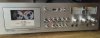
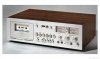
The Akai GXC-760d I have here
1.jpg ​


Looks&feels

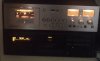
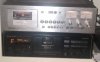
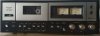
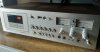
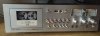
High time for a look at the last installment of this series. Unfortunately the face-plate of mine isn't mint, it has a few little dents here and there. Still though, what a beauty right! To top-off the already slick and stylist design we are now familiair with, it has those remarkable round touch buttons in the middle. They are mesmerizingly lid in their designated colors when engaged. Akai actually developed that icon system for "play" et cetera you still find on anything from cd-players to the app you play your movies on. They developed on from there to a color-code system: green for play, red for record, yellow for ff and rew and orange for pause. No colour for stop. You will see that they consistently applied that to their many many tapemachines, in different forms. But the way they did it on the '760 is my favorite. I kind of wonder why they didn't use the same bulps&buttons unit on the GX-600-series RTR's actually.
side.jpg pauz.jpg rg.jpg lights.jpg

Besides the great looks the design is also highly functional. You always immediately see what is going on with this deck. And you got those big buttons right in the middle for all the main functions, that will work at a light touch but won't be bothered if you hit'm up either. The tape compartment opens smooth, in that push-tilt fashion, but also quick. The big window and bright tape illumination allow you to actually read the etiket on the tape quite easily. The monitor button is set a little apart, so you won't confuse it with say the tape-type selector. All buttons and indicators are positioned "intuitively" and when you use the deck you will know they really thought it all out. One thing I don't like, and is also Akai standard stylo up to the 80's, is the separated record level pot's for left and right. Especially since the mic record levels come along with the line levels, it's a bit fuzzy to make subtle, even adjustments during recording. Overall though this deck is a joy to operate.
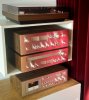
AKAI.jpg Some AKAI family shots front.jpg


The GXC-710d on the guest seat; ready for dubbing
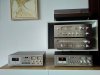
1060.jpg


Features
Besides the usual functions the '760 has an MPX filter, the memory-stop function, and the internal tone-generator that goes with the front panel bias adjustments. It also has a "peak level indicator" switch that set's the VU meters in an according mode. It offers tape monitoring because it is a three-head deck, an uitput level attonator, and mic inputs can be mixed with line inputs. The double Dolby amp allows for seamless monitoring. While the one Dolby amp encodes the input signal before it goes on tape, the other Dolby amp decodes the signaal that comes from the tape, in realtime. One feature I have missed on occasion is the muter, also know as "the DJ distinguisher". In general, it is just not one of those semi-editing tape machines. It is best suited for "straight ahead" recording. The whole 700 'series is from before Dolby-C and metal tape, so neither of these technologies are supported. I don't miss'm, but some might.

Perhaps the neatest features of the '760 are in it's tape transport. First of it is a double capstan model that, combined with a three-head setup and bias adjustments makes for an excellent recorder setup. Secondly, it is a three-motor setup that allows for a level of refinement not to many mid 70's decks get close to. When the door is closed, the tape is actively pulled tight bij reel motors moving in opposite directions. When playing, the take-off reel motor is steplessly and dynamically breaking from the rear. When fast forwarding or rewinding, the deck also applies dynamic braking on the supplying reel, while at the same time steplessly adjusting speed. This causes the tape to spool fast at the beginning of the tape, where most decks are slow, but then slows down towards the end, to make sure the tape is really neatly and tightly rolled up. The system also allows for direct switching between for instance ff and play. It wil slow-to-stop, and then engage the requested function. In all, an exceptional transport!


Inside the machine
Let us take a closer look at that transport. It consists of the two heavy flywheels also featured in the '740. With the same big outer rotor speed adjustable AC motor, forming the closed double capstan loop. The difference is that this motor does not drive the reels. It is not connected to any idler-wheel or clutch or other mechanical part causing either wear or vibration. The reels are each driven by their own direct drive motor. No rubber wheels, clutches or any of that. A very clean design. These direct drive motors are quite unique (don't brake them). They are stepless, and also function as dynamic brakers. So that is without the inevitabel vibrations a clutch or idler-wheel would cause. When "breaking" they generate electricity, and that in turn is used as a reel-speed sensor.

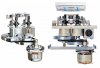
open.jpg mech.jpg

A less then perfect shot from the inside I admit, but you get the idea. The capstan motor is on the left, and right behind it the motor speed control PCB. The bleu cube sticking out is a multi-turn potmeter I put in there. I have completely overhauled this machine, and boy that was a lot of work! The brown PCB in the back is where the Akai GXC-760d holds it's magic sauce, controlling all those advanced reel-motor functions. A very elegant pre-IC or "computer controlled" system, that just negotiates the forces from both those special DD-motors to hold each other in check. The opamp is out of view, one floor down from there. It includes the two discretely built Dolby amps. The power supply and oscillator PCB is to the right, including a 5 Watt cement resistor. VU meter control is in front of/over it. In the middle-front some electronics to do with the switchboard and and there are many smaler boards around. The tramsport is out of sight here. The Head block comes up when engaged together with both capstans. To this end a truly excessieve plunger slams on a leaver with enough force to feel in thru the floor. Again, nothing is done lightly in this series of decks, and the '760 actually weighs in at 11,1 kg.

Performance
For the best possible performance, you need to treat this thing like a diva. For instance, you'll want to use either a TDK SA tapes from the late 80s or a TDK SA-X from the early 90s. Others will do, but never reach the same depth and clarity when combined with this deck. The deck has to stand exactly leveled, or the capstan-motor might start making tiny noises. You also need to warm the deck up, and keep room temperatures a bit even. Otherwise the potmeter controlling the motorspeed will drift (I'm still thinking about modifying that out - it is already better than original). However, if you take care of all that, and the cleaning and demagnetizing, and bias calibration, and careful record level adjustment and all that.. This particular deck makes absolutely baffling recordings. And that is from the very first centimeter of tape, just flawless. Especially with TDK SA-X (record with the tape selector in chrome, playback in fero-chrome) the dynamic is amazing. The sound is clear, full, and even fairly spacious. The dynamic fast forward and rewinding works very smoothly as well. In fact, it makes most other decks look rather crude and clumsy at that. While to be fair, the plunger engagement "KABLAM!" takes a little getting used to. Another thing to consider it that the deck runs fairly hot. Nearly the entire top is an air vent, so it needs a bit of breathing space. And the tapes come out a little warmer then I would prefer. LED's instead of bulbs over the tape compartment might help with that. Over all though, I am over the hills with this deck! Such a joy to use, and the sound quality it (re)produces is beyond anything I have ever heard from cassette.

Well, I hope you enjoyed this elaborate comparison!:beerchug:


.
 
Last edited:
Hello. I was waiting patiently for the last installment. I have gcx760 deck to play my prerecorded cassettes. I think it is a perfect one for this use, having long lasting heads and dual capstan drive. Lack of dolby c and metal cassettes playback is not a problem. I recently replaced the capstan rollers.
I use ct43 for the playback of the cassettes recorded by myself and metal tapes.
I have to admit that for recording I am using jvc 661 deck. Thank you for such a great thread. Robert.20230212_084330.jpg 20230212_084358.jpg
 
Thank you Robert!
Some nice decks you have there. Which pinch-rollers did you put on your deck? I can find those with a white plastic core, but I'm not sure about the quality of these. And the one German site that sells those with a solid brass core... :eek: at 160,- euro a set.
 
Hello. I have used $10 ones from ebay. It took only five minutes to replace them. They made a big difference as the original ones were glassy and hard. I am planning to buy more of them just to use a new tire on the old ones. Robert.20230213_184116.jpg20230213_184349.jpg
 
My first 3 head was a GX-M50(?) And that got me into the 3 head recording experience. Ie. "This is so simple! Just turn this little bias know and flip between source and tape until they sound the same!" Made a few great recordings off CDs with only a hint of a sense of depth. Then I found recording over old stuff wasn't cutting it (bias trimmer out of whack?) and moved on to another 3 head as they were $20-$30 a pop back then at thrift stores and on craigslist. My Hitachi D-777 auto reverse deck had the same 4 track head that just shifted over when the direction changed. Seemed a bit simplistic compared to the Sony TC-K96Rs flip head.
 
My first 3 head was a GX-M50(?) And that got me into the 3 head recording experience. Ie. "This is so simple! Just turn this little bias know and flip between source and tape until they sound the same!" Made a few great recordings off CDs with only a hint of a sense of depth. Then I found recording over old stuff wasn't cutting it (bias trimmer out of whack?) and moved on to another 3 head as they were $20-$30 a pop back then at thrift stores and on craigslist. My Hitachi D-777 auto reverse deck had the same 4 track head that just shifted over when the direction changed. Seemed a bit simplistic compared to the Sony TC-K96Rs flip head.
I have the GX-M50 and like it a lot but have not made any recordings yet.
I will have to do that and see how it compares to the GX-740D that i am working on.
 
The Akai GX740D how does it compare to the Denon DN-790R, Aiwa AD-WX808 and Akai GX-M50? is the 740D better due to being double capstan? those are the other decks i have.
The double capstan is huge advantage in it self. How the performance of your decks compare will largely depend on the state of them (including calibrations). So I geus, you tell us?
 
The double capstan is huge advantage in it self. How the performance of your decks compare will largely depend on the state of them (including calibrations). So I geus, you tell us?
Thank you I will report once i make some recordings.
For now i am focused on the GX740D restoration. I have received the pinch rollers so i need to install them and order me some belts.
 
A small addition:
I thought I'd try something else this time and bought a broken down Sansui SC-3003. But then it turns out it has an Akai transport, and well most of the deck is actually the Akai CS-707d. Sansui made a front plate for it and their own PCB's but basically we have the highest version of the CS models in the 700 series here.

So, what do we find? Well, the transport is of the more common plastic wheels and rollers kind. Driven by a smallish DC motor. But once it was running smooth again it turned out to be a pretty stable transport. Rewinding only just makes it to the end though; to many wheelies involved that are all adding some resistance for that modest motor to overcome. The sound quality is alright, in the sense that it sounds a bit dry and not overly dynamic. But tape-role is good and in all the sound is definitely enjoyably. It holds up in Dolby actually. Recording on it produces 'simple' but proper sounding tapes. There are no real mistakes or biases in the sound. So yeah, for a common deck of it's day it performs quite well. It does however not produce the rich sound of the higher up models, nor does it get close in built quality. This is the cassette-sound like I remember it:rflmao:


IMG_20230318_145749.jpg​
 
Thank you, thank you!

it is indeed fascinating how the brands swapped out parts. From what I understand a later "Sansui" deck was actually a Nakamichi. While the Akai record player shown above (the AP-006) is said to have a Micro-Seiki arm. With the rest of it being typical Akai build.
 
I recently picked up an Akai GX-M10 for $50 that I'm in the process of restoring. Replaced 2 of the 3 belts, but that last one requires me to remove the power supply a bit, and I'm dreading that. But I need to replace the belt, because it's the one that activates auto-stop when you hit the end of the tape (which currently does not work). Playback speed is also janky - a bit too slow - so I'll need to adjust the pot on the motor as well. But other than that, she's a beauty! Too early to do a proper assessment, but I suspect the M10 will sound great. Not too shabby for $50!

IMG_5702.jpg
 
Back
Top Bottom