• The move to the new server is done. There are some software and database maintenance updates in process. This has us passing the hat around to help out. We appreciate any donations. Seriously, even a dollar helps. The payment page may be found here - https://www.audiokarma.org/support.html

6EM7 / 2A3 build

LOL. A bit cheesy, but it could be just this easy. My original plan was to use a 5U4G. When I was designing the power supply, I knew I wouldn't get to a B+ of 350VDC with that tube, so I went with 5AR4 instead. The 5AR4 and a 10 Ohm dropping resistor put me right at 350 with the Hammond 302AX PT. If i simply go back to the 5U4G, keeping the dropping resistor, I'm probably very close to where I need to be.

I popped in a 5U4G in an hour ago and it's running fine. Haven't checked any voltages yet, we'll see.
 
The 6EA7 tube should be decoupled from the output tube. Your power supply should have a low enough impedance to share both channels, but input stages and output stages need to be or should be decoupled. I would use the 5AR4 and modify your PS down the road until it is dialed in. Too much voltage is always better than not enough (to a point).

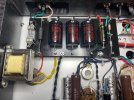
My standard 2A3 or 300B power supply usually follows a double "pi" design with a shared first capacitor. The 5H chokes (156L) are rated at 75mA each and are small enough to fit under the chassis;

1736944126070.jpeg
 
That wouldn't be a hard change. I have some Hammond 156R 1.5H 200mA chokes on hand. Early on (been thinking about this amp for a year) I was going for a PS more like the one I built for my 6L6GC SEUL, based loosely on the Cascade Tubes Lacewood 2 amp. I decided on as much simplicity as possible for this one, but I guess a step too far. I just modeled the PS in that Duncan PUSD2 app adding another LC leg with the 1.5H and a 30uF cap. Looks like an option for the future.
 
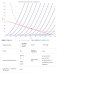
Didn't spend a bunch of time on this today, but I did get back in there. The 54UG did what I was hoping. B+ is 315VDC. I ended up with 750 ohm cathode resistors. Plate is now 260 and the resistors dropping 45 - 46 VDC so I'm right at 60mA with 15 to 16 Watts dissipation. These values held with my US Westinghouse 2A3 and the JJ 2A3-40s. My Electro-Harmonix tubes are not very well matched, but still in a decent range per tube. I used an online load line calculator and the results seem good with my number plugged in.

Was going to add the extra PS leg for the driver today, but it would have been just screwing the choke to the side wall and zip tying the cap to something... It will have to wait a bit. I'll build a small turret board to mount everything for a neater install later on.

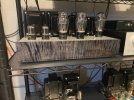
Been listening for half the day. Hard rock, classic rock, some jazz. The thing that stands out to me, besides overall clarity and detail, is the gravity and feel of the bass. A notable departure from my Dynaco PP clones and my 6L6GC based SEUL. Pretty happy with the result so far.Load line current condiditons.jpg
 
Last edited:
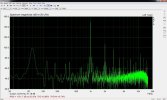
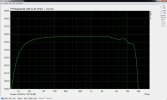
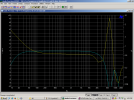
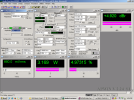
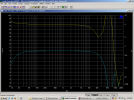
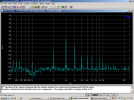
Added the choke and cap for the driver B+. Was able to just fit the extra cap on my PS board by adding two more turrets. Worked out pretty well. ARTA FR sweeps show some HF roll off, but not until the very top. Pretty flat for the rest. I scaled the graph for 1dB per division. Distortion seems good. The low frequency distortion looks high, but I got rid of that with the filament balance pot after I took this screen shot. Nice way to set balance!

Adding the driver LC leg to my PS made an insignificant change in overall B+. 1 or 2 volts. I did try a 5U4GB which raised B+ a little. Did distortion and FR sweeps with that tube too, no change.

The amp sounds great to me. The slight roll off isn't an issue for my 60 year old ears... I do wonder if I can work to improve that however.

Bottom plate and feet are on. Going to run it for a while before any more changes.

2A3 Left THD.jpg2A3 Left channel.jpg
IMG_2198.jpg
IMG_2199.jpg
 
Test data looks great (and amp too)!

Frequency response is typical of a SE amp with no feedback. The transformer is the limiting factor for high frequency extension here. My 1627SE frequency response looks similar.
 
Thanks! It's running now. Just listened to "Jeff Beck Blow by Blow". Pretty happy with the outcome.
 
They sound good too, but I think I'm favoring the JJs ATM. I have a set of Penta Labs 2A3 inbound. I know Penta rebrands and often uses Chinese tubes, but these are older date codes and do say made in US on them. They also look very much like RCAs. We'll see, price was right!
 
I have 9 pair of various 2A3's (double plate & single plate) and my favorite of the bunch are the Sovteks (4 pair).

Some, but not all 2A3 and 300B tubes will "break-in". For example, initially a few pairs had high(er) then normal distortion in circuit, but after about 50 hours the distortion went down considerably and this is the new normal for the tube.
 
Last edited:
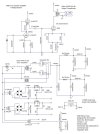
Final schematics. Some changes to the power supply. Added the 2A3 cathode resistor value I landed on and added some voltages.

2A3 SET Power supply.jpg
6EM7-2A3 SET.jpg

Been using this for more than a week now. On all day when I'm home.

I've tried a few 2A3s and a few 6EM7s. Different 2A3s can change the character a bit, but not in a big way. None of the tubes I have on hand are objectionable. They all sound great, but I think I favor the JJ 2A3 40 for now. Today I'm using new issue Electro Harmonix and I can't find anything I dislike about them.

Different story with the 6EM7s used in the circuit @THD+N designed. The tubes I've tried didn't have much of an impact on sound. They just work. I like that! Testament to a well designed circuit.

Volume is much more than enough through the Forte 1s in my 11X14 room. Even very hard rock and metal sound controlled and clear with solid bass. Hard to believe it's only 3.5W.

Done for now. Thinking about a small desktop speaker / headphone amp building off the same 6EM7 driver! I have some old "Voice of Music" 5K OPTs with a 32 ohm output hanging around.
 
Last edited:
For reference, here is some test data for my Shishido 2A3 mono amp. The power output is down a few bits due to my slightly low B+ in the direct coupled (Shishido design) mode.

Cyan is Frequency Response
Yellow is THD+N

1 Watt/8 Ohm, THD+N
1737929167301.png

1 Watt/8 Ohm, Frequency Response
1737929185479.png

Full Power (3.5 Watts/8 Ohm), THD+N
1737929201649.png

Power Response, 8 Ohm
1737929212957.png
 
Final schematics. Some changes to the power supply. Added the 2A3 cathode resistor value I landed on and added some voltages.

View attachment 3411246
View attachment 3411247

Been using this for more than a week now. On all day when I'm home.

I've tried a few 2A3s and a few 6EM7s. Different 2A3s can change the character a bit, but not in a big way. None of the tubes I have on hand are objectionable. They all sound great, but I think I favor the JJ 2A3 40 for now. Today I'm using new issue Electro Harmonix and I can't find anything I dislike about them.

Different story with the 6EM7s used in the circuit @THD+N designed. The tubes I've tried didn't have much of an impact on sound. They just work. I like that! Testament to a well designed circuit.

Volume is much more than enough through the Forte 1s in my 11X14 room. Even very hard rock and metal sound controlled and clear with solid bass. Hard to believe it's only 3.5W.

Done for now. Thinking about a small desktop speaker / headphone amp building off the same 6EM7 driver! I have some old "Voice of Music" 5K OPTs with a 32 ohm output hanging around.
Glad the driver circuit worked out for you @SS904. Clean and simple, no sand required!
 
Here is some data of the 6EA7/6EM7 circuit in a 300B SE amp. I am using Lundahl LL1623 wired for 5.6k primary impedance (8 Ohm secondary).

1 Watt / 8 Ohm, THD+N
1738168638293.png

1 Watt Frequency Response & THD+N (Cyan is magnitude, yellow is distortion)
1738168656279.png

1 Watt FFT (1kHz tone is nulled by internal filter)
1738168667542.png

Full Power (7 Watts @ 5% THD+N)
1738168676544.png
 
The data you show all have flatter FR plots to 20K than what I am getting. Do you think this is simply a transformer characteristic, or is there something I can do beside adding feedback that could help a bit? I was wondering about the coupling cap values. I understand it is a high pass filter, so maybe no effect to 20K, just a thought.

Very happy with the sound so far. It is very clean and balanced. No harshness, tight bass, wonderful mids within a reasonable SPL. I'm sure I'll never notice the 16ish KHz drop off, but...
 
The data you show all have flatter FR plots to 20K than what I am getting. Do you think this is simply a transformer characteristic, or is there something I can do beside adding feedback that could help a bit? I was wondering about the coupling cap values. I understand it is a high pass filter, so maybe no effect to 20K, just a thought.

Very happy with the sound so far. It is very clean and balanced. No harshness, tight bass, wonderful mids within a reasonable SPL. I'm sure I'll never notice the 16ish KHz drop off, but...
You can try a moderate amount of FB, but too much and the input required to drive the amp to full output could get out of hand since the circuit has just the right amount of gain with no FB for nominal output.

It would not be the coupling caps or time constant of the circuit. The only other device left is the OPT. Choosing a SE OPT is always a challenging compromise. Lamination material (M6, Hi-B, Amorphous) will also have an impact on performance.

You can try bypassing the 10k input grid stopper. It's not really needed and is forming a high pass filter (>100kHz) with the Miller Capacitance of the first tube section.
 
Missed this first time around, looks very nice.

Had a peek at the 6EM7 tube data, honestly that low mu section looks like it could be an output tube in it's own right. Could skip the 2A3 entirely, use the high mu section to drive the low mu and have yourself a spud SE amp.
 
Back
Top Bottom