• The move to the new server is done. There are some software and database maintenance updates in process. This has us passing the hat around to help out. We appreciate any donations. Seriously, even a dollar helps. The payment page may be found here - https://www.audiokarma.org/support.html

a/d/s ( aDs ) L570 Crossover Capacitor Repair/Restore/Upgrade

foo.kamikaze

Active Member
Hi.

I recently purchased a pair of a/d/s L570 bookshelf speakers on Minneapolis Craigslist. The two were in okay shape. They have signs of normal use over 30 plus years, but no abuse. Unfortunately, about their surrounds is rust that is contributing to the surrounds lifting off the metal surface.

I planned on sending the pair of tweeters to Richard So, former employee of a/d/s, and "ADS-Master" restorer. He restored the tweeters, midranges, and crossovers for my aDs 910 speakers. Now they sound so sweet, and are good for another 40 years! Anyway, I digressed, so in addition to sending the tweeters I needed to send the woofers too. While spendy for a small set of speakers, to my ears, just about any ADS speaker is worth restoring. They are easy on the ears.

Finally to the crux of this posting...

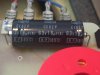
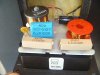
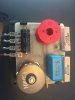
To save money, I chose not to send the crossovers to Richard So. The big complex crossovers for the ADS 910 speakers were no brainers, but the L570 crossovers appear straight forward. So I'm looking for instructions and recommendations. I've attached a picture of the crossover, with a close up of the capacitor.

I believe the only capacitor to replace would be the black Nippon Chemicon CE02P. The specifications read 63v 18 microfarad F(K) 85 degrees Celsius. Do I need to replace anything else on the crossover board? Do I stay with the same brand name or can I go with another? Should I stay with the specifications on the capacitor or would a change in volts, microfarads, and/or degrees Celsius improve longevity or sound?

Honestly, I know very little to nothing about electricity and electronics. I have no diagnostic equipment to check capacitance etc. I know enough about soldering to be dangerous.

Any and all help is appreciated in advance.
IMG_0574.jpg IMG_0576.jpg
 
Register to hide this ad
You can replace the 18mfd 63V Electrolytic with the same type cap (100Vdc). Or change for a film cap. Check Parts Express, Parts connection. Ecap replacement is the cheapest way. Good luck with the ADS. If I haven't before, Welcome to AK.
 
You can replace the 18mfd 63V Electrolytic with the same type cap (100Vdc). Or change for a film cap. Check Parts Express, Parts connection. Ecap replacement is the cheapest way. Good luck with the ADS. If I haven't before, Welcome to AK.

Thanks for the welcome, and answers.

You said I could replace with, "same type cap (100Vdc).

Where did you find that value (100Vdc)?

I've heard film caps are better in that they last longer. Is this correct?
 
Fortunatley, you have an axial (sideways) cap in that position. They're easier to find with a 10% tolerance that ADS seemed to like. Most radial (upright) caps used in old ADS now come with a 20% tolerance, I don't know if that means anything more than catering to the self-inflicted OCD of audiophiles, but it's not that big of a deal to pursue those specs. You may want to think about resistors as well - they're a wear item. The problem with be finding sand cast resistors of the same length. The ones on your board are shorter than most. I wound up bucking up for Mills resistors (4 times the cost) just for their physical dimensions.
 
Fortunatley, you have an axial (sideways) cap in that position. They're easier to find with a 10% tolerance that ADS seemed to like. Most radial (upright) caps used in old ADS now come with a 20% tolerance, I don't know if that means anything more than catering to the self-inflicted OCD of audiophiles, but it's not that big of a deal to pursue those specs. You may want to think about resistors as well - they're a wear item. The problem with be finding sand cast resistors of the same length. The ones on your board are shorter than most. I wound up bucking up for Mills resistors (4 times the cost) just for their physical dimensions.

I'm not too proud to admit I don't know which are the "sand cast resistors". Are those the gray rectangular parts?
 
The sand cast resistors are the 2 rectangles on the outer edge of the crossover board. One is 2 Ohms and the other 2.7 Ohms. Many replace those with the Mills brand of resistor. Parts Express had those also.
 
Last edited:
Oh yea, any thoughts on updating the "blue" (I think?) tweeter capacitor? It looks to be 8uF, though the text is a little hard to see? It's a good cap already, but I like too refresh those too. Film caps can degrade if over powered, causing them to over heat. I guess that depends on the listening habits of the previous owner?
 
So let's see if i got this right:

Replace the black capacitor. Is this for the woofer?
Replace the blue capacitor, which is for the tweeter.
Replace the gray resistors. Mills seems to be the brand to go with according to @Porkloin and @StimpyWan.

What about the copper wire coil spools the black and red? What are they?
 
So let's see if i got this right:

Replace the black capacitor. Is this for the woofer?
Replace the blue capacitor, which is for the tweeter.
Replace the gray resistors. Mills seems to be the brand to go with according to @Porkloin and @StimpyWan.

What about the copper wire coil spools the black and red? What are they?

●The 18uF black cap is for the woofer.
●The blue capacitor is for the tweeter.
●Mills are good!
●The wire coils are inductors. They roll off bass, the same way capacitors roll off highs. I tend to leave stock inductors in place, unless damaged.
 
Thanks again @StimpyWan.

I'm a measure twice and cut once kind of guy, so sorry for redundancy.

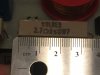
I took more pics of my crossovers to provide more information for future AK'ers. I included a metric metal ruler for size reference in the pictures.

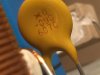
What is the electrolytic that appears as an old yellowing tooth? Does that need replacing?

IMG_0633.jpg IMG_0636.jpg IMG_0642.jpg IMG_0640.jpg IMG_0631.jpg
 
That "yellowing tooth" is a polyswitch. It's a little circuit breaker that protects the tweeter from being blown. The issue is, they can wear out. Especially if tripped often. This can result in reduced treble. Some bypass them with a wire jumper, then externally fuse the whole speaker. Parts Express sells new replacements, if desired?
 
I couldn't determine the value of the poly switch from manufacturer's markings, so I guessed at it's value. The average ADS tweeter is fused at 1.5 amps. I got a .65 amp polyswitch, figuring that going lower would be safer. I have yet to blow the thing, but I'm the audio equivalent of your Grandma behind the wheel of a car.

Polyswitch.gif
 
I'm trying my best to use the advice given here, and feeling pretty confident, but when I search a couple big name websites the confidence disappears like smoke rising in the air. So many brands, and so many specifications. Specifications pop up which weren't mentioned in this discussion, or specs on the original parts don't appear on the new part. I feel like I'm trying to decipher Egyptian hieroglyphs.

I went to Parts Express, and searched resistors, and found the Mills brand. I found a 2 Ohm resistor ( Mills 2 Ohm 12W Non-Inductive Resistor Part # 005-2 ). Here I got the Mills brand name right and the "2 Ohm" right, but where's the original parts 5% (whatever that is) and the new part has 12W. What?

Any suggestions to help my searches? What information matters? How do I create useful searches?
 
The Mills resistor you found at PE is the correct resistance (2 ohm), will handle 12 watts (as opposed to the 7 of your original resistor) and has a 1% variance (tolerance) from it's rated resistance (as opposed to the 5% of your original resistor). It's a better resistor, which is a good thing,
A higher voltage rating on capacitors means that the cap will withstand higher voltage pulsing in and out of it, so you should look for at least as high a voltage rating as you already have, but it would be great if you could go even higher, the drawback being increased cost and physical size.
Ditto on wattage ratings.
Lower tolerance ratings mean that the component in question is in actuality closer to the number of ohms/farads/henries (resistance/capacitance/inductance) printed on the side of the component. It's best to AT LEAST match the tolerance of your existing components, but lower tolerance numbers would be great.
Your woofer capacitor (the black one) is a relatively low value, so poly-caps are an option - higher value ones cost a fortune and can be as big as a pop can. Buying stuff of the correct physical dimensions for a PC board can be a pain. Your PC board looks like you have a bit of leeway to work with.
 
Thanks @Porkloin

On the black capacitor for the woofer/bass, are the following values:

63v - If I understand correctly, I should NOT go below 63v, and when @NAD80 said, "100vdc", he meant 100v as an acceptable alternative to 63v? Is the "dc" direct current because "ac" versus "dc" is a filter option? Are all speaker and stereo capacitors "dc"? How do I know, if they are all not "dc", whether each one is "dc" or "ac"?

18uF (K) - In English this means, 18 microfarads? What does the "(K)" mean? How can one play with this value? I assume I should not go lower. Do I have to stay at 18uF

BP (85 degrees Celsius) - What is the BP? Again, I need 85 degrees Celsius, and no less, right? I can go higher? How high?

The resistor values are as follows:

2 Ohm - is the resistance. Can this be higher? For example, the 2.7 Ohm resistor value is hard to find. I found a 2.5 Ohm, and a 3 Ohm. I don't think going lower is wise here nor for any other value, so would a 3 Ohm resistor work?

5% - is the variance or tolerance. So here, unlike many other values, I want to go lower, which keeps values from straying to far from the desired target?

CW - I don't know if this is related to "5%" or the "7" that follows, or if it stands alone. What is "CW"?

7 - Watts. Okay so of the "CW" the "W" is watts? Here again, stay at or above this value?

This is my first attempt to choose, buy, and replace a capacitor, or any electrolytic, EVER. I believe, with a little effort, I can complete this restore with my own hands. I restored my aDs 910 cabs with the help of Audiokarma with good results, but had to pay for the crossover rebuild. I felt accomplished, and a deeper appreciation for my hobby doing the cabs myself, and I'm looking for that satisfaction restoring these crossovers.
 
On the voltage spec of the 18mfd cap 100vdc was chosen because the higher voltage is easier to find than the lower voltage spec plus it is a higher rating. Less chance of exceeding the voltage limit of the cap. Keeping the same capacitance value is vital to keep the correct frequencies of the crossover working. A change in value shifts the frequencies seen by the drivers. Can damage the drivers if driven at the wrong frequencies. Higher wattage ratings on the resistors is ok. Less heating of the resistor is better for longer life of the resistor.
 
On the voltage spec of the 18mfd cap 100vdc was chosen because the higher voltage is easier to find than the lower voltage spec plus it is a higher rating. Less chance of exceeding the voltage limit of the cap. Keeping the same capacitance value is vital to keep the correct frequencies of the crossover working. A change in value shifts the frequencies seen by the drivers. Can damage the drivers if driven at the wrong frequencies. Higher wattage ratings on the resistors is ok. Less heating of the resistor is better for longer life of the resistor.
Hope the op comes back after getting the parts needed for this repair. I have a little more electrical background but can't wait to hear about how this turns out. Please keep the thread going.
 
I'll admit I'm a bit confused by this thread. Aside from the description that there is some partial disengagement of the rubber woofer surround, after 18 posts there has been no explanation of why these 570 speakers require woofer or tweeter overhaul and/or crossover component replacement.

You'll be hard-pressed to find stock crossovers from mid-priced speakers that are better constructed than those from a/d/s, but what-the-heck - - - let's spend money unnecessarily and pretend we are better engineers than the original design team.

BTW, the blue cap is a 8.2uF, 100v, 10% tolerance polyester capacitor.

crossover 2.jpg
 
Last edited:
^^ Good points.

I don't know how old these speakers might be, but the blue film cap is probably OK and I would be more suspect of the black electrolytic as they do have a more limited lifetime.

OTOH, upgrading (as opposed to just repairing or getting things back in spec) is certainly a thing you can do. If upgrading I'd look for a higher quality cap for the black one, perhaps a Mundorf E-cap from Parts Connexion or Sonic Craft. Mills resistors are a good product although the existing may also be a noninductive audio grade resistor, I don't know. As for the blue cap, if I was going to replace it, I'd probably go with 'not the cheapest'. For example the PE Daytons come in two tolerance grades(1 and 5%) of metallized film, and separate film-and-foil (which is a 'better' grade). Or there are tons of other choices. If you're only doing 1 cap you can splurge a bit and maybe spend $5-$10 on a cap instead of $1.99.

Just a few thoughts. But these speakers may be just fine as is.
 
Back
Top Bottom