• The move to the new server is done. There are some software and database maintenance updates in process. This has us passing the hat around to help out. We appreciate any donations. Seriously, even a dollar helps. The payment page may be found here - https://www.audiokarma.org/support.html

Advent modification

Status
Not open for further replies.
There is a valid advantage to stacked Advents and that is headroom, and increased efficiency. I can easily bottom single Advents with bass heavy material.
Particularly when using the supplemental BSC you advocate. :yes:

An alternative to the traditional stack would be to wire the second box in such a way as to make the pair a 2.5 system where the second woofer is used for BSC. Only one tweeter would be used. This arrangement is less critical of placement of the second system, still the second woofer should be close to the woofer in the main pair.

:lmao:​

I've not done any work on this, but it was something I wanted to discuss before this thread turned into speakers according to zilch.
I'm always up for participating in a discussion of Advent-stacking.... :thmbsp:
 
And yet another easy one, Pete: put a 1.6 mH inductor in Spice (you claim to be well familiar with it,) and what does it do? How much BSC does it provide between 100 Hz and 1 kHz?

attachment.php

"Spice (you claim to be well familiar with it,)"

Dude you ought to research who you're talking to when you make accusations. And are you going to point us to a bio covering your background? I won't even get into the complex chip designs that I do, here ya go, I did this for fun, out of curiousity. I am the author of this thread:
http://www.diyaudio.com/forums/showthread.php?s=&threadid=107404&highlight=jensen

And this one, I am PB2 there:
http://www.diyaudio.com/forums/showthread.php?s=&threadid=48873&highlight=jensen

You use SPICE to simulate crossover circuits? You're so proud that you know how to use SPICE LOL! That looks like a text book filter function, what do you think happens when you load it with a real (non-resistive) driver such as the Advent woofer? I've been using CALSOD for speaker simulation for probably 15 years, it is old but an excellent program. Don't even bother asking about the tools I use for chip design, I'm fairly certain you wouldn't understand.
You are not a challenge to me, you are a pest.

It's fairly clear that you are in the school of flat response. The target response that I prefer is more complex, not exactly flat, and no I'm not going to educate you about it.

Pete B.
 
Dude you ought to research who you're talking to when you make accusations.
HUH?

What accusations?

You mean, "Gratuitous blather?"

Post your revised Advent passive crossover design.
Post your BSC family transfer functions.
Post your accurate nearfield measurement of Advent low-frequency response.
Post your findings relating to fiberglass vs. foam damping.
Post your sim of the Advent woofer with a 1.6 mH inductor in series.
Post your preferred system response.

Post ANYTHING substantive on topic and worthy of discussion here.... :yes:

You use SPICE to simulate crossover circuits? You're so proud that you know how to use SPICE LOL! That looks like a text book filter function, what do you think happens when you load it with a real (non-resistive) driver such as the Advent woofer?
I KNOW what happens -- I MEASURE it.

Do want to see the actual voltage drive next...? :p:
 
What accusations?

"Gratuitous blather?"

Post your revised Advent passive crossover design.
Post your BSC family transfer functions.
Post your accurate nearfield measurement of Advent low-frequency response.
Post your sim of the Advent woofer with a 1.6 mH inductor in series.
Post your preferred system response.

Post ANYTHING substantive on topic and worthy of discussion here.... :yes:

I KNOW what happens -- I MEASURE it.

Do want to see the actual voltage drive next...? :p:

I came here to answer basic questions about the BSC circuit that I offered, nothing more. You arrogantly demand that I answer all your questions as if I'm on trial, and as if you know more, LOL! Another internet wannabe! I've seen plenty of them and they are a waste of time.

What part of "I'm not going to educate you about it." do you not understand?
 
About 5 years ago, in private discussion, I argued for a non-flat target response with a gentleman who goes by DDF. He works in telecom, is a speaker design enthusiast, and knows psychoacoustics from many perspectives including his professional work. He argued for flat at that time, I offered some of my ideas which he would not accept. Seems he's had some time to think it over. I don't agree with all of this but some of my thoughts are covered here:
http://www.diyaudio.com/forums/showthread.php?s=&threadid=103978

A fascinating post:
http://www.diyaudio.com/forums/showthread.php?postid=1239836#post1239836

Note that there is discussion covering a center phantom image, which is related to my comment about the center image coming into focus with BSC. There is magic to psychoacoustics in a sense, we trick the brain by providing something closer to the real performance.

Pete B.
 
The OLA and NLA have completely different values for woofer inductors so again, you leap to the conclusion that the difference is the filling material, ignoring the XO differences. The inductor is even bypassed in the extended position in the NLA, not in the OLA. See my crossover page if you want the values and crossover schematics.
Did that, and in the context of this thread, it raises several significant issues.

http://baselaudiolabs.googlepages.com/ADVENT_LA_XO.html

The BSC is effectively gone in the NLA lowpass filter. Even when the 0.3 mH inductor is in series (in "Normal" and "Decrease" modes,) it does not provide anywhere near that of 1.6 mH.

1) If the response characteristics of the NLA steel-frame woofer are the same as those of the original, and, as you suggest, "The woofer can be used as a replacement in the earlier LA," then NLA, lacking BSC, is a very different loudspeaker with respect to low-frequency response, and would require supplemental BSC to restore the "Original" Advent sound.

2) Alternatively, if the NLA is sonically similar to the original and LA, then, implicitly, its steel-frame woofer must have a falling response providing a magnitude of BSC equivalent to that in the lowpass filter of the earlier Masonite-woofer models, and the NLA woofer would not be a suitable substitute without crossover modification unless that additional BSC (read, "bass boost,") is desired, for example, when used in freespace, without boundary reinforcement.

Somebody bring me a pair of NLAs, or NLA woofers only, even, and we'll resolve this question by measuring them.... :yes:
 
I built Pete's BSC circuit and I'm not sure how to take it. My OLA's are about 8 feet apart on 10 inch stands and a foot and 1/2 from the back wall toed in toward the listener some 14 feet away. From what I'm hearing the BSC is pulling the sound toward the center, sort of condensing it. The speakers do indeed "disappear" to a greater extent but there is no extension of sound behind and in front of the Advents in the slightest. Also the Advents sound a bit muted as if the highs were taken down. I haven't listened to them long enough to see if there is a difference in actual pin pointing of the instruments. Pete, here's a picture, not the neatest job but I made sure no wires are touching where they aren't supposed to.

Your comments are fascinating with regard to this thread where the phantom center image is discussed:
http://www.diyaudio.com/forums/showthread.php?s=&threadid=103978

You might want to try 4 dB instead of 6 as I discuss here:
http://www.classicspeakerpages.net/IP.Board/index.php?s=&showtopic=2692&view=findpost&p=74748
 
I simulated it in CALSOD, SPICE, and measured it with LAUD but the data is on my last system that I've not power up in 6 months or so. The circuit is very simple would take minutes to simulate. I'm not interested in a curve debate. I certainly look at speaker data, been doing it for over 25 years but I also learned that the room interface and psychoacoustic concerns are highly complex and I therefore put much weight on the in room listening experience.

attachment.php
 

Attachments

  • BSC EQ Bode.jpg
    BSC EQ Bode.jpg
    49.4 KB · Views: 389
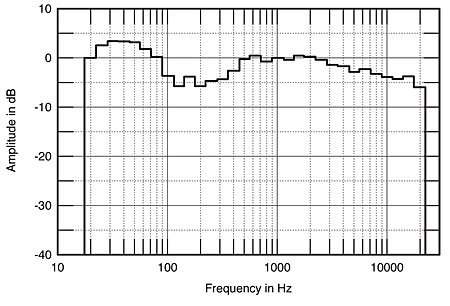
Expensive commercial speaker lacking BSC

A $6995/pair commercial speaker, as measured in room:
706Vaqfig08.jpg


Note the lack of BSC as can be seen in the response from 100 to 1kHz.
This system has a built in powered and EQ'ed sub woofer which explains
the response below 100 Hz.

The curve showing a lack of BSC is about as close to text book theory as it gets.
 
I wonder how it would look with 2-Pi boundary reinforcement. :yes:

Did I sim your transfer curves accurately @ #110, Pete? :dunno:
 
Hi all.

I haven't read the whole thread, (I will) but HERE is the best article that I've seen on the subject of the dreaded baffle step problem. In home design, it's difficult to measure the baffle step, because it's really hard to measure the lower mid, or upper bass because of the wavelengths involved. - The lower, the larger. - It starts to screw up your testing.

The best speakers that I ever designed, for a first listen, were the ones that I used John L. Murphy's passive ver of the unit on. They were very small boxes, so they needed it more than larger ones. It wasn't so much the good drivers that I used, but moreover the tonal balance was PERFECT. - Something that I NEVER get from a first design until I used this.

It can be done actively, or passively. Passively, the coils wind up large because of the lower frequencies involved. Some purists will say that we don't want all that extra wire in the way from the coils, but the tonal balance that I got from this passive thing, made any, "Audibility" of the fat coil pale in comparison to the advantage of a balanced speaker sound. It was total :music:. Drivers were an Audax 6.5" Aerogel cone, and a Focal titanium dioxide tweeter, pictured in my siggy pic. The downside of the passive ver. is that it knocks off 1-6DB sensitivity of the speaker in question, depending on how you want it to sound, or how much correction that you want. :)
 
Real Rooms are Cavity Resonators - 2pi is BS

It is wishful thinking that a room is anything like a 2 pi environment. Art Ludwig says "Maybe knowing about room response is like knowing how sausage is made - its better to be ignorant." And there are many ignorant people who think it is a 2pi environment. Rooms are cavity resonators, here are some examples:

From Art Ludwig:
http://www.silcom.com/~aludwig/images/hbl_opt.gif

http://www.silcom.com/~aludwig/Room_acoustics.html

From his site:
The response was calculated at a point 2/3 of a room length away from the woofers, centered in width, and 3-feet above the floor. I also made calculations at points 2-feet away from this point, in various directions. The geometry is shown here http://www.silcom.com/~aludwig/images/room.gif[4.4 kb]. The large red circles are the two woofers. The 5 small circles are the points where the response was calculated. The color of the listening points match the color of the curves in the computed frequency response[24kb]. The top graph is for the horrible room, and it is pretty horrible. The second result is for the optimum room (design #3), with equal interior volume. It is also horrible. The lines across the top show the room resonances, and unlike the cooked-up corner-corner test case, the response no longer neatly follows the resonances. The response also changes a lot when the listening point is moved two feet in any direction. The reference sound level of 0 dB is the level 1 meter in front of a theoretical point source in an anechoic chamber. For a speaker mounted flush in a wall, the image program creates an image at the same location as the real speaker, increasing the sound level by 6 dB. The center listening point is 12.7 feet away from the woofer, which in free space would reduce the level about 12 dB. So if there were no "room gain," the level of the black curve would be -6 dB. The resonances and images provide a room gain which boosts the response substantially above -6 dB, a big help in achieving a big bass response, but at quite a cost in smoothness of response. And remember this is with absolutely perfect speakers. Maybe knowing about room response is like knowing how sausage is made - its better to be ignorant. But being an engineer I want the truth, even if it is ugly. I played around with various room dimensions, speaker placement, etc, without much success. The one thing that did appear to smooth out the response was to increase the absorption coefficient, and particularly the absorption of the wall facing the speakers. At some point I plan on looking into this further.
 
I don't believe anyone suggested that 2-Pi accurately characterized room rise.

Did I get your transfer functions right or not, Pete? :dunno:

I DID put some effort into getting at the facts regarding the actual thread topic here.... :yes:
 
I also built Pete B's baffle step compensation circuit.
I put it between the Preamp(Quintessence) and the amp(Technics SE-9060).
My OLA's really woke up. They seem more musical.
I think subjective listening is the final test of any system and I like the change the BSC made.
 
I also built Pete B's baffle step compensation circuit.
I put it between the Preamp(Quintessence) and the amp(Technics SE-9060).
My OLA's really woke up. They seem more musical.
I think subjective listening is the final test of any system and I like the change the BSC made.
Are they positioned away from boundaries, i.e., on stands and out from walls?
 
They are 6 ft from the back wall, 5 ft from the side walls, 9 ft from the listening position, 6 ft apart, slightly toed in, on the carpeted (berber)floor.

I have stands to raise the tweeters to ear level, That should help imaging, although they image and soundstage pretty well now.
 
The speaker stands improved the bass. It cleaned up the mudiness opened up
bottom end. Soundstage improved more than I thought it would, more resolution and detail.
I used two selections to audition this setup: BIS-SACD-1451 Bach Cantatas,26,62,116,139: Bach Collegium Japan, Masaaki Suzuki conducting; and Alan Parsons Project: I Robot, I wouldn't want to be like You, Day after Day,ect.
 
Status
Not open for further replies.
Back
Top Bottom