
• The move to the new server is done. There are some software and database maintenance updates in process. This has us passing the hat around to help out. We appreciate any donations. Seriously, even a dollar helps. The payment page may be found here - https://www.audiokarma.org/support.html

Akai GX-635D full restoration

the 2SC458's are the ones yes and I had 10 pairs on the preamp board. There are also some 2sc945's that I've been advised to change while I'm in there so I stocked up on KSC945C which puts the collector in the center making them an almost drop in replacement for the 2sc945's. But, OnSemi is discontinuing the KSC945c, I bought 2000 of them and they still had around 18K left so I'm sure there's plenty to go around for anyone who needs them but I would get them quick. I bought a few thousand of several different transistors that are being or have now been discontinued by OnSemi which should last well into the rest of my life provided I don't become the only HiFi repair Mogul overnight hahahahahahahahahaha, never gonna happen! I might have a piece of paper that says I've been trained in electronics but there's just no replacing the countless years of experience found on AudioKarma. There are guys here that really know their stuff and are very humble as well. I have a LOT to learn but I continue learning from these folks on a daily basis! I'm merely trying to pay it forward and document some of my restorations mistakes as well as success's so that hopefully someone else may gain some knowledge from those documented projects when they come to AudioKarma looking for answers. There are so many well Documented procedures and restorations alike on here that it blows my mind when I go through them and just read, it leaves me in awe. I sincerely hope that the information I'm able to provide in this thread helps you in some way with your 635. All the best my friend!:music:

Steve
Hi, I need suitable transistors for my unit. What might be an available sub for the KSC945c transistors? Thanks
 
Last edited by a moderator:
Dear all, first of all thank you all for you high value contribution on our challenges here. I'm starting the renovation of my gx-635d. I have changed the transistors and now I'm watching at the capacitors. I have the service manual and references of the caps. Regarding the few stiroflex coming straight from the 70' mines looks very very bad (picture joint)
My question: do you know where can I buy those (radial) in Europe or do you have any recommendations for replacement?
1000032514.jpg
 
Dear all, first of all thank you all for you high value contribution on our challenges here. I'm starting the renovation of my gx-635d. I have changed the transistors and now I'm watching at the capacitors. I have the service manual and references of the caps. Regarding the few stiroflex coming straight from the 70' mines looks very very bad (picture joint)
My question: do you know where can I buy those (radial) in Europe or do you have any recommendations for replacement?
View attachment 3230685

Why you considered they looks bad? Wrong color? ;) If you decided to make full recap, then replacing of capacitors should be first, transistors after that. I am not an expert of Akai decks (had one GX636 30 years ago, and considered it is really not what I need. Good looking but that's all), but if there are no well known troublemakers (like Frako and Rifa miniprint in Studer and Revox), I would leave them alone.
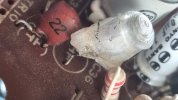
 
Why you considered they looks bad? Wrong color? ;) If you decided to make full recap, then replacing of capacitors should be first, transistors after that. I am not an expert of Akai decks (had one GX636 30 years ago, and considered it is really not what I need. Good looking but that's all), but if there are no well known troublemakers (like Frako and Rifa miniprint in Studer and Revox), I would leave them alone.
Those ones look more as mushrooms
 

Attachments

  • 20240620_175236.jpg
    20240620_175236.jpg
    76.1 KB · Views: 22
  • 20240620_175303.jpg
    20240620_175303.jpg
    55.8 KB · Views: 22
Those ones look more as mushrooms

And it offends your noblest feelings?
What happened between you and Mushrooms? Most of them are forbidden even in Amsterdam.
But do not worry, they are not mushrooms.
Install back plate and do not look on them.
And do not forget to delete all pictures, however it is not guaranteed you will not see them in your nightmares :)
 
Those grey ones are polystyrene caps. They rarely fail. I would not replace them. They are quite heat sensitive, so be cautious. As Radiokom stated, experience with Akai decks of this vintage seldom have cap issues.

On the other hand, the 2SC series transistors are known trouble makers-gotta go.
 
Last edited:
Those grey ones are polystyrene caps. They rarely fail. I would not replace them. They are quite heat sensitive, so be cautious. As Radiokom stated, experience with Akai decks of this vintage seldom have cap issues.

On the other hand, the 2SC series transistors are known trouble makers-gotta go.
Ok thanks guys. I was at this point. I just changed the 16 transistors with KSC1845FTA ones. I put all together and power on
 
Ok thanks guys. I was at this point. I just changed the 16 transistors with KSC1845FTA ones. I put all together and power on
Hi Kai's
So for now I left the "magical" capacitor in his forest of capacitors . Power and insert a old tape to test playback and record... Seems
 
New problem with the capstan motor. Now it starts spinning slowly and stops. If I turn manually the motor I turns freely. Other transistors or capacitors maybe need to be replaced?
Additional remark : in low speed the motor is turning... Strange
 
Last edited:
New problem with the capstan motor. Now it starts spinning slowly and stops. If I turn manually the motor I turns freely. Other transistors or capacitors maybe need to be replaced?
Additional remark : in low speed the motor is turning... Strange
Solved, it was a bad contact on the speed switch
 
I come back to you as I get this issue with high speed :(
Low speed is ok. When I push fast speed. Capstan motor accelerate but not the r2r motors. Could it be the tr3 transistor (c2336) or the big capacitor on the top of the machine?
Sorry I have poor electronic knowledge...
 
I come back to you as I get this issue with high speed :(
Low speed is ok. When I push fast speed. Capstan motor accelerate but not the r2r motors. Could it be the tr3 transistor (c2336) or the big capacitor on the top of the machine?
Sorry I have poor electronic knowledge...
Changing the tr3 transistor didn't resolved my speed problem dropping down.
More over, now when I power on the motors are turning opposite side
Any ideas?
 
Changing the tr3 transistor didn't resolved my speed problem dropping down.
More over, now when I power on the motors are turning opposite side
Any ideas?
Have you tried the Tapeheads forum?
There is usually a lot of active reel to reel guys there!
 
Changing the tr3 transistor didn't resolved my speed problem dropping down.
More over, now when I power on the motors are turning opposite side
Any ideas?
No Now the symptom is that the capstan and motors are turning over speed. I put back the old tr3 and same ... Over speed. Pushing the speed button nothing happens
 

AKAI SCM-200 Capstan Motor – Speed Problems Caused by Deteriorated Solder Joints? My Repair Experience and Measurements​

The SCM-200 capstan motor used in the AKAI GX-747, GX-646, GX-635, GX-636, GX-620 and GX-625 tape recorders can develop a rather unusual problem. The motor initially runs at the correct speed but gradually slows down, sometimes stopping completely. In other cases, it starts running too slowly and, after some time, gradually returns to its normal speed.

I suspect that one possible cause of these symptoms is deteriorated solder joints where the motor winding wires are soldered to the lead wires.

At first glance, the solder joints may look perfectly fine. However, if you carefully try to unwind the winding wire from the lead wire, it may come loose without applying any heat from a soldering iron. This suggests that the solder joint may have deteriorated over time, possibly due to prolonged exposure to heat. A poor electrical connection could cause intermittent resistance and lead to unstable motor speed.

I experienced this problem myself. When I saw that replacement SCM-200 motors were being offered on eBay for around €170, I decided to take a risk and investigate whether I could repair mine instead.

Before disassembling the motor, I measured the resistance and inductance of both windings, as well as their dissipation factors, first with the motor cold and then after heating it to approximately 60–70°C with hot air.

The measurements below were taken from my motor after the repair, when it was working properly.

Winding measurements after repair​

Winding 1

ParameterCold motorHeated to approx. 60–70°C
Resistance100.5 Ω100.8 Ω
Inductance99.6 mH99.8 mH
Dissipation factor (D)5.694.88
Winding 2

ParameterCold motorHeated to approx. 60–70°C
Resistance165 Ω169 Ω
Inductance211.6 mH214 mH
Dissipation factor (D)6.885.76
Most of the measurements looked reasonably good, but the change in the dissipation factor after heating the motor continued to bother me. This was one of the reasons I decided to investigate the motor further.

I eventually disassembled the motor, resoldered the connections between the winding wires and the lead wires, applied fresh insulating varnish where appropriate, and reassembled everything.

The result has been excellent so far. The motor has been working perfectly for several weeks, and the speed problem has not returned.

Unfortunately, I did not record the same set of measurements before the repair, so I cannot directly compare the electrical parameters before and after resoldering. Therefore, I cannot say for certain that the dissipation-factor changes were caused by the faulty solder joints.

Nevertheless, based on my experience, I believe that these connections are worth checking before spending a lot of money on a replacement SCM-200 motor.

Has anyone else encountered similar problems with the SCM-200, particularly a motor that slows down after running for a while or initially runs too slowly before recovering its normal speed?

I would also be interested to hear whether anyone has measured the winding resistance, inductance and dissipation factor of a healthy SCM-200 motor, both cold and heated.

I hope this experience may help someone repair their original motor instead of replacing it.
 

Attachments

  • IMG_1491.JPG
    IMG_1491.JPG
    112.1 KB · Views: 5
  • IMG_1493.JPG
    IMG_1493.JPG
    155.9 KB · Views: 5
  • IMG_1495.JPG
    IMG_1495.JPG
    175.4 KB · Views: 5
  • IMG_1494.JPG
    IMG_1494.JPG
    178.1 KB · Views: 3
  • IMG_1499.JPG
    IMG_1499.JPG
    175.8 KB · Views: 3
  • IMG_1500.JPG
    IMG_1500.JPG
    223.8 KB · Views: 3
  • IMG_1501.JPG
    IMG_1501.JPG
    123.2 KB · Views: 5
  • IMG_1502.JPG
    IMG_1502.JPG
    233.2 KB · Views: 5
Back
Top Bottom