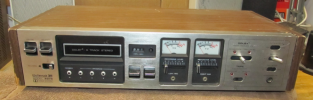
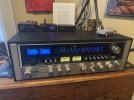
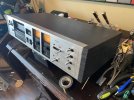
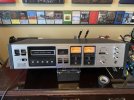
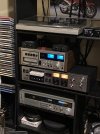
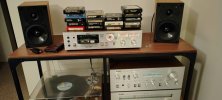
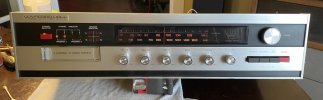
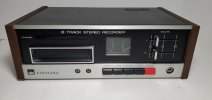
The Wollensak is generally considered "better" than the Akai's, but only by a marginal amount. The only place the Wolly isn't considered "better" than the akai's is with regards to the motor. The Akai's use (so I've read) a fairly large AC motor. The Wollensak's use a DC motor that has been reported to be a bit on the weak side and somewhat failure prone.
The Ac motors are freq locked to the mains and require pulley changes to affect speed corrections, the DC motor in the Wolly is adjustable by a VR pot. If an Akai is running slow and it's not the belt or a leaking run/start capacitor, it's the motor itself. If The wolley runs slow (or fast) a twiddle on the vr may bring it back in.
Which is actually "better" is kind of a worthless argument with everything over 40 years old by now. In theory, the AC motor should be better (torque) and should stand up to aging better than a DC motor with it's commutator brushes that wear with use.
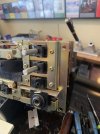
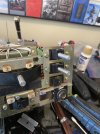
My Wolley 8075 was exhibiting motor issues that seems to be typical of them as they age. That was until I took it apart, cleaned the internals and soaked the bronze end bushings in oil. Now, it runs strong enough to fight my hand trying to slow it down. I suspect a lot of Wollensak DC motors that were condemned were actually just in need of a servicing, something that a lot of people just don't want to do because everything inside a motor case is on the order of "black magic" to them. The Wolley motor is even more "black magic" because it has a speed sensing section on the back of it too. I believe it varies the torque according to load sensing, which is why it "fights back" when I try to slow it down by grabbing the pulley.
Then there's the general specs of both. The 8075 has it over the CR-81d pretty much everywhere other than 15 khz vs 16 khz. But it's all pretty close and in practice, probably not even noticeable. I'd be pretty skeptical if someone said they can hear that 1 khz difference, even more so if they're over 50 years old. Which, frankly, captures virtually all of the demographic that still fool around with 8 tracks these days.
Akai CR-81D specs:
Frequency Response: 50Hz to 16kHz
Signal to Noise Ratio: 47dB
Wow and Flutter: 0.35%
Total Harmonic Distortion: 4%
Wollensak 8075 specs:
freq response: 30hz-15khz (with Scotch special tape)
signal to noise ratio;
wow and flutter: 0.1%
Harm distortion:
Dolby off - better than 50
Dolby on: better than 60 at 4000hz and above, better than 59 at 2400hz, BT 5 at 1200hz, BT 53 q5 600hz.
The Wollensak has Dolby B, which makes for better SNR over the Akai's. Even without Dolby, the 8075 is better spec than the Akai. I used to think like most that Dobly wasn't of much use and it just makes things sound "dull' until I got a proper Dolby deck and a good Dolby recorded tape. It was actually another 8 track deck, my superscope TDR-830 and Rush: Farewell to KIngs taht was factory recorded in Dolby. I Flicked on Dolby and the tape hiss pretty much just dissappeared. It was marvelous! No tape hiss on magnetic tape! Dolby is a dead format, but I find myself trying to maximize it's use on tape now. It actually works when it's used the way it was intended.
Those max high freq numbers are pretty much moot though. The real limitation is the tape formulation and 8 rack tape tops out at 12 khz. You only got up into the 15/16khz range using "wide range" tape formulations. They didn't make a lot of that because most machines didn't reach that high, so there's not a lot of it around anymore. You can still find it, but it' not common and it's all 40+ years old at this point anyways.
8 track just didn't get the development dollars compact cassettes did, so they're all stuck in the early "type I" tape formulations, which is the primary upper freq response limitations that have to deal with. For the same reason, not many consumer recorders were designed to use anything much over 12khz.
There's also the fact that those are "new" specs and anything 8 track has got a good 40 years of aging and use on it. So what any one particular machine is actually doing for specs is anyone's guess.
8 Track is a "lo-fi" format. But that's a part of it's charms. Once you've got a decent player and rebuilt the carts, it's a simple jam the cart in it's pie hoe and let it run. No muss, no fuss. And it can actually sound surprisingly good once everything is "up to snuff". It's not CD, Vinyl or even compact cassette, but get it right and it's surprisingly warm. It's even comforting if you went through the 8 track era. I and the signal through a 10 band EQ and a BBE 482i and it is surprisingly good.
"Boston" is meant to be on 8 track to my ear. It just fits better than CD or vinyl. Can't explain it, it just sounds better to me for whatever reason. Maybe it's just nostalgia for a dead format.
"Kerchunk"
It's the groovy sounds of the 70's man! Yeah baby!