• Please note that Audiokarma will be offline briefly for updates early on Monday morning, September 28th.

Another Super High End Phono Stage! No expense spared...

The actual RIAA equalization network is unchanged and designed by National Semiconductor so it should be very very accurate. The only changes that have been made are in the gain and loading with some DC blocking and radio interference added, so it should all be kosher. The values I have kept to around 1% to maintain accuracy.

The EQ circuit values were probably ripped off from Richard Marsh's article in The Audio Amateur (3/1980) prior to Richard's revisions (in the next issue). They have appeared in several National Semiconductor app notes without correction. I'll see if I can find my notes on this issue...
 
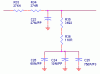
Okay, here are the corrected values. These changes do make a noticeable improvement in equalization accuracy when checked via circuit simulator. This network does not include the now-discredited "Neumann Pole." Neither does it include the "IEC Amendment," which seems to be an unsettled matter in some quarters. Even very light loading (megohms) on the output side immediately affects network accuracy, but this isn't a problem in the current context.
 

Attachments

  • CorrectedRIAA.GIF
    CorrectedRIAA.GIF
    2.6 KB · Views: 1,355
G'day mate, thanks for that excellent circuit analysis. It confirms my initial suspicions that some revision to the RIAA network was needed. Regards, Felix aka catman.
 
Okay, here are the corrected values. These changes do make a noticeable improvement in equalization accuracy when checked via circuit simulator. ....

Nice research Mike, and quick! Are there any specific tolerance requirements for these resistors and caps?

.
 
Are there any specific tolerance requirements for these resistors and caps?

Always use 1% or better resistors in RIAA networks. Caps are often problematic. It's hard to find anything better than 5%, but you really need better ones to achieve reasonable accuracy. Use a good capacitance meter for selection if you can get your hands on one.
 
This circuit is looking cooler by the minute. Are there plans to incorporate Mike's discovery into the PCB?
 
I am confused by the specifications of the caps in this:

attachment.php


For example:

27N/PP

Is that a 27 nF (nanoFarad)?

If so, what does the /PP, /PS designate?

Thanks

Shelly_D
 
I just got back and read Mike's discovery.

The RIAA component differences are this:

Mikes first resistors total value = 27.774k Current value = 27k, resistors changed to 27k + 750ohms = 27.750k, difference is less than 0.1%.

Mikes second resistors total value = 4.038k, Current value 3.93k, resistors changed to 3.83k + 200ohms = 4.03k, difference is miniscule.

Mikes first capacitors value = 27nf, current value = 27nf, no change necessary.

Mikes second capacitors total value = 79.5nf, current total value = 80nf, difference less than 1%.

I think we have nailed it, even the values I am running currently are close enough, in fact mine are probably closer to the ones Mike found than the ones put up by National Semiconductor, they must be because of the sound I am getting. :music:

No one could argue with capacitance variations less than 1%, even Rod Elliot rates 2.5% as accurate enough. Buying a few more capacitors if obtaining 5% tolerance ones and measuring the values to get as close as possible is the way to go for absolute accuracy.

So we are definitely heading in the right direction, thanks Mike.:thmbsp:

I have a few more things to try and will get onto it as soon as I get organized.
 
Last edited:
Okay I have been thinking about this while I was away, I noticed in my Rod Elliot P06 and our current CNC that there is a slight rustling sound when you put your ear near the speakers, not just the usual hiss like sound you get when you turn up the volume a fair bit. In both cases it's below the level of surface noise during playback, not knowing if it affects the sound or not I tried to get rid of it to see.

I tried putting some bypass caps, some 33pf Wima PP caps I had on hand, between the negative input and the output pins of the op amps. Where the gain resistors go, this is very popular in other designs and is used in the 640P. It cured the rustling sound which I thought was due to some sort of feedback noise.

I will be conducting listening tests to see if it improves or diminishes the sound quality at all.

I want to reduce the noise as much as possible as in the back of my mind I have an idea of putting pair of AD797's with the appropriate gain circuit, in front of the CNC as they are ideal for LOMC carts and very low noise when used with the same. This could be a good way build a simple but high quality LOMC phono stage or an add on module. We will see, if Comet Supply ever delivers my LOMC cart.
 
Did you consider putting in the 10pf cap on the + input per the NS schema? Possibly filter the noise from the source?

I found even though the 33pf caps took out the slight rustling sound as I call it. It upset the overall balance of the thing and as it is the same in the P06 and can only be noticed with my ear close to the speakers, 6 inches or less away with the volume turned up, I am not going to worry about it further. Also maybe it goes away once the input from the cart is applied.

I will try the input loading cap today, I will put a spot for it on the PCB, especially for those who have carts that need higher than normal capacitance.
 
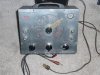
If calibrated, is this type of capacitance bridge capable of the 1% accuracy required?

This Eico 950B is from 1968, so it is at least a year older than most of my gear.

.
 

Attachments

  • Capacitance Bridge-C.jpg
    Capacitance Bridge-C.jpg
    118.3 KB · Views: 185
Older instruments like the 950B can be pressed into service if you have 1% or better reference capacitors with values somewhere near (+/-20%) the ones you're measuring, so you can evaluate readout error in that vicinity on the dial.
 
I noticed in my Rod Elliot P06 and our current CNC that there is a slight rustling sound when you put your ear near the speakers, not just the usual hiss like sound you get when you turn up the volume a fair bit. In both cases it's below the level of surface noise during playback, not knowing if it affects the sound or not I tried to get rid of it to see.

Could that rustling sound be opamp oscillation? Do the opamps get hot to the touch in the circuit? Do you notice an increase in the noise as you touch them?
I've read of this before and that it's usually in the ultra-sonic frequency range. OTOH I have no experience with it so may be talking out my arse! :yes:
 
Last edited:
Could that rustling sound be opamp oscillation? Do the opamps get hot to the touch in the circuit? Do you notice an increase in the noise as you touch them?
I've read of this before and that it's usually in the ultra-sonic frequency range. OTOH I have no experience with it so may be talking out my arse! :yes:

I thought it could be as well, I feel it's the feedback circuit, they don't get hot and no increase in noise when you touch them. And I am sure Rod Elliot would have sorted it out if it was a problem. It doesn't seem to affect the sound in either circuit though and it could just be that the both of these are not in cases so they have no shielding at all.
 
Last edited:
Back
Top Bottom