

You are using an out of date browser. It may not display this or other websites correctly.
You should upgrade or use an alternative browser.
You should upgrade or use an alternative browser.
Another Super High End Phono Stage! No expense spared...
- Thread starter Fasterdamnit
- Start date


Arkay
Lunatic Member
The timing sounds nearly perfect for me. By the time these boards arrive, all the dust (literally and figuratively!) should have settled from my move (etc...), and I should be set up and ready for a small project (I'll have only a tiny bench space to work on, compared to now) and I'll be ready and looking for a good, new, small phono stage. Really looking forward to this. Great work by all involved! :thmbsp:

I have mine with a 100 ohm in the first stage and a 150 ohm in the second, it gives about a 3db boost which is fine for me, having 100ohms in both stages will double that.
I have been back and forth with the PCB manufacturer's and have increased the order to 30 boards, they didn't show me the silkscreen at first but everything is fine and they should be in production now. The boards are 3" x 4" with solder mask, mounting holes and silkscreen. I didn't go with component numbers, I preferred values instead, with not a lot of components it makes it easier IMO.
They even have "CNC Phono Stage" printed on top.
I have been back and forth with the PCB manufacturer's and have increased the order to 30 boards, they didn't show me the silkscreen at first but everything is fine and they should be in production now. The boards are 3" x 4" with solder mask, mounting holes and silkscreen. I didn't go with component numbers, I preferred values instead, with not a lot of components it makes it easier IMO.
They even have "CNC Phono Stage" printed on top.
Last edited:

Big Bill
Summertime Rolls.....
................I have been back and forth with the PCB manufacturer's and have increased the order to 30 boards, they didn't show me the silkscreen at first but everything is fine and they should be in production now................They even have "CNC Phono Stage" printed on top.
Nice!:thmbsp:

BinaryMike
Pelagic EE
Sounds like the current design will provide ~ 26 dB of gain. Would I have to equally modify the voltage divider for both stages in both channels to increase the gain, or just the first stage?
Overall gain is close to 34.5dB at 1Khz with original feedback resistors. Input to the 2nd stage is about 7.3dB above first stage input level; just enough to keep 2nd stage noise contribution negligible and therefore maximize input stage dynamic range. I figure almost 40dB of headroom relative to 5mV @ 1KHz for the input stage when operating on +/-18V supplies. That's an exemplary figure, but the 2nd stage overloads 7.3dB sooner, leaving us with less than 33dB overall headroom at 1KHz. It gets worse at high frequencies, but there's dispute among the experts about how bad this problem really is. My preference, if I had a low-output MM cart, would be to increase first stage gain by a few dB before looking at other alternatives. If I needed more output level, to complement a low-gain amplifier, I would be looking very hard at building a discrete 2nd stage with higher-voltage supplies.
Edit: It's better to increase resistance on the high side of the feedback divider if you need more gain. Increasing the low side resistance also increases input noise.
Last edited:

G'day all, interesting. I would think that 40 db is about the minimum required with typical moving magnet cartridges.
The simple single op amp stages I have built have delivered 40 db. A few db more would be even better (as in my ESP P06), but 40 db is acceptable although the volume control will need to be increased a little. Regards, Felix aka catman.
The simple single op amp stages I have built have delivered 40 db. A few db more would be even better (as in my ESP P06), but 40 db is acceptable although the volume control will need to be increased a little. Regards, Felix aka catman.
Electronics Confucius says:
Lower value resistors introduce less noise in the feedback loop than higher values.
Noise is amplified at the same rate as the signal. If the noise is lower than the signal it can never overtake it no matter how much gain you have. You can string a hundred amps together and the noise will still be the same ratio as the signal.
The output of the CNC is comparable to the P06 with 100/3320 first stage and 150/3320 second stage, I have compared both many times. And never needed to adjust the volume control. And IMHO the output of the P06 is on the high side as it's louder than every other Phono Stage I have tried. (And that's a lot ). When using it with my Luxman L-430 I only needed the volume control at 9.00 o'clock maximum.
The noise level of the P06 is the same as the CNC, neither can be heard without your ear against the speaker though, that being said the 640P has lower noise than both of them.
The headroom argument is either not relevant to genuine rail-to-rail op amps or my ears are shot, they don't seem to suffer from loss of head room at lower voltages. The AD823 runs beautifully on batteries and is recommended to do so, my P06 sounded much nicer on twin 9v batteries than it did with the P05 or my other much more highly filtered and lower noise PSU.
As to using batteries I recently read a review of the Acoustec Sutherland PHD Phono Stage that costs $3,000.00 and has rave reviews. Here is the start of the review:
AC power lines create noise. Period. There's only one feasible way around that annoyance. Batteries. Designer Ron Sutherland brings us a new battery-powered phono stage with smart circuitry that allows this preamp to turn on and off automatically, thereby maximizing the life of your batteries.
One of the noisiest components in your home stereo is the incoming AC power. Even if it were delivered to your home as idealized 60Hz sine wave, it would not stay that way long. The audio power amplifier does not draw current from the power line evenly. There is a large current spike drawn when the sine wave reaches its voltage extremes, while at other times current draw is essentially zero. High frequency harmonics and noise are introduced into the same power line that's used for sensitive phono preamplification.
That's probably why people say that the power supply is half the battle with amplifiers.
Using two 6v lantern batteries per side is the way to go IMO, it offers long life, low cost and better sound than using a linear supply. Try it and let your ears be the judge.
Lower value resistors introduce less noise in the feedback loop than higher values.
Noise is amplified at the same rate as the signal. If the noise is lower than the signal it can never overtake it no matter how much gain you have. You can string a hundred amps together and the noise will still be the same ratio as the signal.
The output of the CNC is comparable to the P06 with 100/3320 first stage and 150/3320 second stage, I have compared both many times. And never needed to adjust the volume control. And IMHO the output of the P06 is on the high side as it's louder than every other Phono Stage I have tried. (And that's a lot
). When using it with my Luxman L-430 I only needed the volume control at 9.00 o'clock maximum.The noise level of the P06 is the same as the CNC, neither can be heard without your ear against the speaker though, that being said the 640P has lower noise than both of them.
The headroom argument is either not relevant to genuine rail-to-rail op amps or my ears are shot, they don't seem to suffer from loss of head room at lower voltages. The AD823 runs beautifully on batteries and is recommended to do so, my P06 sounded much nicer on twin 9v batteries than it did with the P05 or my other much more highly filtered and lower noise PSU.
As to using batteries I recently read a review of the Acoustec Sutherland PHD Phono Stage that costs $3,000.00 and has rave reviews. Here is the start of the review:
AC power lines create noise. Period. There's only one feasible way around that annoyance. Batteries. Designer Ron Sutherland brings us a new battery-powered phono stage with smart circuitry that allows this preamp to turn on and off automatically, thereby maximizing the life of your batteries.
One of the noisiest components in your home stereo is the incoming AC power. Even if it were delivered to your home as idealized 60Hz sine wave, it would not stay that way long. The audio power amplifier does not draw current from the power line evenly. There is a large current spike drawn when the sine wave reaches its voltage extremes, while at other times current draw is essentially zero. High frequency harmonics and noise are introduced into the same power line that's used for sensitive phono preamplification.
That's probably why people say that the power supply is half the battle with amplifiers.
Using two 6v lantern batteries per side is the way to go IMO, it offers long life, low cost and better sound than using a linear supply. Try it and let your ears be the judge.
G'day mate, interesting points on which I pretty well agree however I'll differ slightly on the matter of circuit noise. Quoting from the ESP projects website for the P06 phono stage article:
'Noise is extremely low, since any amplifier stage noise is rolled off above 2kHz with the passive filter. Another excellent opamp is the OPA2134, and these are used in my own units.' Regards, Felix aka catman.
'Noise is extremely low, since any amplifier stage noise is rolled off above 2kHz with the passive filter. Another excellent opamp is the OPA2134, and these are used in my own units.' Regards, Felix aka catman.
Last edited:
BinaryMike
Pelagic EE
The headroom argument is either not relevant to genuine rail-to-rail op amps or my ears are shot, they don't seem to suffer from loss of head room at lower voltages.
AC power lines create noise. Period. There's only one feasible way around that annoyance. Batteries.
R2R op-amps offer only a slight headroom improvement over conventional ones. On +/-18V supplies, for instance, you get clipping at nearly 36Vpp instead of about 32Vpp, which amounts to 1dB. On fresh +/-9V battery supplies, the R2R advantage is 2dB. The audible effect of whacking your headroom limit is dependent on amplifier overload characteristics, and most likely to be apparent as unduly emphasized click and pop noise. Clipping artifacts from the first stage are strongly low-pass filtered by the RIAA network, and so may be less audible than 2nd stage clipping.
Regarding the statement about power line noise: I presume that Voyager's signal is still being monitored by NASA's AC-powered deep space receiving equipment. Do correct me if I'm wrong.

ghazzer
Senior Member
Electronics Confucius says:
Noise is amplified at the same rate as the signal. If the noise is lower than the signal it can never overtake it no matter how much gain you have. You can string a hundred amps together and the noise will still be the same ratio as the signal.
I concur, but this is assuming that the amplifier circuits are 100% noise free, which is where the battery P/S makes a contribution. Any noise from the amplifiers will just keep adding, and decreasing the S/N ratio, which is where an AC based P/S makes a contribution.
.
Regarding the statement about power line noise: I presume that Voyager's signal is still being monitored by NASA's AC-powered deep space receiving equipment. Do correct me if I'm wrong.
"The 33-year-old Voyager 2 spacecraft has experienced an anomaly where the data it sends back is unreadable."
Probably because of line noise in the receiving equipment.
Due to govt cutbacks they said they can't afford all those D cells.
Last edited:
BinaryMike
Pelagic EE
Touché.

shelly_d
Not An Audiophool
I concur, but this is assuming that the amplifier circuits are 100% noise free, which is where the battery P/S makes a contribution. Any noise from the amplifiers will just keep adding, and decreasing the S/N ratio, which is where an AC based P/S makes a contribution.
.
+1. Each amp will generate its own noise. It has to. That's just the physics of the thing. Therefore that noise is present in the output of the device, along with the amplified signal. Assuming the next amp along the chain produces the same amount of noise as the first, that is a potential for lowering the signal to noise ratio by as much as 3dB. This fact of life was a real headache to long distance telephone conversations before the days of digital carrier.
Shelly_D

Fasterdamnit
Super Member
+1. Each amp will generate its own noise. It has to. That's just the physics of the thing. Therefore that noise is present in the output of the device, along with the amplified signal. Assuming the next amp along the chain produces the same amount of noise as the first, that is a potential for lowering the signal to noise ratio by as much as 3dB. This fact of life was a real headache to long distance telephone conversations before the days of digital carrier.
Shelly_D
LME49990 in first stage of anything. VERY quiet.
Input Noise Density (f = 1kHz) 0.9nV/√Hz (typ)
1.3nV/√Hz (max)
shelly_d
Not An Audiophool
LME49990 in first stage of anything. VERY quiet.
Input Noise Density (f = 1kHz) 0.9nV/√Hz (typ)
1.3nV/√Hz (max)
Certainly true. Modern Op Amps have gotten noise down to amazing levels, but some is still there. Just trying to keep the physics real.
Shelly_D

Big Bill
Summertime Rolls.....
Ground zero CNC gets a new home....
While waiting for the printed boards to be ready I decided to that the original CNC deserved a new home that could house the four 6 volt batteries we recently hooked up. :yes: Here it is:
While waiting for the printed boards to be ready I decided to that the original CNC deserved a new home that could house the four 6 volt batteries we recently hooked up. :yes: Here it is:
Attachments
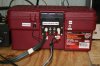
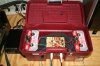
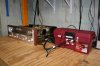
While waiting for the printed boards to be ready I decided to that the original CNC deserved a new home that could house the four 6 volt batteries we recently hooked up. :yes: Here it is:
I saw those Rayovac batteries at Walmart, for around ten dollars for four it's a no brainer.
The case looks a little on the tentative side though.