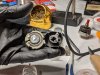
Still wondering what the stethoscope was for?
Listening to the beat?

Listening to the beat?



You can use toluline as that's the carrier for the butyl rubber in the sealer. Wipe the surrounds with it to clean, remove any remaining original sealer, then apply a very light application. These woofers are not designed to be 100% sealed as evidenced by the mesh dust caps which adt as vents.I'm new to AK and found this thread, because I'm restoring a pair of AR-4x's. In at least one spot, it looks like there's a crack in the surround (see photo; steel cable used to indicate location of apparent defect). Closer inspection didn't reveal an actual hole, so I'm thinking that the sealant has cracked, which probably has left a sort of vent in the surround. Given the apparent deterioration of the sealant since 1970 or so, would it be a good idea to apply thinner with a cloth or sponge and mop up the old sealant before applying the new?
Not sure really what you mean by shrouds.Thanks. That's about what I figured. Just ordered some toluene. Rather tricky to come by. Found some "non-curing flow grade butyl" on I'm-a-gone. And "non-curable" duct sealing compound. I finished restoring the pots a couple of days ago. The center conductors were both so degraded by pitting that no amount of cleaning could make them work. My hillbilly engineering solution: copper foil tape cut into a donut and layered on top with lots of solder. That worked; I just hope it's durable. I figure I should replace the stuffing and shrouds. The old stuffing is shedding so much super-fine glass "dust," I don't want to handle it again. And the shrouds practically disintegrated to the touch. Any recommendations for shroud material?
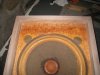
I mean the super-light fabric between the woofer and the insulation. It's visible in the picture. I haven't examined it very carefully because it's so fragile and tears if you look at it funny, but it looks like a relatively fine weave, but very thin, very light. I think the idea is to be transparent to sound but a barrier to glass dust from the insulation.Not sure really what you mean by shrouds.
Here's a zoomed-in pic. The marks on the tape for scale are millimeters.Not sure really what you mean by shrouds.
I’ve reused it every time. Just handle with care.I mean the super-light fabric between the woofer and the insulation. It's visible in the picture. I haven't examined it very carefully because it's so fragile and tears if you look at it funny, but it looks like a relatively fine weave, but very thin, very light. I think the idea is to be transparent to sound but a barrier to glass dust from the insulation.
You can use toluline as that's the carrier for the butyl rubber in the sealer. Wipe the surrounds with it to clean, remove any remaining original sealer, then apply a very light application. These woofers are not designed to be 100% sealed as evidenced by the mesh dust caps which adt as vents.
I remember seeing a tech note from either AR or KLH, I want to say the latter, stating that any speakers brought in for service should get a coat of dope on both the surround and dust cap.

I guess so. I can't think of a good substitute.I’ve reused it every time. Just handle with care.
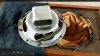
Cool. Good to know. Thanks, Glenn! I wasn't confident that anyone would pay attention to a post on an old thread by a noob. Then again, AK seems to be populated by some of the friendliest folks on the internet.Only for KLH's. Here's the 4x woofer from the set I use to own. Note the dust cap, and an early KLH Six woofer where you can clearly see the sealer on the dust cap.
Cheers, Glenn
View attachment 1879833 View attachment 1879834
Only for KLH's. Here's the 4x woofer from the set I use to own. Note the dust cap, and an early KLH Six woofer where you can clearly see the sealer on the dust cap.
Cheers, Glenn
View attachment 1879833 View attachment 1879834