• The move to the new server is done. There are some software and database maintenance updates in process. This has us passing the hat around to help out. We appreciate any donations. Seriously, even a dollar helps. The payment page may be found here - https://www.audiokarma.org/support.html

AR Cloth Surround Sealant?

I'd post some pictures, but Google Photos is slow to load tonight. I guess I can direct you again to my Instragram (@Geomorphdog). Anyway, the speakers came out nicely. I think the surrounds could probably use another coat of rubber, but I'm not eager to mix up another batch. Toluene is nasty stuff!
Hey Geo,

I don’t use Instagram, but be careful putting too much sealer on the surrounds. It should be just enough to fill the fabric weave. Pushing in the woofer cone, and a slow return is what you want.
 
Hey Geo,

I don’t use Instagram, but be careful putting too much sealer on the surrounds. It should be just enough to fill the fabric weave. Pushing in the woofer cone, and a slow return is what you want.

Probably wise to stay away from Instagram. I got the photos, so I'll post those below. I'm wary of applying too much sealant, and that's another reason I haven't put on another coat yet. I know about the slow return. As it is, the return isn't all that slow; the return doesn't seem noticeably retarded by limited air flow. The speakers sound OK, but I don't know how they sounded before.

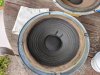
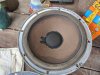
Here's both woofers after removing the old sealant:
IMG_20200614_143125.jpg
IMG_20200614_143132.jpg

And after a new coat of sealant:
IMG_20200614_151842.jpg
IMG_20200614_151901.jpg

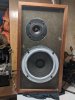
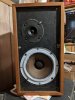
Here are the speakers fully reassembled (new stuffing, old shrouds, new putty):
IMG_20200614_190318.jpg
IMG_20200614_190343.jpg

Cheers,
Stephen
 
Probably wise to stay away from Instagram. I got the photos, so I'll post those below. I'm wary of applying too much sealant, and that's another reason I haven't put on another coat yet. I know about the slow return. As it is, the return isn't all that slow; the return doesn't seem noticeably retarded by limited air flow. The speakers sound OK, but I don't know how they sounded before.

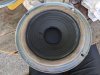
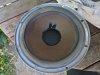
Here's both woofers after removing the old sealant:
View attachment 1920386
View attachment 1920387

And after a new coat of sealant:
View attachment 1920388
View attachment 1920389

Here are the speakers fully reassembled (new stuffing, old shrouds, new putty):
View attachment 1920390
View attachment 1920391

Cheers,
Stephen
What is the sealant you used? I hope not a caulk type. If so it will stiffen over time and ruin the woofers. The only sealer to use is the stuff flea bay seller “vintage-ar” sells, or contact Roy C. directly as he makes it.
 
What is the sealant you used? I hope not a caulk type. If so it will stiffen over time and ruin the woofers. The only sealer to use is the stuff flea bay seller “vintage-ar” sells, or contact Roy C. directly as he makes it.

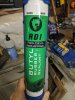
It was in a caulking tube, but they said it was pure butyl rubber and wouldn't stiffen or harden. I put some in a cup with some toluene (maybe too much) and mixed it up as best I could. The mixture seemed like milk but with some curdled bits. Sounds like I should try again with better stuff. Or at least see whether I can get something with a better consistency from what I have and test it on some loose-weave fabric first.
 
It was in a caulking tube, but they said it was pure butyl rubber and wouldn't stiffen or harden. I put some in a cup with some toluene (maybe too much) and mixed it up as best I could. The mixture seemed like milk but with some curdled bits. Sounds like I should try again with better stuff. Or at least see whether I can get something with a better consistency from what I have and test it on some loose-weave fabric first.
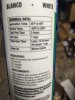
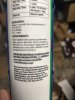
Can you post a pic of the caulking container?
 
I just bought a bottle of vintage-ar's cloth surround dope over the weekend and should be here any day now. I share this info just in case anyone happens upon this thread and is wondering if he's around or not.
 
Probably wise to stay away from Instagram. I got the photos, so I'll post those below. I'm wary of applying too much sealant, and that's another reason I haven't put on another coat yet. I know about the slow return. As it is, the return isn't all that slow; the return doesn't seem noticeably retarded by limited air flow. The speakers sound OK, but I don't know how they sounded before.

Here's both woofers after removing the old sealant:
View attachment 1920386
View attachment 1920387

And after a new coat of sealant:
View attachment 1920388
View attachment 1920389

Here are the speakers fully reassembled (new stuffing, old shrouds, new putty):
View attachment 1920390
View attachment 1920391

Cheers,
Stephen
That looks a little scary, I can't see the weave anymore. At least on my phone.
 
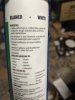
If that is Red Devil 0697/0I Butyl Rubber Sealant (white), here is the ingredient list:
Code:
Chemical Name           CAS No      Weight-%

Calcium Carbonate       1317-65-3   <60
Butyl Rubber Solution   MIXTURE     <15
Titanium dioxide        13463-67-7  <2.5
Non-hazardous Ingred.   Proprietary <20
Petroleum Hydrocarbon   64742-48-9  <5.0

from the sds here (pdf)
 
If that is Red Devil 0697/0I Butyl Rubber Sealant (white), here is the ingredient list:

Chemical Name CAS No Weight-%

Calcium Carbonate 1317-65-3 <60
Butyl Rubber Solution MIXTURE <15
Titanium dioxide 13463-67-7 <2.5
Non-hazardous Ingred. Proprietary <20
Petroleum Hydrocarbon 64742-48-9 <5.0

from the sds here (pdf)

Calcium carbonate isn't good. Sounds like I'd better remove it and get the good stuff. Damn.
 
I <3 toluene! I just ordered the sealant from vintage-ar. It's a learning experience, I suppose.

Always.

But congratulations: you undid the error, solved the problem (nice work GD!), and success is at hand. It's a good day when no drivers die.

To address a few issues.

Butylene rubber is basically chewing gum, and remains sticky for decades. It will eventually oxidize, harden, and flake off, but this is fixable with solvent and new rubber. Vintage AR dissolves sheets of butylene rubber in toluene or a mix of toluene and xylene (volatility). This is RoyC's recipe and his former business.

The label for the caulk you used says "full cure" which means it will polymerize and harden. That is the core problem, and one shared by all of the purported dopants; all harden, raise Fs, and ruin the driver.

Calcium carbonate is limestone and it is added as an inert filler to add mass, stiffen the material and make it formable. The caulking used to seal around the driver-baffle junction in an acoustic-suspension cabinet is typically a filled caulk (Mortite was the actual brand used) consisting of butylene rubber and calcium carbonate. It's fine for that purpose, although we now have very nice latex caulks which are better sealants easier to remove. (The baffle sealant never touches the cone,)

Here's a thread which has piles of details about sealants with links to the discussion on Classic Speaker Pages:
 
Just out of curiosity, what the OP have to do to "undo" the mistake? Will just painting on the good stuff from vintage-ar be enough to fix the issue *and* properly seal the surrounds? You know, in one fell swoop like that? If so, how much are they going to have to use? An entire bottle for only one surround? Or will there be multiple steps involved? Like, first you need to peel off the caulking stuff and then do this then do that? Inquiring minds want to know!

I ask for the sake of future googlers that find themselves in the same situation as our beloved OP here.
 
I can't imagine that the application of the new goo is going to remove the stuff on there. Maybe pure toluene will dissolve it enough to wipe/scrape it off.

I'm looking forward to seeing the progress on this!
 
Just out of curiosity, what the OP have to do to "undo" the mistake? Will just painting on the good stuff from vintage-ar be enough to fix the issue *and* properly seal the surrounds? You know, in one fell swoop like that? If so, how much are they going to have to use? An entire bottle for only one surround? Or will there be multiple steps involved? Like, first you need to peel off the caulking stuff and then do this then do that? Inquiring minds want to know!

I ask for the sake of future googlers that find themselves in the same situation as our beloved OP here.

The gunk shown in #42 must be removed completely before doping the surround with the proper butyl compound. Sadly, removing the gunk shown in #42 won't be easy. It looks like it was liberally applied to the surround, the frame, and some of the cone. :eek: Removal should be done as soon as possible to minimize the curing of the gunk.

The first step is to see if any of the gunk can be scraped off. I would use a butter knife or something like it that does not have a sharp edge. It is important to not cut or poke a hole in the cloth surround.

The next step is to use a solvent to loosen the gunk. Toluene would be my first choice, but Xylene would work although it would evaporate quickly, leaving little time to remove the gunk. Doing it outside is important to avoid inhaling any fumes. The solvent needs to be applied only to the surround, avoiding the connection of the surround to the frame and cone. You do not want to loosen glue holding the surround to the frame and cone. The solvent should loosen or soften the gunk on the surround so that it can be scraped or wiped off with a rag. Care needs to be exercised to avoid damaging, ripping, or otherwise destroying the surround.

The application of the solvent to the surround should be repeated until all the old gunk is removed. I expect from the way it looks like the gunk was slathered on that the removal may take a while. The end result of the removal is that the surround cloth should be a natural color and does not feel sticky after allowing the solvent to evaporate.

Only after all the gunk is removed from the cloth surround should the proper Butyl doping material be applied. I like to use an acid brush - 3/8" with metal handle. With AR drivers, I find that applying a single, thin coat is all that is needed. The butyl compound is applied only to the surround between the frame and cone.
 
Just out of curiosity, what the OP have to do to "undo" the mistake? Will just painting on the good stuff from vintage-ar be enough to fix the issue *and* properly seal the surrounds? You know, in one fell swoop like that? If so, how much are they going to have to use? An entire bottle for only one surround? Or will there be multiple steps involved? Like, first you need to peel off the caulking stuff and then do this then do that? Inquiring minds want to know! I ask for the sake of future googlers that find themselves in the same situation as our beloved OP here.

I was under the impression that as the cure had not completed, the OP had successfully removed the mess using toluene. Hence the comment, "I <3 toluene!" Because it is a seven-day cure, and was caught early, it seemed that toluene plus a cloth was sufficient to remove it. The OP should clarify.

To address your question about merely painting over the mess as a repair, no, that will not work. The painted-on caulking must be completely removed, as it over time hardens, stiffening the surround and raising Fs. Painting over a stiff mess will further ruin the speaker because the surround will become so rigid, inflexible, and heavy that it cannot possibly function qua surround. Worst case a glopified and ruined surround can be completely removed and the fabric replaced with cloth surround material, which is available. This changes the speaker, as Ken Kantor, who actual understands these things, has many times explained the issues involved and why it is difficult it is to return a refoamed driver to its original functioning:
But, with a woofer, a careful job can get the driver functioning at least somewhat within the ballpark of the original. ... However, with something like a midrange, the changes wrought by refoaming will be really extreme. There is almost zero chance of getting something close to the original performance, and the refoamer generally has no way to check was has been done.

How in the world do you folks know there weren't significant response changes from your midrange repairs? As a speaker manufacturer, I've seen tens of thousands of mids scrapped because a glue was applied at the wrong temperature or the cross section curvature of a surround roll was slightly off from print.

I have never made this particular mistake, but I have successfully removed paint and caulk from wood using low molecular weight solvents (toluene, xylene) which I do not like to use for this purpose (neurotoxic, hepatotoxic, nephrotoxic, etc.) because of the quantity required for furniture and trim, and non-toxic paint removers like CitriStrip (methylpyrrolidone which swells the bonds, softening paint) which I have used by the gallon. I have used CitriStrip to remove all manner of polymerized material, but that is from wood and tile, not paper.

This problem of improper surround coating endlessly resurfaces and there's only one way to fix it.

So I'll tell you what needs to happen to save newbies, and I'm going to be completely blunt:
(1) Audio hobbyists need to learn to perform basic research, i.e. spending a few hours reading forums, before running off to mutilate speakers with whatever glop is available from the local hardware store based upon some "helpful" suggestion posted by an ignoramous. Every hobbyist suddenly becomes an expert in surround coating techniques and re-invents the myriad of ways in which to fail.

(2) Audio hobbyists must cease listening to morons endlessly promoting pernicious nonsense, including coating surrounds, or even the cones themselves, with polyvinyl acetate (PVA, Aleene's, white glue, etc.), varnishes (shellac, lacquer, corona varnish, etc.), caulk (silicone, butylene, elastomer, etc,), cement (gasket cement, rubber cement, contact cement), silicone oils, etc.

(3) Postings containing nonsense as in (2) should be annotated by moderators with notes saying, "The proposed technique is known to ruin the surround and destroy the speaker's characteristics, do not follow it.". I'm not in favor of censorship (always best to have the marketplace of ideas), hence the annotation instead of removal, but the nonsense about surrounds is pernicious and destructive, and endlessly recirculates to mislead newbies into ruining vintage speakers which must them be replaced at great expense. I've seen posters suggest absolute garbage and then become utterly belligerent when it is debunked. White-Glue Cult is the worst, of the lot, but Gasket Cement Cult and Caulking Cult are also quite contentious.​

Like others (again, nice work GD), I try to post to the threads with the information I've previously posted to debunk the nonsense, but it's hopeless. Too much nonsense recirculates and speculation abounds. It would be a full-time job to keep it in check.

 
Here is some text I previously posted from Colloms and Darlington about surrounds (underlining added for emphasis):
High Performance Loudspeakers: Optimising High Fidelity Loudspeaker Systems (Seventh Edition)
by Martin Colloms and Paul Darlington
2018

Pages 292 to 292
7.2.5 Surrounds
This component is important to all drivers but it is most critical in lower frequency applications, where it must perform two roles. First, it must enable the large amplitude linear excursions required at low frequencies, together with a resistance to the considerable differential air pressures experienced, and where necessary, provide effective absorption and termination of energy at the cone edge right through to the mid-range. It must also support the cone for years without sagging, preventing decentration and catastrophic voice coil scraping. Surrounds may be formed as a series of concentric corrugations, either as an extension of the cone edge often with applied damping or as an additional formed component. These are seen on some very high power and larger public address and studio applications. By contrast, almost all hi fi drivers today employ some form of half-roll surround of selected composition. These are satisfactorily linear and can also be made to the high compliance values required for low-resonance sealed-cabinet drivers. In addition, they may be formed from a variety of materials, some of which offer excellent termination properties at higher frequencies. The curved shape of a roll surround endows it with a resistance to the high differential pressure between the front and rear sides of a bass driver. Less distortion results from materials that overload gradually, and plastic foams and rubbers are often preferable to treated fabric. Although they are quite heavy, surrounds of moulded neoprene are extensively used with bass drivers (Figure 7.4) while other similar materials such as nitrile modified rubbers are also in use.

Preferred suspension materials such as PVC and nitrile rubbers have densities in the 1 to 1.1 x 10^3 kg m^3 range, comparing well with the density of polypropylene and Bextrene cone plastics. Butyl rubber has also proved popular with dense, heavy]coned pulp cone drivers. For lighter grade cones, foamed polyurethane works well especially with an additional sealing coating, though unless UV stabilized and treated it can degrade prematurely in tropical conditions.

...

Designers must take into account divergent surround requirements, namely useful dissipation of vibration energy above 150 Hz or so; a profile which allows reasonably linear excursion up to typically 8 mm peak to peak, (much more for powerful sub-woofer bass units) and a mechanical structure which inhibits self-resonance. For a particular prototype driver, a response dip occurred at about 600 Hz, whose source was eventually traced to an anti-resonance in the surround. A flat section had been designed between the half]roll and the cone edge, but another was unintentionally present between the outer 'roll' edge and the clamping point on the chassis. The unwanted circuit comprised the 'roll' vibrating with the compliance of the two adjacent flat sections. Readjustment of the roll dimension to eliminate the outer flat portion removed the dip. Such 'surround response dips' remain a common design problem. Recent designs have modeled the surround shape to include an additional mass component to help terminate cone-surround modes.

The surround must also be regarded as an additional radiating element, in part producing an out-of-phase component and should, in theory at least, be as narrow as practicable for the required excursion. Another issue is the significant temperature variability of compliance and termination shown by many surround materials, particularly nitrile rubber and PVC. For a given driver compromises may need to be found as between optimum bass excursion and linearity and upper range response uniformity. Hitachi patented a particular type of geometrically pleated surround using a moulding of doped fabric claiming improved excursion linearity and termination.


Page 302
On this basis designers might consider avoiding magnetic fluid and, for that matter, polyurethane foam surrounds as well, the latter frequently degrading totally after a decade or less. By contrast many previous generations of loudspeakers built with more conventional materials have been known to operate satisfactorily for several decades, if not more than half a century.
 
I was under the impression that as the cure had not completed, the OP had successfully removed the mess using toluene. Hence the comment, "I <3 toluene!" Because it is a seven-day cure, and was caught early, it seemed that toluene plus a cloth was sufficient to remove it. The OP should clarify.

To address your question about merely painting over the mess as a repair, no, that will not work. The painted-on caulking must be completely removed, as it over time hardens, stiffening the surround and raising Fs. Painting over a stiff mess will further ruin the speaker because the surround will become so rigid, inflexible, and heavy that it cannot possibly function qua surround. Worst case a glopified and ruined surround can be completely removed and the fabric replaced with cloth surround material, which is available. This changes the speaker, as Ken Kantor, who actual understands these things, has many times explained the issues involved and why it is difficult it is to return a refoamed driver to its original functioning:


I have never made this particular mistake, but I have successfully removed paint and caulk from wood using low molecular weight solvents (toluene, xylene) which I do not like to use for this purpose (neurotoxic, hepatotoxic, nephrotoxic, etc.) because of the quantity required for furniture and trim, and non-toxic paint removers like CitriStrip (methylpyrrolidone which swells the bonds, softening paint) which I have used by the gallon. I have used CitriStrip to remove all manner of polymerized material, but that is from wood and tile, not paper.

This problem of improper surround coating endlessly resurfaces and there's only one way to fix it.

So I'll tell you what needs to happen to save newbies, and I'm going to be completely blunt:
(1) Audio hobbyists need to learn to perform basic research, i.e. spending a few hours reading forums, before running off to mutilate speakers with whatever glop is available from the local hardware store based upon some "helpful" suggestion posted by an ignoramous. Every hobbyist suddenly becomes an expert in surround coating techniques and re-invents the myriad of ways in which to fail.

(2) Audio hobbyists must cease listening to morons endlessly promoting pernicious nonsense, including coating surrounds, or even the cones themselves, with polyvinyl acetate (PVA, Aleene's, white glue, etc.), varnishes (shellac, lacquer, corona varnish, etc.), caulk (silicone, butylene, elastomer, etc,), cement (gasket cement, rubber cement, contact cement), silicone oils, etc.

(3) Postings containing nonsense as in (2) should be annotated by moderators with notes saying, "The proposed technique is known to ruin the surround and destroy the speaker's characteristics, do not follow it.". I'm not in favor of censorship (always best to have the marketplace of ideas), hence the annotation instead of removal, but the nonsense about surrounds is pernicious and destructive, and endlessly recirculates to mislead newbies into ruining vintage speakers which must them be replaced at great expense. I've seen posters suggest absolute garbage and then become utterly belligerent when it is debunked. White-Glue Cult is the worst, of the lot, but Gasket Cement Cult and Caulking Cult are also quite contentious.​

Like others (again, nice work GD), I try to post to the threads with the information I've previously posted to debunk the nonsense, but it's hopeless. Too much nonsense recirculates and speculation abounds. It would be a full-time job to keep it in check.

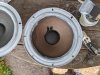
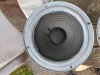
Here's a few pics after gunk removal.
IMG_20200711_164448.jpg
IMG_20200711_164503.jpg
IMG_20200711_164551.jpg

The stuff came off relatively easily, but by that I mean it only took about 4 hours, similar to, maybe shorter than, the first time. As you can see from the detail, I couldn't remove all traces of the white stuff. Although it was all over the place, the original mixture was pretty dilute, similar to the consistency of whole milk or half & half.

The new sealant is supposed to get here next week.

Before ordering the white stuff, I spent a long time trying to find something that was pure butyl rubber. It does appear that you either need to make it yourself by dissolving the rubber sheets in toluene, or get it from someone who does.
 
Here's a few pics after gunk removal.
View attachment 1923821
View attachment 1923823
View attachment 1923824

The stuff came off relatively easily, but by that I mean it only took about 4 hours, similar to, maybe shorter than, the first time. As you can see from the detail, I couldn't remove all traces of the white stuff. Although it was all over the place, the original mixture was pretty dilute, similar to the consistency of whole milk or half & half.

The new sealant is supposed to get here next week.

Before ordering the white stuff, I spent a long time trying to find something that was pure butyl rubber. It does appear that you either need to make it yourself by dissolving the rubber sheets in toluene, or get it from someone who does.

Wow! Nice job cleaning that up. I was worried for you as I read through the thread. I think you got to it in time. Excellent!

You may need to use all of the sealant to reseal those. You may even need to get more. Usually, one is just touching up the old coat, not completely replacing it.
 
Back
Top Bottom