• The move to the new server is done. There are some software and database maintenance updates in process. This has us passing the hat around to help out. We appreciate any donations. Seriously, even a dollar helps. The payment page may be found here - https://www.audiokarma.org/support.html

AR Cloth Surround Sealant?

One small was not enough for my KLH Model 6 woofers. Just ordered some more. Was enough for the Model 17s a few years ago but that is a smaller woofer. New capacitors and doping compound did a lot for the Model 17s. Hopefully USPS will be faster this time than last time, it took a full week to work its way down from Albany.
 
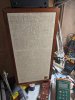
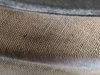
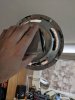
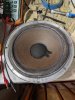
Here's a few pics after gunk removal.
View attachment 1923821
View attachment 1923823
View attachment 1923824

The stuff came off relatively easily, but by that I mean it only took about 4 hours, similar to, maybe shorter than, the first time. As you can see from the detail, I couldn't remove all traces of the white stuff. Although it was all over the place, the original mixture was pretty dilute, similar to the consistency of whole milk or half & half.

The new sealant is supposed to get here next week.

Before ordering the white stuff, I spent a long time trying to find something that was pure butyl rubber. It does appear that you either need to make it yourself by dissolving the rubber sheets in toluene, or get it from someone who does.
I’m going to sleep much better tonight! Terrific job removing that goo!
You’ll want to seal the fabric, but just enough to do the job. Don’t apply more than is needed, and apply it only on the surround, not the basket or cone. See my pics posted earlier.
Glenn
 
My bottle of surround dope came in yesterday, and surprise!, it even comes with a brush and instructions. This is not the first thing that I've ordered from Larry, so really, it's not much of a surprise that he would include everything that is needed to complete the job. My first experience with him was when I ordered the crossover renewal kit for my old AR 2ax's. Larry does a great job with his instructions in that he explains everything step-by-step so that even a novice can easily understand how to do it.
 
Here's a few pics after gunk removal.

Wow. That's an impressive difference. Good work!

The stuff came off relatively easily, but by that I mean it only took about 4 hours, similar to, maybe shorter than, the first time. As you can see from the detail, I couldn't remove all traces of the white stuff. Although it was all over the place, the original mixture was pretty dilute, similar to the consistency of whole milk or half & half.

A soft toothbrush might better reach into those nooks and crannies without causing abrasion.

Before ordering the white stuff, I spent a long time trying to find something that was pure butyl rubber. It does appear that you either need to make it yourself by dissolving the rubber sheets in toluene, or get it from someone who does.

That is correct. It's mostly a DIY deal. The butylene rubber is commonly darkened from its natural amber color using carbon black.

I previous explained why the vendors selling speaker surround products will not supply butylene rubber solutions:

It is highly doubtful that any large company will sell a speaker sealant that uses a solvent like toluene. Just too much trouble. Not only can it not be shipped by mail, carriers will charge a hazardous fee for it, it must be labelled as known by the State of California to cause cancer, and lawsuits can arise from use, let alone misuse. Large manufacturers which sell solvent-based adhesives and sealants can amortize the cost; smaller producers cannot.

I know of no large company selling a butylene rubber solution for speaker surrounds. Such a product is a boutique item sold by small vendors which fly under the radar. It would be best to check on the exact content of any purported "sealant" before ruining speakers, as the vendor may not be truthful and may be selling diluted gasket cement, elastomer caulking, or some other unsuitable concoction.
 
As GD noted, the driver should have some airflow through the dustcap.

Here's what I previously wrote on that subject of sealed cabinets, in addressing infinite baffle and acoustic suspension:

Perfectly Sealed Box

When any sealed box, be it infinite baffle or acoustic suspension, is perfectly sealed then the air pressure internal to the box differs from the air pressure external to the box. The interior cabinet air would be trapped at the time of manufacture, and its volume fixed. As a result, as the external pressure increased or decreased the cone would be moved in or out, changing its resting position. This is how a barometer functions.

Air Exchange

To avoid having the resting position vary with air pressure—air pressure varies with altitude and with storms, so it constantly changes, which is how a barometer works—every cabinet must therefore have a means to permit air exchange between the interior and exterior. The mechanism of exchange must be small to avoid having the backwave exit through that orifice and thus (a) (in infinite baffle and acoustic suspension) interfere with the front wave or (b) (in acoustic suspension) reduce the restoring force on the woofer by reducing the interior cabinet pressure.

At the same time, the orifice must be sized large enough such that air does not rapidly move through it or the orifice will squeak, like one of those rubber squeeze toys for dogs or children. A pinhole will squeak.

Dust Cap as Exchange Orifice

The dustcap is a nice way to exchange air from the interior of the cabinet to the exterior, and this also cools the voice coil preventing it from overheating and even burning out. It provides a nice surface area so the rate of air flow through any spot is small.

Cabinet Sealing

Despite the need for tiny amounts of air exchange, in both acoustic suspension and infinite baffle the cabinet best functions with a nearly perfect air seal. This is why a gooey caulking like Mortite (tm) or other filled butylene rubber was historically used around the drivers and the back. It is why the surround must be resealed after some decades, because the butylene rubber in the surround has oxidized, hardened, flaked off, or otherwise degraded. The drivers must be perfectly sealed to the baffle, the back must be perfectly sealed to the cabinet, and the surround must be perfectly sealed to prevent air from moving through it. The only air exchange is through an opening kept small and diffuse, and that is the dust cap.

As has been demonstrated, the dust cap must be a bit porous to allow some air flow to equalize the air pressure and to cool the woofer voice coil which can otherwise become quite hot.
 
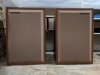
I just finished supplying a coat of the Vintage-AR sealant to the surrounds of the AR-4X surrounds. Still got the respirator mask on. First, here's before:
IMG_20200716_122456.jpg IMG_20200716_122541.jpg IMG_20200716_123153.jpg

After the drivers had sat for a few days after removing the gunk, I gave them each a robust brushing with a high-quality paint brush. I gave special attention to the under sides, as best I could, since those were still gritty to the touch, perhaps from old fiberglass; I don't know. The third photo above shows one of the drivers from the back and held up to the light. I wanted to check to make sure the weave was truly open.

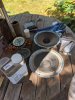
I took them outside to do the resealing:
IMG_20200718_150701.jpg

I brought the can of toluene and used it to clean the disposable brush afterwards, and I added a small amount, on the order of 1 ml or less, to the remaining sealant on the jar; maybe it's my imagination, but it seemed to be a little bit thicker when I was done, so I thinned it a little bit.

I had to run the surrounds back inside at some point, because the breeze deposited a bit of organic debris onto one of the surrounds, and I hadn't brought tweezers outside with me; I wanted to pick it off and make sure no more debris was deposited.

Here are the "after" pictures (still tacky):
IMG_20200718_154538.jpg IMG_20200718_154614.jpg IMG_20200718_154552.jpg IMG_20200718_154728.jpg
In contrast to the time required to remove the old stuff and new gunk, applying the new sealant too very little time. I'm a little surprised how different the two surrounds now look. One is significantly darker, more gray. Possible causes include the following: 1) the drivers are clearly different in other ways; the confess are different colors, and one metal frame had only four mounting holes, while the other had eight. Perhaps the surrounds are also different. 2) Maybe I was more thorough in removing the old sealant from one of the surrounds. They looked pretty similar without the new sealant, but adding the new sealant re-dissolved the small amounts of old sealant on each surround. Different amounts of the original black sealant made one darker than the other. 3) I applied more sealant to the darker one, and more sealant makes it look darker for ... reasons. 4) The darker one is the one I did second of the two. During application, the brush picked up small amounts of the original black sealant, and those amounts became progressively more concentrated on the brush as I proceeded.

The instructions say to wait a few days before deciding whether to apply a second coat. They also say that one coat is usually enough for ARs, and that a second is more often needed for KLHs. I've lost who it was above that said I might need to apply more than is usual because I had been so thorough in removing the old stuff. My results are much less gloppy than the original appearance. I suspect that's largely to do with the difference between the care exercised by a lone hobbyist restoring a prized artifact from the previous century vs. the relative carelessness of someone on an assembly line designed to maximize widget production.

I'm going to go retrieve my stuff from outside and re-read the instructions. Thanks to all of your advice. I will post another follow-up when I decide to either apply a second coat or reassemble the speakers.

-STL
 
That looks really good, both in removing the white caulk, and the new coating application :thumbsup:

I've just picked up a Fisher console with rolled cloth surrounds on the 5.75" mid-range and 12" Rola drivers. At 50 years old, they likely could use a touch-up as well, so this thread was very helpful and informative!
 
Wow! Nice job cleaning that up. I was worried for you as I read through the thread. I think you got to it in time. Excellent!

You may need to use all of the sealant to reseal those. You may even need to get more. Usually, one is just touching up the old coat, not completely replacing it.

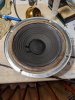
An update on my AR-4X's: I got the new sealant and ended up applying two coats. I waited a long time (weeks?) between coats, because it seemed to take forever for the stuff to dry. Ah, but that's the thing: It never does. It literally never got less sticky than the day I put it on. Eventually I decided it was time, put on the respirator, and applied a second coat. This time I was doing it with the whole speaker intact, complete with duct putty to seal in the two drivers each. (Good thing I got a big chunk the first time; I think I'm looking at the third time sealing it back up with new putty.) Here are a couple of pictures of the unmounted driver shortly after applying the first coat:
IMG_20200718_154538.jpg
IMG_20200718_154614.jpg
The photos are interesting, because in the close-up it looks like there's barely any sealant on the surrounds, while in the more distant view the surrounds look shiny enough.
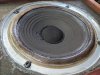
Looking at the timestamps on the picture file names, I did the second coat a little over two weeks later. Here are a couple of pictures of the same driver, mounted this time:
IMG_20200804_145952.jpg
IMG_20200804_150011.jpg
To me anyway, that seems like a pretty marked difference after the second coat. It looks to me like the sealant is fully coating the material.

Thing is, I can't really tell the difference from the "push test," i.e., push in the cone with the fingers of one hand; wait a bit; and release. I can't really tell that it takes any longer to come back out to its neutral position. I tried another test, and you're going to love this one: I put my lips on the surround to make a seal and blew with modest force, or at least tried to. All I got out of it was the yucky sensation of the butyl rubber unsticking from my lips when I pulled them back off. The short of it is that I couldn't get any air through.

But how do they sound? They sound great, but I'll get back to that.

After applying the second coat, on the same day, I used Restor-a-finish with #0000 steel wool and, after that, a bees' wax, etc., finisher. Here's a picture after using the Restor-a-finish on one cabinet:

IMG_20200804_160937.jpg
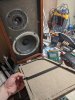
I then cut six pieces of paired velcro and stuck the covers back on. Before applying the new sealant, I had thought I might like to leave them uncovered. Given how sticky the sealant is, I could see that going badly. Here are a couple of pictures, the first when I'm about to stick the cover back on, and the second with it stuck:
IMG_20200822_125641.jpg
IMG_20200822_125732.jpg
These are real beauties now!

I didn't do much cleaning of the cloth. These had never been relegated to an attic, garage, or basement by the original owner. Lately, he had been using them as stands for another pair of speakers. The cloth is on the fragile side, so I just vacuumed it, with no visible effect.

As for the sound. I tried them first with the back-side pots set to the middle of their ranges. In that configuration, the speakers sounded muffled, but they brightened up when I adjusted the pots (turned them "up"). That initial adjustment seemed fine for a while. One day, I put on a Coltrane CD, Prestige. Maybe it was just the barely produced nature of the recording, but it sounded muffled. I turned up the pots again, this time just about as far as they would go, and now they sound great.

But what's up with my needing to use the extremes of the adjustable ranges, and why did I have to go there from a less extreme position after a month or two of use? I asked my friend, "Did you generally feel the need to turn the dials to their brightest, or nearly so?"

I love his answer: "First of all, if your question is a general question about my approach to life, well, it's been sort of phasic--i.e., yes, I go through periods in which I feel the need/want to live life at 11. But if this is just about the AR-4Xs ... The pots haven't worked well in MANY years. The treble range of the speakers just gradually deteriorated, because of the pots, I'm assuming. But there was a long period in which I could get the treble to perform when I turned the pots all the way up. Not sure how that related to the pot inner structures, but it worked ... for a while. Then even that quit on one of the speakers. In the AR-4Xs' early life I don't recall fiddling with the potentiometers much at all."

I responded, "Those pots required major reconstruction to replace metal that was pitted out of existence. Wasn't uniform, though."

"I just ran across a 'To Do' list from 1999. On it was, 'Fix AR4 potentiometers.'"

I've looked around a little on Audiokarma in the last day or so. I've found the "I just turn them all the way up" thing to be relatively common. I guess I'm unclear on what the adjustment does. Some questions, then:
  • I had thought, maybe assumed, that turning the pot was changing the crossover frequency. Am I wrong about that? Is the pot actually a volume knob?
  • Does the experience of the original owner indicate a deterioration of the tweeters?
  • Does my need to turn them up after a couple of months indicate an actual change, or just my using a better reference recording? Would it be expected, for example, for the new capacitors (Daytons, 20 uF, +/- 1%) to change in a way that would require the same adjustment to both speakers?
  • Finally, my thought was that the need to "turn it up" and the malfunctioning of the pot were essentially unrelated. Thoughts?
Currently, I'm pretty please with how the speakers sound, but it does worry me that I don't have any further to go in terms of adjustment.

 
Looks great! You want to be careful with steel wool. The drivers can suck bits of it
into the magnets/voice coil area/etc.

You don't mention how fast the woofer cone rebounds. It should take more than a
second or so. Don't seal the dust caps (looks like you didn't).

The way to be sure about the pots is to put new ones in. It's not too hard to imagine
your originals' performance could deteriorate that quickly.
 
I’m going to sleep much better tonight! Terrific job removing that goo!
You’ll want to seal the fabric, but just enough to do the job. Don’t apply more than is needed, and apply it only on the surround, not the basket or cone. See my pics posted earlier.
Glenn

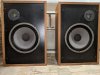
A final (?) note: I recently finished (for now) restoring a Dynaco SCA-80 that was also given to me by the same friend. I had originally intended to put the old team back together, i.e., put the SCA-80 and the AR-4Xs in my living room. But then I came across some Hartley Zodiac 1B's on CL, bought them, and was so amazed by their sound that I've put them in the living room instead. They have substantially larger woofers and noticeably beefier bass. Perhaps the difference is simply one of design, but just now it occurs to me to wonder whether my noticing the beefy bass of the Hartleys is an indication that I still haven't sealed the AR-4Xs well enough.

Here are the 1Bs:
IMG_20200913_172503.jpg
And with the covers off:
IMG_20200913_172333.jpg
They come in matched pairs:
IMG_20200913_172559.jpg

More recently, I found a Magnavox console with an AMP 185 AA tube amp. My thought is to use it with the AR-4Xs as a bedroom system.
 
Looks great! You want to be careful with steel wool. The drivers can suck bits of it
into the magnets/voice coil area/etc.

You don't mention how fast the woofer cone rebounds. It should take more than a
second or so. Don't seal the dust caps (looks like you didn't).

The way to be sure about the pots is to put new ones in. It's not too hard to imagine
your originals' performance could deteriorate that quickly.

That was fast!

Thanks for the caution RE: steel wool. Although, what's done is done, and I think I managed without making a mess of things.

I've heard that it should take up to a second to rebound. Mine doesn't. But help me out with thinking this through: If the surround is well sealed then is it possible that so little air would leave the box upon pushing in the cone, that the cone would rebound quickly? Or is there enough air exchange through the dust protector to make that "not a thing"?
 
Don’t over do it with the sealer. It should just be a very thin allpication. The 4xs are not an air tight design.
 
Looks great! You want to be careful with steel wool. The drivers can suck bits of it
into the magnets/voice coil area/etc.

You don't mention how fast the woofer cone rebounds. It should take more than a
second or so. Don't seal the dust caps (looks like you didn't).

The way to be sure about the pots is to put new ones in. It's not too hard to imagine
your originals' performance could deteriorate that quickly.
Don’t over do it with the sealer. It should just be a very thin allpication. The 4xs are not an air tight design.

Right, I haven't wanted to overdo it. With the first coat, it didn't appear to throughly cover the fabric. With the second coat, the sheen is continuous. I don't see how another coat would improve anything. Wouldn't too much tend to make it too stiff?
 
Looks great! You want to be careful with steel wool. The drivers can suck bits of it
into the magnets/voice coil area/etc.

You don't mention how fast the woofer cone rebounds. It should take more than a
second or so. Don't seal the dust caps (looks like you didn't).

The way to be sure about the pots is to put new ones in. It's not too hard to imagine
your originals' performance could deteriorate that quickly.
These woofers will bounce back a bit faster the KLHs, or AR3/3as because of the vented dust caps.
 
A final (?) note: I recently finished (for now) restoring a Dynaco SCA-80 that was also given to me by the same friend. I had originally intended to put the old team back together, i.e., put the SCA-80 and the AR-4Xs in my living room. But then I came across some Hartley Zodiac 1B's on CL, bought them, and was so amazed by their sound that I've put them in the living room instead. They have substantially larger woofers and noticeably beefier bass. Perhaps the difference is simply one of design, but just now it occurs to me to wonder whether my noticing the beefy bass of the Hartleys is an indication that I still haven't sealed the AR-4Xs well enough.

Here are the 1Bs:
View attachment 2002742
And with the covers off:
View attachment 2002744
They come in matched pairs:
View attachment 2002741

More recently, I found a Magnavox console with an AMP 185 AA tube amp. My thought is to use it with the AR-4Xs as a bedroom system.
That sound like a very nice bedroom system. Pics are a must once you have it setup.
 
These woofers will bounce back a bit faster the KLHs, or AR3/3as because of the vented dust caps.
That's reassuring. I mean, they seem to sound great. My perception is that the Hartleys just have an unusually strong bass response for a "bookshelf speaker."
 
Right, I haven't wanted to overdo it. With the first coat, it didn't appear to throughly cover the fabric. With the second coat, the sheen is continuous. I don't see how another coat would improve anything. Wouldn't too much tend to make it too stiff?
Yup! Even that 2nd coat looks a bit heavy to me. But if you’re happy with their sound, then don’t worry about it.
 
Yup! Even that 2nd coat looks a bit heavy to me. But if you’re happy with their sound, then don’t worry about it.
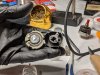
So, Glenn, can you help me to understand how the pots work? Here's one opened up:
IMG_20200524_145441 (1).jpg
So, you've basically got a wirewound resistor that's tapped at a point determined by the turning of the "dial." I can understand that, if the metal on the disc were removed in spots due to pitting, then the tweeter would just drop out entirely when the inner tap point was over that missing metal. I don't see how anything that happens inside the pot could result in a gradual change in tweeter response. Wouldn't any change due to deterioration of the pot be an on/off kind of thing? When I first opened this thing up, substantial chunks of the inner disk were just missing. With an ohmmeter on the terminals, the reading would just go to "OL" at certain points. Even now, one of the pots doesn't make a good connection at one extreme, so I can't turn it all the way up without it simply dropping out. Otherwise, the change in response is smooth.
 
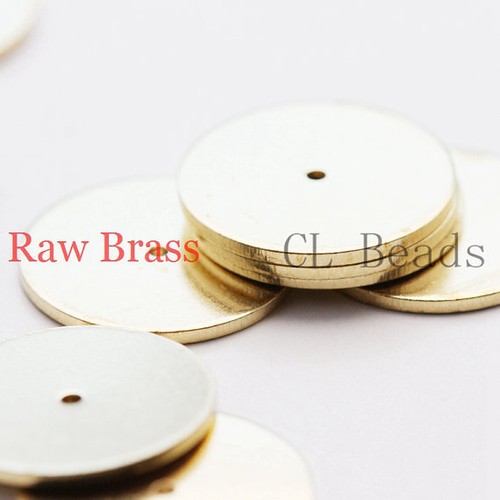
If you want to repair the original discs, beadmaker suppliers sell a brass disc
that fits. You'll need a small screw and nut to secure it once you drill out the
original rivet. Something like this. (14mm). I think I was able to find a US
supplier, and you might somewhere off ebay.

s-l500.jpg
 
That's reassuring. I mean, they seem to sound great. My perception is that the Hartleys just have an unusually strong bass response for a "bookshelf speaker."
If it's got a 10" woofer, yeah it's going to go deeper than the AR.
 
Back
Top Bottom