• The move to the new server is done. There are some software and database maintenance updates in process. This has us passing the hat around to help out. We appreciate any donations. Seriously, even a dollar helps. The payment page may be found here - https://www.audiokarma.org/support.html

AU-11000A all out...

Meteli

Active Member
So year ago I got Sansui AU-11000A and I did not like it's original sound, like behind thick planket, soft. No base and high's are meh...

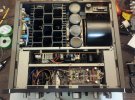
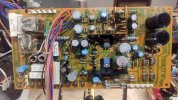
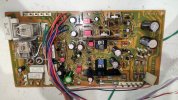
re-cap is on!
11k1.jpg

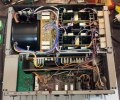
11k3.jpg

and here we have BA-2000 and CA-2000, front and rear amp seperated.
11000A etu ja pääteosa.jpg

11k4.jpg

11k5.jpg

Sansui 11000A is very easy to dismantle, no need to solder anything, only ground wire if you like. Gold plated pins on sockets.
 
Register to hide this ad
Everything back togeter and listening through diy Mona Kea -speakers, a four way, 12" woofer, AMT tweeter speakers.
11k15.jpg

But here is the thing, I still do not like this amplifier. still not accurate, still like sound is coming behind planket. Yes it is better, but still what you exspect.
For ouple of year I forgot this aplifier and found better ones, but still...
One time I was trying out my Pioneer C-90a pre amp and hooked it up with this Sansui. For my amazement sound was pretty ok, far better then 11000a pre connected. so it gave an idea with my Sansui 881, it pre amp that causes hum in 881 recievers and it did! This experiment helped me to remove all hum from 881, I am happy. It seems that resistor noise from pre-amp causes "warm sound" in these old amps. I think it is heavy amplification on preamp.

So what next?

11k9.jpg
 
Yes, I desided to take all out, everything.
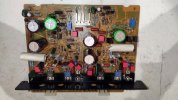
I removed electrolytics from preamp, changed evey single resistor to Vishay MRS25 -resistors, all boards. Not a single old resistor left in this amp, not a single old transistor left, apart from end.

11000a2.jpg

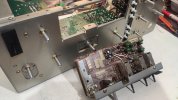
I even went further and opened all switches:

11k8.jpg

So how I do it I bought little bit extra resistors and measured similar pair to change. Not nessesary correct value, but very close as a pair.
11000a5.jpg
 
Last edited:
There was nothing wrong with switches or potentiometers, but I am not going to open this thing all the time, so I also opened up all potentiometers.
Rivet nut is the hard part, but changing it to M3 nut gives easier service for future.
11000a3.jpg

Volume pot it a work of art, hand calibrated.
11000a4.jpg

How I clean these is;
-dismantle
-clean with isopropanol
-clean traces with eraser
-again with isopropanol
-F100 and D100 to correct places.
 
So rest of parts are here:
Film caps also all changed along with ceramic caps to C0G, evrything.
11000a1.jpg

So, how is the sound?
It is far more different from capacitor change, this point I am not sure how much capacitors even affect sound, it is clean, chrisp, detailed, planket is gone. Base is as deep as are in lower wattage Sansui amplifiers what was always missing from 11000A. It sounds like Sansui amp, sparkle highs and round, live like midrange and deep deep base.
Most difference is in soundstage, it is detailed and wide, way more detailed from earlier and truly like band is in the room. Difference to newer amps is that life like performance, kind of echo in the room.

One difference is that this amp does not even warm up now with my speakers, maybe little bit if you touch heatsinks, they are not cold. even with capacitor change heatsinks did get little warm, but not anymore.

In my opinion specially those darker brown resistors were +30% out from spec and is it very much worth it to change all resistors. It is not single resistor that makes noise, it is when hundred of them makes little sound and that combines to that "warm" sound. But these amps are very different beasts when you give them a change with modern components. This amp is like what first owner would have heard in new or even better, this is my favorite amp.

 
That is a tremendous amount of work, and very well done by you, if I may say so. :bowdown:

But the main thing is, it now sounds how you like it to sound, and really, how it 'should' sound. :thumbsup: I found the same thing with my AU-D11 II, which like you, I gave it a nearly 100% resistor swapout. (all the standard ones, and many of the others).
 
Last edited:
So rest of parts are here:
Film caps also all changed along with ceramic caps to C0G, evrything.
View attachment 3787488

So, how is the sound?
It is far more different from capacitor change, this point I am not sure how much capacitors even affect sound, it is clean, chrisp, detailed, planket is gone. Base is as deep as are in lower wattage Sansui amplifiers what was always missing from 11000A. It sounds like Sansui amp, sparkle highs and round, live like midrange and deep deep base.
Most difference is in soundstage, it is detailed and wide, way more detailed from earlier and truly like band is in the room. Difference to newer amps is that life like performance, kind of echo in the room.

One difference is that this amp does not even warm up now with my speakers, maybe little bit if you touch heatsinks, they are not cold. even with capacitor change heatsinks did get little warm, but not anymore.

In my opinion specially those darker brown resistors were +30% out from spec and is it very much worth it to change all resistors. It is not single resistor that makes noise, it is when hundred of them makes little sound and that combines to that "warm" sound. But these amps are very different beasts when you give them a change with modern components. This amp is like what first owner would have heard in new or even better, this is my favorite amp.
What level of quality resistors did you chose?
Film? 1%? Mil-spec?

I have an AU-11000 that I've changed out everything out except the resistors.
I am intrigued by your findings.

A parts list, perhaps...
 
I recently restored a AU-9900 & it was a workout just on the recap/transistors due to having to straighten all the leads to remove them. I can't imagine doing everything.
 
Yes, I desided to take all out, everything.
I removed electrolytics from preamp, changed evey single resistor to Vishay MRS25 -resistors, all boards. Not a single old resistor left in this amp, not a single old transistor left, apart from end.

View attachment 3787474

I even went further and opened all switches:

View attachment 3787476

So how I do it I bought little bit extra resistors and measured similar pair to change. Not nessesary correct value, but very close as a pair.
View attachment 3787482

My Tech and I took a similar approach with my AU-X11. Not because it sounded bad. It actually sounded great but wanted to go another level.
Resistors were replaced with Vishay as well.
Results were better imaging, more detail, etc.... Zero floor noise.
I find it to as close to an alpha based amp as you are going to get.
 
That is a tremendous amount of work, and very well done by you, if I may say so. :bowdown:

But the main thing is, it now sounds how you like it to sound, and really, how it 'should' sound. :thumbsup: I found the same thing with my AU-D11 II, which like you, I gave it a nearly 100% resistor swapout.(all the standard ones, any many of the others).
Yes, it is huge amount of work and most of all you have to be very careful, extra check when you change basicly all parts in amplifier without powering up anywhere mid way.
I also have AU-alpha 607MRX and I think I will do this same operation to it some point. I did give it ago agains other similar aplifiers that had electrolytics swapped and it does have extra layer in soundstage compared to Yamaha and Pioneer (I have A/B switch). I can't wait how much difference full metal film resistors do to that.
One thing though; I still not sure if I got bias correct on that, translation to English is so bad in 607MRX manual and it is somewhat difficult.
Great work! Now you have a superb sounding amp!
Thank you for both of your kind words, it really made my day with smile and coming from you kind of writers here in this forum who often see awnsering to us mear mortals.
 
What level of quality resistors did you chose?
Film? 1%? Mil-spec?

I have an AU-11000 that I've changed out everything out except the resistors.
I am intrigued by your findings.

A parts list, perhaps...
Yes, silent metal film 1%
Sorry I do not have parts list as I usually start one amp and continue going through it as long as I have parts in stock and mark up what I need to order.
What I did with full resistor swap was I collected every resistor value as I was going through schematics, change them, checked what I need and ordered more.

Parts that I use are:
Vishay MRS25 -resistors, so might be odd value not in that particular catalog, but other type or brand and metal film does work.
Most "mylar" (green polyester) I try to change to Murata C0G type capacitors, why I did this is because ceramic capacitors are most ideal capacitors.
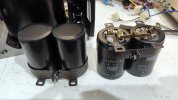
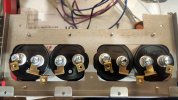
If I can I try to remove electrolytics out of the board, even polyester will be better then electolytics and polypropelene even better, but not something to pursuit over. Those big black caps are Panasonic polypropelene and new holes drilled to board.

I recently restored a AU-9900 & it was a workout just on the recap/transistors due to having to straighten all the leads to remove them. I can't imagine doing everything.
One board at the time, one value at the time. Because some boards are fragile, I usually cut parts out and suck out rest of the leg with pump.

Sansui is easy... I have done this to Pioneer M90a... never again!
 
Last edited:
One thing I recret on this, actually two; I did not do earlier, but second thing is, I do not have experience to alter capacitance values like "Leestereo" does with he's projects. I have no courage to drop in double size cap just like that.

What comes to the first point; Anyone who thinks amplifiers essence or "soul" is somehow lost, let me put it this way. 50-year old amp is not the same amp first owner bought and heard and what one have as a sound is just time and current gone through parts and let asure you, specially resistors in powersupply can be all over the spec, were current goes through it consumes carbon balls or strands that weld together over the years. noise comes from electric arc inside resistor. What I have found, it is resistors in "0V" or signal path that are in best shape, they got least amount of use.
For those who consider to have electrolytics swap, go for it, if you can go even further. doing full resistor swap made this amplifier real joy to listen, better then it was with all the fog in sound.
 
I do not have experience to alter capacitance values like "Leestereo" does with he's projects. I have no courage to drop in double size cap just like that.
I had already started doing this early on in my restorations, and like you I was unsure about how far I could go with value increases. Ben showed the way, and I subsequently used his excellent restoration technique, with a few tweaks of my own, to great effect. ;)
 
It's a labor of love.
It certainly helps to have professional rework equipment.
Absolutely....on both counts. I applaud the effort & tenacity. Some (many?) will poo-poo the idea of replacing every component, but it's great to see where someone did it & it noticeably improved the unit. I wish I had seen this before I did my 9900.....then again, maybe it's best I wasn't tempted......lol.

 
Back
Top Bottom