• The move to the new server is done. There are some software and database maintenance updates in process. This has us passing the hat around to help out. We appreciate any donations. Seriously, even a dollar helps. The payment page may be found here - https://www.audiokarma.org/support.html

AU-719 on the bench

As far as I can see the driver and outputstage of the 719 is similar to the 919 in topology, just less and different output transistors. And in speed a lot closer to the 919.
I could be wrong....
You're not wrong, that's an accurate description. ;) (One of the first if not the first outing for the 'Diamond Differential' circuitry ;) )
 
Last edited:
Really nice to see everything worked out in the end. Also curious what you think from a comparison with the X901.
Enjoy the music!
Who doesn't like a happy ending ?

I don't want to take anything away from the incredible job John has done with the 719 or to side-track his thread too much. Suffice to say that this may well be as good as the 719 can get, and that's exceptionally good indeed. If I was forced to pick I'd say my unrestored X901 is slightly more analytical but it's very close. To appreciate just what an achievement that is, the X901 is an α-X balanced amp with 8 more years of development from the 719/919.

John (Hyperion) is probably better placed than me to judge. He has a restored X701 (same as X901 but slightly less power) and my unrestored X901 waiting in line at his workshop.

One thing I can say is (on paper) the X901 has much less distortion than the very clean 719 or even the 919, both of which were lower again than the much improved 717. From the 07 series onwards Sansui became progressively more focused on a transparent, pure and unadulterated sound. I love it but we're all somewhere on a spectrum, the other extreme being those who prefer a Sansui tube amp through vintage speakers. They might consider the Source Direct button of the X901/X701, which bypasses all accessory circuits, such as subsonic filter, tone, muting or balance controls to connect source to output in a single leap, as something of a gimmick. I don't. For me it's Sansui's equivalent of the Milleneum Falcon's hyperspace or Tesla's ludicrous mode.
 
I am glad to see things work out so well. You know, it is said that the AU 719 is not much of an amplifier when compared to the AU 717 and to the topologically different AU 819 and 919 and here we have it being compared to an X balanced 901.

Cheers

Marc
I'll tell you my opinion when my 717 finally arrives. Those who have owned or listened to both the 717 and 719 often say it comes down to sound preference. The 719 is not as cutting edge as the 919 but it is an advancement on the 717. Both are dual mono amps. The 719 included the newly developed Diamond Differential circuit, had a little bit more power and less distortion. Externally they look almost identical but IMO the 717 is a bit prettier inside, with more black paint, though some of the 719s came with black transformer covers, mine didn't. Mostly it seems to me to come down to the 717 being TOTL for its year while the 719 was a bit over-shadowed by the very talented 919.

The fact that the 719 is being compared with an X901 says something.
 
Externally they look almost identical but IMO the 717 is a bit prettier inside, with more black paint, though some of the 719s came
They sure look a lot better inside, with the extra shielding on the small signal boards. I love the industrial design, even more from the au 919 and X1 which you could put on show in your living room with the hood off ( at least I could.)
And I never listened to one of these legendary amplifiers so I can't wait to hear your opinion about them.
But I think we have to realise that we listen with bias to, and an amplifier that looks so good can hardly sound less.
 
They sure look a lot better inside, with the extra shielding on the small signal boards. I love the industrial design, even more from the au 919 and X1 which you could put on show in your living room with the hood off ( at least I could.)
And I never listened to one of these legendary amplifiers so I can't wait to hear your opinion about them.
But I think we have to realise that we listen with bias to, and an amplifier that looks so good can hardly sound less.
There's a similar bias that lends more credence to a TOTL amp when a later amp may not be the TOTL but may be a good deal better musically. Improvements pioneered in the best amps find their way down to even the mass market. I try to only listen wth my ears. As for reliability, I joked with John that my poor, abused and neglected R-7 with its phono stage rusted away continues to be my most reliable Sansui.

Anyway, the AU-719 has been introduced to the TU-719 so we can expect a brood of little Sansuis.
 
AU-719 with black transformer covers vs AU-717 with even more black paint

iu

iu
 
Do you realize the AU-717 is missing the front RF shield? There should be a bit more "black paint" there. :D
View attachment 2172625
Yeah, I noticed that after I posted it, well spotted :thumbsup: I just grabbed a couple of images from google to make the point that with black covers on the transformers the layouts of the 719 and 717 are virtually identical.
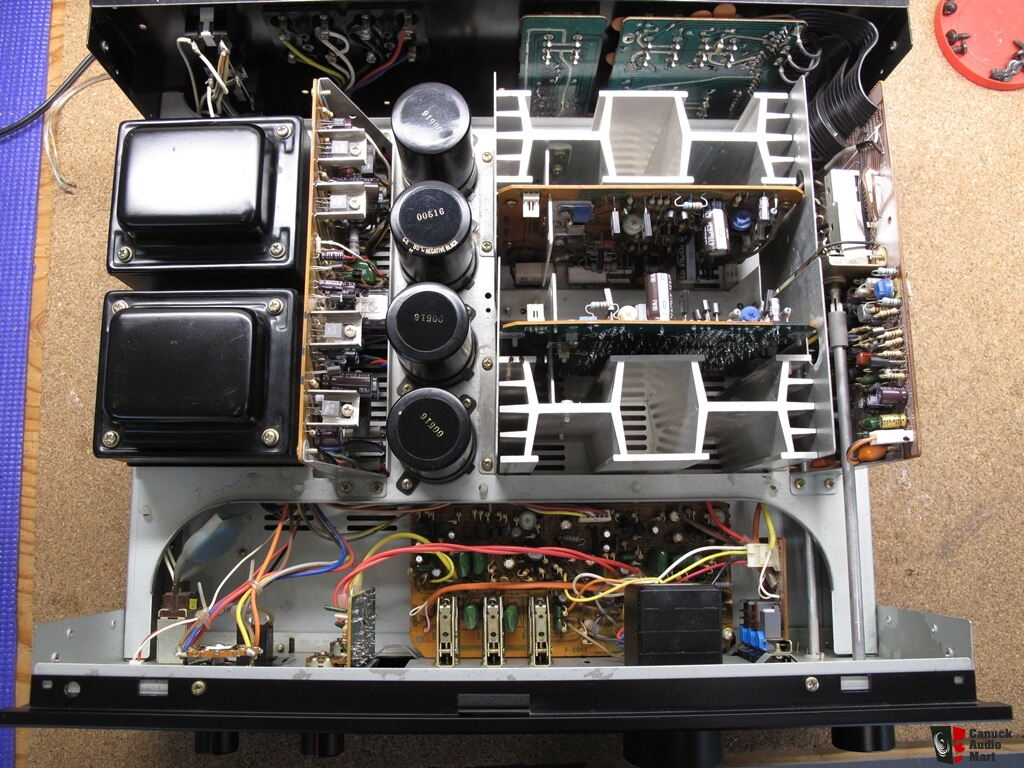
There's a popular fallacy that the 719 was less well made than the 717 but it seems Sansui used the same chassis, added a bit of DD circuitry and only dropped a couple of covers for the 719. The 717 also has the whole chassis painted black. Hardly a drop in build quality.

The 517 & 519 seem to use the same chassis/layout while the 819 is closer to the 919, though without the separate toroidal transformer to drive the output stage.

Interesting that the 517, 717, 519 & 719 were all true dual mono amps, while the 819 & 919 weren't ?

AU-519

1255385-20cd5992-sansui-au519-integrated-beauty.jpg


AU-517
iu


AU-819 & AU-919

AU-819_inside_2.JPG
iu
 
Interesting that the 517, 717, 519 & 719 were all true dual mono amps, while the 819 & 919 weren't ?
About this an interesting link here:
https://ishinolab.net/modules/doc_serial/audio_history_japan/serial001_010.html
This former Sansui engineer tells the story of the development starting with au 517/717 up to the first X-balanced amplifiers. His story is that they choose the dual mono because it was popular at that time. He is not a fan of the concept. Because every choice has its advantages and disadvantage.
Interesting read.
 
About this an interesting link here:
https://ishinolab.net/modules/doc_serial/audio_history_japan/serial001_010.html
This former Sansui engineer tells the story of the development starting with au 517/717 up to the first X-balanced amplifiers. His story is that they choose the dual mono because it was popular at that time. He is not a fan of the concept. Because every choice has its advantages and disadvantage.
Interesting read.
It's a great window into the mind of a product designer, and far too easy to get lost in. Took me back to Signal Theory in my 3rd and 4th years of Engineering. With his focus on TOTL amps there's not much on the 719, other than the DD circuit itself. I guess producing a lesser version of a new design isn't as intriguing. The 919 sure cast a long shadow. I also found his comments interesting regarding the popularity of receivers over integrated amps in the US. I don't remember seeing many receivers when I was growing up in Australia, nor do they seem to be popular in the UK or Europe generally. I wonder why that is ?

John, you've worked on the 717, 719 and 919. Would you describe the 719 as a 717 with the addition of DD circuitry or a 919 with lesser components ?
 
HI, everyboddy. I am new here. Please advise where should i post? I own a Sansui AU 719 which i want to recap & restore. I have put together a list of parts to order, but am not sure i picked up the correct ones. Need help!
 
HI, everyboddy. I am new here. Please advise where should i post? I own a Sansui AU 719 which i want to recap & restore. I have put together a list of parts to order, but am not sure i picked up the correct ones. Need help!
Well, you should start your own thread (in this sub forum) - not tag onto the end of another, then I am sure you will get lots of help. ;)

upload_2022-1-27_12-39-4.png

Can you see the 'post new thread' blue button over on the right?

Welcome to AK and especially the 'Exclusively Sansui' sub-forum. ;)
 
Last edited:
Here is a 'before' picture of the regulated PSU/Protector board - I had to remove the two largest electrolytics to make it easier to get the board out.

View attachment 2124881

And the completed board.
View attachment 2124883

Greetings Hyperion!

I couldn't help but notice the little label by the fuses which reads T 3.15A

Does that mean 3.15 Amp 250V fuses are installed there?

I'm having a hard time sourcing 7A fuses where I live, so I've put 5A in there for now.. but.. couldn't resist asking you about this particular board / label.
 

Attachments

  • image.png
    image.png
    137 bytes · Views: 6
Does that mean 3.15 Amp 250V fuses are installed there?
I honestly can't remember, the schematic says the lower fuse F601 should be a 5A, and there seems to be a paper label underneath the upper fuse F01 (and other fuses) which may have the required rating indicated on them. If you look at F04 - on the left, you can just see that it says 5A, so I think it is possible all the ones marked 7A on the schematic are all 5A, thinking back I am sure F601 was a 3.15A. I always remove all fuses, check their rating, clean them, and re-tension the clips - so if I found a wrong rating fuse, this would have triggered a memory - hence why I think that one was a 3.15A.

During testing I ran this amplifier to over 'full power', and had no 'nuisance' blowing of fuses, so I think the ratings as described above are good. ;)
 
Last edited:
Greetings Hyperion!

I couldn't help but notice the little label by the fuses which reads T 3.15A

Does that mean 3.15 Amp 250V fuses are installed there?

I'm having a hard time sourcing 7A fuses where I live, so I've put 5A in there for now.. but.. couldn't resist asking you about this particular board / label.
What you have to use depends on which version you have. The 3.15 label is for the AC main voltage and in this version that is 220/240.
From memory in my AU-719 the (soon to be) DC fuse holders also had a 7A label but I put 5A in.
 
Back
Top Bottom