• The move to the new server is done. There are some software and database maintenance updates in process. This has us passing the hat around to help out. We appreciate any donations. Seriously, even a dollar helps. The payment page may be found here - https://www.audiokarma.org/support.html

Audio Research VT130 - Where to begin?

bored184

AK Subscriber
Subscriber
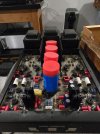
Just recently brought home a Audio Research VT130, it sadly did not come with tubes. Owner took it in on trade and claims that it worked when he took it in. It has not been power on in a number of years and I am wondering what steps I should do to bring this monster back to life? Overall condition is clean and I see no burn signs on the board.
VT130.jpg
 
Register to hide this ad
I'm sure the AR experts will chime in, but it looks to be in good shape. I'd get a schematic, a variac and a mulitmeter and start slowly bringing it without tubes to check for smoke and any power supply issues. Since it's SS rectified, you could start low and bring it up over a couple of days to maybe 80%, so you don't exceed the voltage ratings of the power supply caps. If you get what looks like the right voltage at the first cap, and the negative bias voltages check out, then you could add tubes and bring it up again, checking the voltages and watching for any red-plating on the output tubes.
 
Since it's SS rectified, you could start low and bring it up over a couple of days to maybe 80%, so you don't exceed the voltage ratings of the power supply caps.
I'm thinking SS doesn't require so much care. The cold amp would always briefly experience the full unloaded B+ voltage until the tubes conduct.

Jack
 

Check all power supply outputs.
 
Starting tomorrow I have three days to myself. My current plan is test all the capacitors before I even fire this things up. Once tested I will then bring it up slowly on variac. When I am confident to plug it in and turn it on directly or run it at 120V I will then use the schematic and test voltages in the power supply, first cap and bias voltages.

For the experts out there is this a reasonable plan? I have built / modified a few Dynacos in the past but I am still somewhat new to troubleshooting.

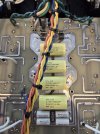
Speaking of capicitors, the arcdb website has set of instructions to upgrade the film caps. I saw them on the board and wondered if it was time to replace those. Any recommendations to current production caps I could use?
 
Should the yellow Rel-Cap caps be replace? I was hoping to unsolder one side and test them but for some reason they are being rather stubborn. power supply.jpg
 
Personally, I would not just shotgun replace any film caps without due cause, nor even electros, necessarily.

My strong suggestion is check what you can without dissasembly, eg voltage type measurements, get some tubes, see where it's at before throwing other parts at it.
 
Personally, I would not just shotgun replace any film caps without due cause, nor even electros, necessarily.

My strong suggestion is check what you can without dissasembly, eg voltage type measurements, get some tubes, see where it's at before throwing other parts at it.
At this point thats what I will end up doing. My thought process was because of age and the lack of use some capacitors may of gone bad because the board is marked 1993. I am learning though that Audio Research did not mess around and used quality parts back in the day. Would you recommend a slow power up with a variac?

Full set of tubes should be here tomorrow.
 
I've owned a lot of ARC preamps and amps. I can say, as a good generalization, that making modifications to ARC components really hurts their value. In fact, the Audio Research service department has a policy of not touching anything that has been modified.

The Rel and Wonder Caps should all be fine. To my previous comment, those are the first things I look at if I'm considering buying an ARC component as a first check that the unit is unmodified. It would be good to check the ESR of the 4 filter capacitors in the power supply section. If they check out okay, personally, I would leave them alone.

Yes, ARC used the best of the best components in their products. I've always wanted a VT-130.
 
Last edited:
I've worked on a bunch of these over the years.

One guy blew his up rolling the wrong tubes... (Nice one Jerry)... :(

There is VERY little needed to be done on this amp! Super reliable and high performance caps already installed.

DO NOT run the amp at less than 60% line for long periods as this can and will blow the regulators...

Ask me how I know!

I will sweep line voltage from zero to 20% taking about 10 seconds. Wait 15 seconds then Zero...wait 10 seconds.

Next sweep line from Zero to 30% taking 15 seconds wait 10 seconds then Zero. 40%, 50%, 60%, 70%.

All this time I'm measuring the B+ voltage on the main filter caps.

When I reach 70% I leave it running for a few minutes (The heaters are starting to conduct) looking at 6550 pentode Cathode current.

Now is the time to check each power tubes cathode current at 80%. This is where 6550 tube imbalance will start to show.

(It's actually a Voltage measurement across the cathode resistor that equates to 6550 current.)

Good time to check AC volts across the power filter, Excessive AC voltage (2 to 10 volts AC is a filter problem).

All this time you are "Reforming" the electrolytic capacitors in the power supply.

You can take a few hours to finally get to 110-120 volts AC line.

This is where poor condition worn power tubes will show up with minimal or less than spec current draw.

Hope that helps.

Buck

PS: This is a great sounding and very reliable amplifier. Clean sweet extended top end with tons of power! A life time keeper!

Edit: You can see the "Soft Start" thermistor just above the left hand two diodes. Careful they get hot, But check closely for condition.

 
Last edited:
Looks like the heat management is a little better than the D70 on my bench at the moment. That one has a 6550 regulator parked so close to one of those blue beer cans that it develops a tan. I replaced them for age and signs of heat stress, but they did measure OK within my ability to check them.


Vaguely on the topic, does anyone have a source for those red caps? The ones on the D70 are MIA, probably crumbled to dust long ago.
 
I've worked on a bunch of these over the years.

One guy blew his up rolling the wrong tubes... (Nice one Jerry)... :(

There is VERY little needed to be done on this amp! Super reliable and high performance caps already installed.

DO NOT run the amp at less than 60% line for long periods as this can and will blow the regulators...

Ask me how I know!

I will sweep line voltage from zero to 20% taking about 10 seconds. Wait 15 seconds then Zero...wait 10 seconds.

Next sweep line from Zero to 30% taking 15 seconds wait 10 seconds then Zero. 40%, 50%, 60%, 70%.

All this time I'm measuring the B+ voltage on the main filter caps.

When I reach 70% I leave it running for a few minutes (The heaters are starting to conduct) looking at 6550 pentode Cathode current.

Now is the time to check each power tubes cathode current at 80%. This is where 6550 tube imbalance will start to show.

(It's actually a Voltage measurement across the cathode resistor that equates to 6550 current.)

Good time to check AC volts across the power filter, Excessive AC voltage (2 to 10 volts AC is a filter problem).

All this time you are "Reforming" the electrolytic capacitors in the power supply.

You can take a few hours to finally get to 110-120 volts AC line.

This is where poor condition worn power tubes will show up with minimal or less than spec current draw.

Hope that helps.

Buck

PS: This is a great sounding and very reliable amplifier. Clean sweet extended top end with tons of power! A life time keeper!

Edit: You can see the "Soft Start" thermistor just above the left hand two diodes. Careful they get hot, But check closely for condition.
This is exactly what I needed, thank you! Did you do your sweeps with the tubes installed and when you say 20% do you mean 20% of 120V? For example 120V x .20 = 24V


When I picked up the amp it didn't come with tubes so I have a 8 matching EH 6550s, 2 matching JJ 12bh7a, and 4 matching JJ 6922 on order. Theoretically they should be here tomorrow.
 
Yes, Tubes installed and 20% of line voltage or 24V.

Having new tubes will make things easier.

The "Red" caps are usually Wima's, Nothing special but their narrow form factor makes Axial replacements a little harder.
 
I believe thats what they are, but all the sources I've found seem to be for 100+. I only need 2. Was hoping someone might know where to get them by the piece.
 
@gadget73

Where I work we get lots of hoses, fittings, and components with caplugs that are subsequently discarded during the assembly process.

If you knew the ID you needed I could check around if there might be some that would work.
 
The last 10 times I needed Caps like that I took my "Discharged" cap to the hardware store... Then to the grocery store,

One time it was some frozen Orange juice containers, Few times it was a candy container, PVC worked...

Fixed a preamp and it had a funny looking part that when removed it was a PEZ dispenser... lol.
 
Back
Top Bottom