• The move to the new server is done. There are some software and database maintenance updates in process. This has us passing the hat around to help out. We appreciate any donations. Seriously, even a dollar helps. The payment page may be found here - https://www.audiokarma.org/support.html

Audio Research VT130 - Where to begin?

@gadget73

Where I work we get lots of hoses, fittings, and components with caplugs that are subsequently discarded during the assembly process.

If you knew the ID you needed I could check around if there might be some that would work.
pretty sure its 2". The capacitors are 51mm diameter, and it needs two wires to sneak under the edge.

The usual places all either seem to have not quite it, significant quantities, or both.
 
I have always ditched those plastic caps when doing ARC repairs and restorations. They looked like s**t, even when new. By now, they're usually warped and singed and look even worse.

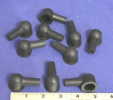
I use these 90° terminal boots on my vintage bikes for battery, magneto and generator connections. They come in lots of sizes and styles, and are easily available.
Make for a neat, tidy replacement.

1786144444191.png1786144492024.png
 
Last edited:
hm, thats an idea. I'll have a look for those. I agree the stock caps look crappy but I want something there.
 
I can check our supplies we have tons of them. They come-on tube fittings and valves from Allen Aircraft and Swagelok. We have tons of them and mostly throw them away now. 2"

What I have used as well is clear PVC caps from Amazon. The are much more durable, and I order them in clear, so the capacitor is viewable. for those Can Caps that the outer cases have voltages, I use a heavy clear heat shrink, and then the clear cap on top.
 
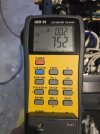
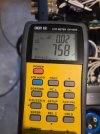
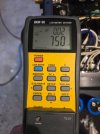
Here are my capacitor and ESR values. These are labeled 800uf - 10 +50%.
My multimeter which is a a EEVblog BM786 measures the capacitance of these much higher then the DE-5000. The DE-5000 is new and I am still in the process of learning to to use it.

Update: Tubes will not be here today. They are still hanging out in Indy.
signal-2026-08-08-08-29-06-450_002.jpg
 

Attachments

  • signal-2026-08-08-08-29-06-450_003.jpg
    signal-2026-08-08-08-29-06-450_003.jpg
    93.6 KB · Views: 3
  • signal-2026-08-08-08-29-06-450_004.jpg
    signal-2026-08-08-08-29-06-450_004.jpg
    94.4 KB · Views: 2
  • signal-2026-08-08-08-29-06-450.jpg
    signal-2026-08-08-08-29-06-450.jpg
    88.9 KB · Views: 2
Last edited:
I can check our supplies we have tons of them. They come-on tube fittings and valves from Allen Aircraft and Swagelok. We have tons of them and mostly throw them away now. 2"

Where I work we get lots of hoses, fittings, and components with caplugs that are subsequently discarded during the assembly process.

I appreciate both of you very much. This one isn't my amp, I'm just trying to get it as right as I can for it's owner. Still need to get back to this, hard to sit and suffer in the workshop when its 97 with a 112 heat index. No AC out there, and I deal with those temps all week at work. Kind of hard to drum up motivation to do more of it on the weekend.

Back on topic, just at a glance those measurements on OP's main caps look OK to me. Pretty low ESR for a cap that large and its within tolerance. Modern caps do seem to test below marked value, sometimes fairly close to the bottom edge of tolerance.
 
I've worked on a bunch of these over the years.

One guy blew his up rolling the wrong tubes... (Nice one Jerry)... :(

There is VERY little needed to be done on this amp! Super reliable and high performance caps already installed.

DO NOT run the amp at less than 60% line for long periods as this can and will blow the regulators...

Ask me how I know!

I will sweep line voltage from zero to 20% taking about 10 seconds. Wait 15 seconds then Zero...wait 10 seconds.

Next sweep line from Zero to 30% taking 15 seconds wait 10 seconds then Zero. 40%, 50%, 60%, 70%.

All this time I'm measuring the B+ voltage on the main filter caps.

When I reach 70% I leave it running for a few minutes (The heaters are starting to conduct) looking at 6550 pentode Cathode current.

Now is the time to check each power tubes cathode current at 80%. This is where 6550 tube imbalance will start to show.

(It's actually a Voltage measurement across the cathode resistor that equates to 6550 current.)

Good time to check AC volts across the power filter, Excessive AC voltage (2 to 10 volts AC is a filter problem).

All this time you are "Reforming" the electrolytic capacitors in the power supply.

You can take a few hours to finally get to 110-120 volts AC line.

This is where poor condition worn power tubes will show up with minimal or less than spec current draw.

Hope that helps.

Buck

PS: This is a great sounding and very reliable amplifier. Clean sweet extended top end with tons of power! A life time keeper!

Edit: You can see the "Soft Start" thermistor just above the left hand two diodes. Careful they get hot, But check closely for condition.

I knew someone with more knowledge of these amps would chime in. Much better than my advice!
 
I've worked on a bunch of these over the years.

One guy blew his up rolling the wrong tubes... (Nice one Jerry)... :(

There is VERY little needed to be done on this amp! Super reliable and high performance caps already installed.

DO NOT run the amp at less than 60% line for long periods as this can and will blow the regulators...

Ask me how I know!

I will sweep line voltage from zero to 20% taking about 10 seconds. Wait 15 seconds then Zero...wait 10 seconds.

Next sweep line from Zero to 30% taking 15 seconds wait 10 seconds then Zero. 40%, 50%, 60%, 70%.

All this time I'm measuring the B+ voltage on the main filter caps.

When I reach 70% I leave it running for a few minutes (The heaters are starting to conduct) looking at 6550 pentode Cathode current.

Now is the time to check each power tubes cathode current at 80%. This is where 6550 tube imbalance will start to show.

(It's actually a Voltage measurement across the cathode resistor that equates to 6550 current.)

Good time to check AC volts across the power filter, Excessive AC voltage (2 to 10 volts AC is a filter problem).

All this time you are "Reforming" the electrolytic capacitors in the power supply.

You can take a few hours to finally get to 110-120 volts AC line.

This is where poor condition worn power tubes will show up with minimal or less than spec current draw.

Hope that helps.

Buck

PS: This is a great sounding and very reliable amplifier. Clean sweet extended top end with tons of power! A life time keeper!

Edit: You can see the "Soft Start" thermistor just above the left hand two diodes. Careful they get hot, But check closely for condition.
If I am looking at the schematic correctly voltage at the main filter caps should be 450V, correct?

What voltage should I see across the cathode resistor? EDITED- Should be the 65mv correct?
 
Last edited:
Just a suggestion regarding reliability re 12BH7's, as a failure of this tube, as used in this circuit position, could be both spectacular and expensive.

JJ 12BH7's have proven to be less than optimum in most applications. They either misbehave or fail entirely.
I do not know whether this is due to an inability to operate at original ratings or to match the characteristic curves of the original types. In any event, the reasons are immaterial.

I would strongly recommend that you use NOS 12BH7's manufactured in Canada, USA or Asia.

The JJ E88CC/6922/6DJ8, on the other hand, is a very good tube, and is generally unconditionally stable and reliable.

I love the glow of tubes in the dark, it's kinda like the smell of Napalm in the morning :)
 
Just a suggestion regarding reliability re 12BH7's, as a failure of this tube, as used in this circuit position, could be both spectacular and expensive.

JJ 12BH7's have proven to be less than optimum in most applications. They either misbehave or fail entirely.
I do not know whether this is due to an inability to operate at original ratings or to match the characteristic curves of the original types. In any event, the reasons are immaterial.

I would strongly recommend that you use NOS 12BH7's manufactured in Canada, USA or Asia.

The JJ E88CC/6922/6DJ8, on the other hand, is a very good tube, and is generally unconditionally stable and reliable.

I love the glow of tubes in the dark, it's kinda like the smell of Napalm in the morning :)
That aint good, I appreciate the advice. How about the current production EH 12BH7s, are they just as problematic?
 
Do the heaters in these run 6v or 12v ? If its 6v, you could get an adapter for a 12au7 to a 6cg7 and run 6GU7 tubes. Same heater pinout difference, and a 6GU7 is a 6 volt only 12BH7. They tend to be cheap too. I've picked up several for a dollar each.


just a thought if you want more options
 
What would be the ideal tube compliment for this amp?

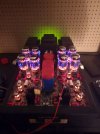
The current setup is 8x matched EH6550, 2x JJ 12BH7 and 4x JJ 6922.
 
What would be the ideal tube compliment for this amp?

The current setup is 8x matched EH6550, 2x JJ 12BH7 and 4x JJ 6922.
I believe ARC originally shipped this amp with Sovtek 6550 tubes.

I'm using EH 6550 tubes in one of my amps (not ARC) and have been very happy with them. The EH 6550 tubes are good, so I'd say just keep them. Vintage RCA 12BH7 and Amperex 6922 tubes would probably be really nice.
 
It has been a while since I have ran some 6550 tubes, but in the amp that I did and from rolling a few types I ended up liking Svetlana Wing C best.
 
I believe ARC originally shipped this amp with Sovtek 6550 tubes.

I'm using EH 6550 tubes in one of my amps (not ARC) and have been very happy with them. The EH 6550 tubes are good, so I'd say just keep them. Vintage RCA 12BH7 and Amperex 6922 tubes would probably be really nice.
I have a set of RCA 12BH7s in the mail now.


I hooked up the speakers last night to my test set and I have static coming from my left speakers. These are brand new tubes so, could there be a break in period or microphonics happening? I will start swapping tubes this evening to see if the static follows a tube to the right channel.
 
Back
Top Bottom