• The move to the new server is done. There are some software and database maintenance updates in process. This has us passing the hat around to help out. We appreciate any donations. Seriously, even a dollar helps. The payment page may be found here - https://www.audiokarma.org/support.html

Audio Research VT130 - Where to begin?

I have a set of RCA 12BH7s in the mail now.


I hooked up the speakers last night to my test set and I have static coming from my left speakers. These are brand new tubes so, could there be a break in period or microphonics happening? I will start swapping tubes this evening to see if the static follows a tube to the right channel.

The tube sockets in this era of ARC equipment were not great.

Give each tube a wiggle while the unit is operating to see if you can localise the problem, or just insert and remove all of the tubes from their sockets several times to see if it helps.

I regularly have to give the tubes in my ARC VS110 a wiggle to get rid of static and crackles. I have more than enough Belton sockets (these are drop-in replacements) in stock to replace them, but laziness prevails...
 
I have a set of RCA 12BH7s in the mail now.


I hooked up the speakers last night to my test set and I have static coming from my left speakers. These are brand new tubes so, could there be a break in period or microphonics happening? I will start swapping tubes this evening to see if the static follows a tube to the right channel.
I would suggest pulling the tubes, cleaning the pins and sockets. Install the tubes and check again. If the problem continues, swap the tubes from right to left. Before swapping the power tubes, drop the bias point then re-bias the tubes in their new locations.

More hours, or break in, will not make things better.
 
I always give my old tubes a light sanding with emery cloth, enough to clean them, but not remove metal. Then I plug them in. Paul.
 
If you wish to replace the sockets (I would), I strongly recommend the Belton brand. Absolute top quality, easily available and very reasonably priced.

These are the models you will need:

VT8-PT
VT9-PT

 
If you don't have emery cloth, just use a small piece of aluminum foil and rub the pins like you would with the emery cloth. Just about everyone has foil in their home.
 
I would suggest pulling the tubes, cleaning the pins and sockets. Install the tubes and check again. If the problem continues, swap the tubes from right to left. Before swapping the power tubes, drop the bias point then re-bias the tubes in their new locations.

More hours, or break in, will not make things better.
What is the best way to clean tube sockets? I have some deoxit somewhere but I do not have anything to clean the inside of the sockets with.
 
Bringing this back to the top. I cleaned the sockets with a dental brush and deoxit. Ive been running the amp for a while and even though the ripping sound is gone the left channel is weak and distorted. I have cleaned the volume and balance controls on my pre with deoxit, ran it in mono, swapped speaker cables (followed left channel), changed sources. I only noticed the distortion today when I changed CDs.

I only have one pre with balanced outputs that can be connected to the amp.
 
I don't know what you have on hand, but I use salvaged transformer-type DI boxes when I need to go from single-ended to balanced. Not real hi-fi, but it will get the job done.
 
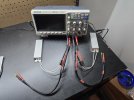
What is the best way to connect this amps outputs to a oscilloscope? My end goal at the moment is to visually see the weak distorted channel. In the first photo is my current thought process. Those are 8ohm 100W dummy loads.

1329.jpg
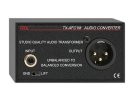
Second, with the input being balanced input only I have a pair of these to change the output of my signal generator to a balanced output. There is a switch that selects GND or LIFT, if I do use these going into the amp and then into the oscilloscope where should that switch be located?
tx-afc1m.jpg
 
The scope could be connected with two probes ( zero and 8 ohm) and adding the two probes on the scope. This is the full signal
Or if using one channel only, use 4 ohm as ground and connect to the 8 ohm outlet. You will see half the signal.
 
The scope could be connected with two probes ( zero and 8 ohm) and adding the two probes on the scope. This is the full signal
Or if using one channel only, use 4 ohm as ground and connect to the 8 ohm outlet. You will see half the signal.
Is my current setup not full signal? I have the left channel going to channel one and the right channel going to channel two. Red banana plugs would go to the 8ohm tap where black would go to ground.
 
On some amps, and some ARC in particular come to mind, I think it's a bit trickier since the grounded taps aren't necessarily the same as where you might normally connect the speakers.

Don't know off top of my head how that plays in but hopefully someone chimes in to clarify what I'm trying to say.
 
On some amps, and some ARC in particular come to mind, I think it's a bit trickier since the grounded taps aren't necessarily the same as where you might normally connect the speakers.

Don't know off top of my head how that plays in but hopefully someone chimes in to clarify what I'm trying to say.
Correct, in this case I want to say the 4ohm tap is the grounded tap. Would I connect the black banana plugs to the 4ohm tap?
 
The tube sockets in this era of ARC equipment were not great.

Give each tube a wiggle while the unit is operating to see if you can localise the problem, or just insert and remove all of the tubes from their sockets several times to see if it helps.

I regularly have to give the tubes in my ARC VS110 a wiggle to get rid of static and crackles. I have more than enough Belton sockets (these are drop-in replacements) in stock to replace them, but laziness prevails...
Well, then, get off your rusty dusty oldie mouldy goldie and swap those babies out, dag nabbit!
 
Last edited:
Is this how to solve my problem?
 
Last edited:
Back
Top Bottom