Get the 1240 instead, or the other similar clones like Reloop 7000, Stanton St150 etc. No point in investing in the AT120, at least not an amount that is very close to the price difference with the tts mentioned above that are the next level oem's and don't have the issues AT120 has.I was impressed how much space for improvement this TT have.
...All of that mods cost no more then $100.


You are using an out of date browser. It may not display this or other websites correctly.
You should upgrade or use an alternative browser.
You should upgrade or use an alternative browser.
Audio Technica AT-LP120USB Super Mod Thread
- Thread starter vincei
- Start date

FileFixer
Well-Known Member
Get the 1240 instead, or the other similar clones like Reloop 7000, Stanton St150 etc. No point in investing in the AT120, at least not an amount that is very close to the price difference with the tts mentioned above that are the next level oem's and don't have the issues AT120 has.
What I can to expect more from that LP-1240 if I want this..? Without good DIYing it`s not possible to do that what I actually have from my LP-120.

Last edited:
^^^
One basic thing - you can't eliminate LP120's clanging motor sound whatever you do. Music covers it but it's still there, you can hear it between songs. For me it defeats all the efforts for improving the stock form of this table. 1240 looks less attractive but does not have this issue, it is much closer to Technics 1210.
One basic thing - you can't eliminate LP120's clanging motor sound whatever you do. Music covers it but it's still there, you can hear it between songs. For me it defeats all the efforts for improving the stock form of this table. 1240 looks less attractive but does not have this issue, it is much closer to Technics 1210.
FileFixer
Well-Known Member
You are wrong, I also eliminate that sound from motor. Only sound what I have sometime from motor is sound like rumble but it isnt rumble sound it is sound from motor in situation when motor try to speed up on normal speed and try to catch that speed and synchronize it but this sound happen only when I push cleaning brush too hard on record and platter speeding down but this happen only for few seconds after that. When platter cathr right speed, nothing happen after that on dead wax and very quiet music.
FileFixer
Well-Known Member
Not sure if we both speak about the same sound, something like "clonk clonk", like it needs grease. If that's the sound - how do you eliminate it?
That sound "clonk clonk" I hear only few second after pushing harder cleanining brush on record. When servo catch right speed I dont hear any sound like rumble. It`s complete dead. When I bought LP120 I hear rumble on speakers which is different sounding than this sound when I clean record but this "clonk clonk" sound I never have on LP120 when play record. When I finish complete damping, dampened tonearm and place slip mat under cork/rubber mat I dont hear anything else like rumble. Motor inside TT also no more stay on metal plate under platter then stay on dampening material. This material is placed between that metal plate and stands for motor. Also metal plate under platter does not stay directly on plastic then stay on tiny rubber which is between that metal plate and plastic.

Steven Levey
New Member
Hello, I've gone through the pages on line regarding mods to the AT-120 and I am very appreciative of the videos on the phono preamp removal, which I followed carefully and accomplished. I did not replace the line-out in the process because a larger diameter phone plug line fit poorly into the lock down clamp in the turntable. Although I wished I had put in a female adaptor on the outside of the base to plug line-out phone plugs. But I had none available at the time. There were a few other mods that I made: (1) removing the stock very soft adjustable feet, which, along with the stock preamp really absorb a great deal of clarity, bass, etc. and replacing them with the rubber anti-vibration blocks (in the photo). (2) Upgrading the cartridge with the Ortofon 2M Blue. I had initially added the Ortofon and was unhappy with it, which was frustrating, until I replaced the stock feet and the preamp. (3) I added the heavier AT tonearm counter weight and an (4) acrylic platter to the top of the felt one that came with the turntable along with a (5) good record clamp. It is recommended to add a good record clamp when using the acrylic platter to avoid slippage. One more thing needs doing and as of yest, I haven't figured out how to put in an end of record tonearm lift. I've been a vinyl lover since the 70's and have restored a number of decent turntables over the years, but having made the mods I made on the AT 120 was the most satisfying in the quality of the results (given how little I spent) when compared to how the AT originally sounded. Now, all of this may sound expensive, especially given the ($250) price of the AT-120, but the only real expense was the cartridge (although I did well with that-$175). The rest of the mods were all $80. Finally, I am using the Schiit Mani phono preamp and it is very good ($120) from the Schiit web site.
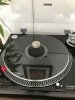 In any case, my favorite parts sites are Audio Advisor and turntablesneedles.com. The latter site is quite amazing.
In any case, my favorite parts sites are Audio Advisor and turntablesneedles.com. The latter site is quite amazing.
Last edited:
Steven Levey
New Member
Any ideas on a workable/fairly inexpensive end of record tonearm lift? The platter comes so close to the tonearm board that it seems nearly impossible to fit some kind of lift in that space.
Steven Levey
New Member
I would also add, as regards those who have motor noise or out of round platters: I've not experienced this and before doing mods and ruining your warranty, you should have returned the table rather than attempting repairs. Also, after looking into the Qup end of record arm lift and taking the measurements offered, I decided to order one, having noticed that it may work, with a little "carving", on the arm board. The thing is, again having refurbished a number of older tables, the quietest and smoothest operating are those with the least mechanical linkage and part of the reason the mods work on the AT 120, is when the preamp and feet are changed, this becomes a very simple and clean sounding unit.
AnzacSonata
Super Member
I own an LP120 and always wondered about this anti-skating thing based on everything I've read...perhaps someone could help me out with a question I have.
I have the stock AT95E cart dialed in via digital gauge to 2.35 grams of tracking force (to combat sibilance I experience with this cart) with an anti-skate setting a tad bit over that. Since owning this turntable, I never experienced the arm flying towards the spindle or any crazy behavior like that, and my LPs always end with the arm slowly moving to the spindle from the runout grooves (I don't really find that the stylus jumps rapidly inward when I lower it to the lead-in grooves, either) -- never rapidly. How is one to know if the AS is working right on this turntable or not? Would I experience what I'm experiencing if the control was out of whack?
Does any of this have anything to do with the constant inner groove distortion I experience since owning this deck/cart combo?
I have the stock AT95E cart dialed in via digital gauge to 2.35 grams of tracking force (to combat sibilance I experience with this cart) with an anti-skate setting a tad bit over that. Since owning this turntable, I never experienced the arm flying towards the spindle or any crazy behavior like that, and my LPs always end with the arm slowly moving to the spindle from the runout grooves (I don't really find that the stylus jumps rapidly inward when I lower it to the lead-in grooves, either) -- never rapidly. How is one to know if the AS is working right on this turntable or not? Would I experience what I'm experiencing if the control was out of whack?
Does any of this have anything to do with the constant inner groove distortion I experience since owning this deck/cart combo?
FileFixer
Well-Known Member
Use blank record or any CD and put stylus on it. If you put antiskate knob on higher values then stylus gone outward, if you put antiskate knob on lower values then sylus gone inward. This is method how you can to see does your antiskate work or not. With working antiskate you can to control where your sylus gone, inward or outward spindle.
And yes, inappropriate antiskate can to produce IGD and other distorsions as wrong tonearm alignment.
And yes, inappropriate antiskate can to produce IGD and other distorsions as wrong tonearm alignment.
AnzacSonata
Super Member
Fixer,
I was told that AS does NOT affect inner groove distortion; this isn't true?
I was told that AS does NOT affect inner groove distortion; this isn't true?
FileFixer
Well-Known Member
In particulary phrase IGD (Inner Groove Distorsion) is distortion what happend because stylii can not to follow groove wall on that inner groves because that this grooves is too much stiff in opposite to outer grooves but all grooves must have same modulation. In that case stylii must to follow any modulation on side walls but it cant and for that reason it loose data in sound and create distortion.
On other side... Antiskate is needed to place stylii between two groove walls and help stylii to follow walls at same precision. So, what happen if you have too much skate force on inward walls? You can to follow inside walls with good precision but outside walls does not have too much pressure from stylii to read all modulation and for that reason you have distortion on right channel in inner grooves. Outer grooves have lower sensitivity then inner grooves because that outer grooves have higher space into grooves and stylii are able to follow it without any error.
Antiskate is only one point to catch good sound with low distorsion. You need to make good alignment, VTF and azymuth.
Sorry if I wrong with some words, English is not my primary language.
On other side... Antiskate is needed to place stylii between two groove walls and help stylii to follow walls at same precision. So, what happen if you have too much skate force on inward walls? You can to follow inside walls with good precision but outside walls does not have too much pressure from stylii to read all modulation and for that reason you have distortion on right channel in inner grooves. Outer grooves have lower sensitivity then inner grooves because that outer grooves have higher space into grooves and stylii are able to follow it without any error.
Antiskate is only one point to catch good sound with low distorsion. You need to make good alignment, VTF and azymuth.
Sorry if I wrong with some words, English is not my primary language.
Last edited:
AnzacSonata
Super Member
In particulary phrase IGD (Inner Groove Distorsion) is distortion what happend because stylii can not to follow groove wall on that inner groves because that this grooves is too much stiff in opposite to outer grooves but all grooves must have same modulation. In that case stylii must to follow any modulation on side walls but it cant and for that reason it loose data in sound and create distortion.
On other side... Antiskate is needed to place stylii between two groove walls and help stylii to follow walls at same precision. So, what happen if you have too much skate force on inward walls? You can to follow inside walls with good precision but outside walls does not have too much pressure from stylii to read all modulation and for that reason you have distortion on right channel in inner grooves. Outer grooves have lower sensitivity then inner grooves because that outer grooves have higher space into grooves and stylii are able to follow it without any error.
Antiskate is only one point to catch good sound with low distorsion. You need to make good alignment, VTF and azymuth.
Sorry if I wrong with some words, English is not my primary language.
So in your opinion, would lowering or raising AS help with end of side distortion?
I don't get distortion in any one specific channel in the inner grooves -- it's just a mess of severely clipped, sibilant, distorted vocals when the arm is approaching the end of a side...
FileFixer
Well-Known Member
It can help but only if you do all previous alignment properly. On mine AT-LP120 with AT95E I dont have any IGD if I set VTF on 2g. Also I have a same cartridge on SL-1900 TT with same VTF and without any IGD. You can first to try different alignment method. AT-LP120 TT does not have 215mm pivot to spindle distance, it have 214,15mm pivot to spindle distance.
When I bought AT-LP120 TT I also have sibilance and IGD but after research and measure real state on this TT I never have any IGD and sibilance when I do right alignment.
http://audiokarma.org/forums/index.php?threads/how-to-properly-setup-your-at-lp120-usb.795926/
When I bought AT-LP120 TT I also have sibilance and IGD but after research and measure real state on this TT I never have any IGD and sibilance when I do right alignment.
http://audiokarma.org/forums/index.php?threads/how-to-properly-setup-your-at-lp120-usb.795926/

yauller
New Member
I came back to this post since I've had my AT-LP120 for about a year now and by reading all your comments I think I must be deaf. :'D
I have a very basic setup of the AT-LP120 (stock), a couple of Audioengine A5+, a Little Dot MKII as a buffer preamp and sometimes I use it to plug in my Beyerdynamic DT880 Pro (the 600 omh version) and I just love the sound of it all.
Of course, when you come from MP3's and CDs in car stereos, you probably don't have a trained ear and pretty much anything you hear on a turntable will sound better. I wish I had the skill to perform some of the upgrades you are referring to in this post. If I'm happy with it as it is, I can only dream of what it sounds like after performing the mods listed in here.
I have a very basic setup of the AT-LP120 (stock), a couple of Audioengine A5+, a Little Dot MKII as a buffer preamp and sometimes I use it to plug in my Beyerdynamic DT880 Pro (the 600 omh version) and I just love the sound of it all.
Of course, when you come from MP3's and CDs in car stereos, you probably don't have a trained ear and pretty much anything you hear on a turntable will sound better. I wish I had the skill to perform some of the upgrades you are referring to in this post. If I'm happy with it as it is, I can only dream of what it sounds like after performing the mods listed in here.
AnzacSonata
Super Member
I think I must be deaf. :'D
Perhaps; I just received a BRAND NEW 180 gram reissue of the Eagles' Hotel California from my wife for my birthday, and this BRAND NEW SEALED IN THE WRAPPER LP still exhibited NASTY end-of-side shrillness and distortion on tracks like "Wasted Time" and "The Last Resort." This is with using a not-burned-out-yet AT95e...
I have a very basic setup of the AT-LP120 (stock), a couple of Audioengine A5+, a Little Dot MKII as a buffer preamp and sometimes I use it to plug in my Beyerdynamic DT880 Pro (the 600 omh version) and I just love the sound of it all.
Then perhaps it's your downstream gear that's better than mine -- my AT-LP120 is going into an Onkyo stereo receiver's dedicated phono input (albeit with some RCA "couplers" to extend the 120's short-ish RCA cables) and I do not experience "loving-worthy" sound, especially on end-of-side tracks...
Of course, when you come from MP3's and CDs in car stereos, you probably don't have a trained ear and pretty much anything you hear on a turntable will sound better. I wish I had the skill to perform some of the upgrades you are referring to in this post. If I'm happy with it as it is, I can only dream of what it sounds like after performing the mods listed in here.
I can give you coming off MP3s perhaps (though, I must say, many MP3 downloads I have done and played back via CD-R discs sound WAY better than some of the vinyl I own), but I disagree that CD (even in a car stereo) HAS to sound "worse" than what one would hear on a turntable...
AnzacSonata
Super Member
It can help but only if you do all previous alignment properly. On mine AT-LP120 with AT95E I dont have any IGD if I set VTF on 2g. Also I have a same cartridge on SL-1900 TT with same VTF and without any IGD. You can first to try different alignment method. AT-LP120 TT does not have 215mm pivot to spindle distance, it have 214,15mm pivot to spindle distance.
When I bought AT-LP120 TT I also have sibilance and IGD but after research and measure real state on this TT I never have any IGD and sibilance when I do right alignment.
http://audiokarma.org/forums/index.php?threads/how-to-properly-setup-your-at-lp120-usb.795926/
That's very surprising. No matter how many times I re-align this cart or add tracking weight to the 95 (which was recommended to me in order to combat sibilance and pinching distortion) I can't get it to track without some kind of annoying shrillness; I probably have to look beyond this cart for a fine line stylus shape.