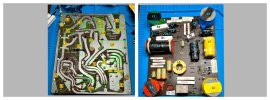
This is my experience with recapping the cross-over boards on my B&W 802 Series 80 speakers.
I’m the original owner of these speakers that I purchased back in 1982. All the tweeter, mid and base drivers on both speakers are still in excellent condition. However the components on the cross-overs I suspected were not.
After 40 years, I decided to try improving the sound quality on them by replacing all the electrolytic capacitors on the cross-over board but not any of the film capacitors. Access to the cross-over is from the bottom of the speaker cabinet. I replace each non polarized capacitor with an equivalent value one that I could get from Parts Express and MadisoundSpeakerStore.com. The outcome of this initial phase of the retrofit was a boomy base that was unpleasant sounding.
In the early 1980s, B&W used the ELCAP non polarized capacitors for their speakers that had rather high values for ESR. B&W at that time designed their cross-over circuit taking into account the higher ESR values. Nowadays non polarized capacitors typically have much lower ESR values.
To eliminate the resonance in the base and mid, I decided to add an external resistor in series with each of the 3 shunting capacitors in the cross-over to increase the ESR back to their original values. To determine what value external resistor to use, I measured the ESR value on both the original and the new replacements non polarized capacitors and use the difference. I did the measurements using a Peak Atlas ESR70 ESR & Capacitance Meter.
My only reservation is that hopefully the 40 year old ELCAP ESR value did not drift too far away from their original value.
The resulting sound after I added the extra 3 resistors was stunning. The added resistors dampened the resonance in the cross-over network and now these speakers are producing tight base sound again. I don't remember them sounding any better. Unfortunately I don't have the equipment or facility to measure the retrofitted speaker's frequency sweep response to confirm that.
Overall, I’m very happy with this relatively inexpensive retrofit. The sound on these vintage B&W 802 Series 80 speakers have been restored to what I optimistically could hope for. They sound fantastic to my ears when paired with my newly acquired Fosi Audio V3 amplifier. These are my favorite speakers again.
Hopefully this will benefit others who are attempting to do a similar retrofit to rescue some great vintage speakers.
Here are the details of the retrofit:
Schematic
I was not able to find the schematic for the B&W 802 Series 80 anywhere. However I was able to find the schematic for the larger model in the series, the B&W 801 Series 80, which used basically the same cross-over circuit but with different component values. The extra resistors were added to C6 and C2 in the base section and C1 in the mid section. C3 already had an 8 ohm resistor in series with it so I didn't bother adding one to it.
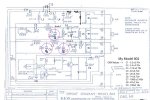
Resistors Added

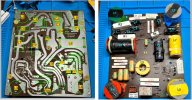
Cross-over Board
I’m the original owner of these speakers that I purchased back in 1982. All the tweeter, mid and base drivers on both speakers are still in excellent condition. However the components on the cross-overs I suspected were not.
After 40 years, I decided to try improving the sound quality on them by replacing all the electrolytic capacitors on the cross-over board but not any of the film capacitors. Access to the cross-over is from the bottom of the speaker cabinet. I replace each non polarized capacitor with an equivalent value one that I could get from Parts Express and MadisoundSpeakerStore.com. The outcome of this initial phase of the retrofit was a boomy base that was unpleasant sounding.
In the early 1980s, B&W used the ELCAP non polarized capacitors for their speakers that had rather high values for ESR. B&W at that time designed their cross-over circuit taking into account the higher ESR values. Nowadays non polarized capacitors typically have much lower ESR values.
To eliminate the resonance in the base and mid, I decided to add an external resistor in series with each of the 3 shunting capacitors in the cross-over to increase the ESR back to their original values. To determine what value external resistor to use, I measured the ESR value on both the original and the new replacements non polarized capacitors and use the difference. I did the measurements using a Peak Atlas ESR70 ESR & Capacitance Meter.
My only reservation is that hopefully the 40 year old ELCAP ESR value did not drift too far away from their original value.
The resulting sound after I added the extra 3 resistors was stunning. The added resistors dampened the resonance in the cross-over network and now these speakers are producing tight base sound again. I don't remember them sounding any better. Unfortunately I don't have the equipment or facility to measure the retrofitted speaker's frequency sweep response to confirm that.
Overall, I’m very happy with this relatively inexpensive retrofit. The sound on these vintage B&W 802 Series 80 speakers have been restored to what I optimistically could hope for. They sound fantastic to my ears when paired with my newly acquired Fosi Audio V3 amplifier. These are my favorite speakers again.
Hopefully this will benefit others who are attempting to do a similar retrofit to rescue some great vintage speakers.
Here are the details of the retrofit:
Schematic
I was not able to find the schematic for the B&W 802 Series 80 anywhere. However I was able to find the schematic for the larger model in the series, the B&W 801 Series 80, which used basically the same cross-over circuit but with different component values. The extra resistors were added to C6 and C2 in the base section and C1 in the mid section. C3 already had an 8 ohm resistor in series with it so I didn't bother adding one to it.
Resistors Added
Cross-over Board