• The move to the new server is done. There are some software and database maintenance updates in process. This has us passing the hat around to help out. We appreciate any donations. Seriously, even a dollar helps. The payment page may be found here - https://www.audiokarma.org/support.html

Best cabinet for a 416-8C (flat ferrite magnet), 511B, 902-8T and more

Remember the voice coil of the woofer and the voice coil of the Altec HF driver should be in vertical alignment! Thats the way it was done in the old days. What you really want is the acoustic centers of the driver and woofer to be aligned at the crossover frequency is another thought, how ever.
 
Remember the voice coil of the woofer and the voice coil of the Altec HF driver should be in vertical alignment! Thats the way it was done in the old days. What you really want is the acoustic centers of the driver and woofer to be aligned at the crossover frequency is another thought, how ever.
Hello twiiii, well at the beginning I am going to be active, using the Behringer DCX-2496, that crossover allows to add time delay to virtually align the drivers... In the future, If I manage to go passive, still don know how I am going to compensate that misalignment. On the Altec documentation they describe a very interesting method using spectrum análisis and just changing the polarity for the compresión driver. Let's see once I finish and start playing will all this how the results will be.
 
As usual, has beet a while without updates, but the projects is still going. Just adding a pair or braces from time to time. I thought adding this long battens diagonal on the side panel would be very difficult, but en end up being pretty easy. I just learn a little detail, no need to pre-dril the receiving bolt holes... The other way, drilling holes end up with loosing bolts.
IMG_20230406_181422355.jpg

IMG_20230406_181442171.jpg

IMG_20230406_181408290.jpg

After a lot of thinking and studies, wondering if I have to use a different bracing, the modern parallel shelf system used on later JBL models for example, thinking that that way could "sound" better, i decided to stick to the Altec original design, as what I want is to recreate their sound, the best way to achieve that is to follow their instructions... Evens when I am going to put the bass reflex port in the back of the cabinet.

Thats all for now guys... More soon.
Cheers.
 
It depends on the rate of the crossover as to the shift in polarity between the drivers. With conventional crossovers its 180 degrees with 12 db per octave. with 18 db/octave 270 degrees and if 24 db / octave 360 degrees. But with the different types of crossovers you can choose using a digital based electronic crossover you can achieve many different results. Urei used one passive rate for the HF section and another passive rate for the LF section with the resonant frequencies being spaced apart so that when the combined sound came out of a 604 the resulting sound was time aligned. You ought to to be able to find the results in the Acoustic Engineering Society publications from back in the 70's. I have forgotten the name of the Professor from Georgia Tech that worked with Don Davis of Altec to develop the time aligned crossover for the 604. JBL ended up buying UREI and the patent rights. They also developed their own version of the 604 with improved throat characteristics and different cone material for lower distortions at higher output levels. Urei also came up with a sectorial horn with a foam surround to improve the HF performance of the 604.
 
It depends on the rate of the crossover as to the shift in polarity between the drivers. With conventional crossovers its 180 degrees with 12 db per octave. with 18 db/octave 270 degrees and if 24 db / octave 360 degrees. But with the different types of crossovers you can choose using a digital based electronic crossover you can achieve many different results. Urei used one passive rate for the HF section and another passive rate for the LF section with the resonant frequencies being spaced apart so that when the combined sound came out of a 604 the resulting sound was time aligned. You ought to to be able to find the results in the Acoustic Engineering Society publications from back in the 70's. I have forgotten the name of the Professor from Georgia Tech that worked with Don Davis of Altec to develop the time aligned crossover for the 604. JBL ended up buying UREI and the patent rights. They also developed their own version of the 604 with improved throat characteristics and different cone material for lower distortions at higher output levels. Urei also came up with a sectorial horn with a foam surround to improve the HF performance of the 604.
Thank you for all this valuable information. I have been trying to have a cue about how time alignment and crossover worked together and this what you just write makes everything to make clic in my mind. Of course, the phase characteristics are in synch with the type of filter used. And thanks also for the piece of history, I found very valuable all the history behind all this objects that we like and enjoy so much... Is a big part of what makes them so valuable.
 
Super beautiful project,
Happiness is to have several small goals and to accomplish them.
I have being almost reaching this enlighmen by my own, but this idea just confirm what I have been feeling these last years after my hifi journey begone. A journey full of little steps, achievements and at the same time momentarily frustrations... But always going forward and persisting to achieve every small goal... Yes, that has been one of the most happiness moments... Achieving little goal. Thank you MacSic, your are helping me a lot to reach this realization.
Cheers.
 
I really like the solid wood cabinets, very special, don't change a thing. That's coming from someone who has built 16 high end cabinets of various plywood's, soild woods, and MDF. Just brace them well and make sure you account for the bracing volume in the overall cabinet volume. Since you have already fixed the cabinet volume, you can consider using steel internal bracing to minimize bracing volume and achieve equivalent stiffness.

Regarding comments about different Altec drivers - unless various cabinet/driver options are observed by the recipient of the speakers, side by side, driven by identical systems in an immediately switched A/B/C etc. comparison, along with real time response measurements, what sounds best is nothing more than subjective opinion. That's from experience and certainly evidenced by the diverse opinions expressed in audio forums.

Have fun and enjoy your project.

 
I really like the solid wood cabinets, very special, don't change a thing. That's coming from someone who has built 16 high end cabinets of various plywood's, soild woods, and MDF. Just brace them well and make sure you account for the bracing volume in the overall cabinet volume. Since you have already fixed the cabinet volume, you can consider using steel internal bracing to minimize bracing volume and achieve equivalent stiffness.

Regarding comments about different Altec drivers - unless various cabinet/driver options are observed by the recipient of the speakers, side by side, driven by identical systems in an immediately switched A/B/C etc. comparison, along with real time response measurements, what sounds best is nothing more than subjective opinion. That's from experience and certainly evidenced by the diverse opinions expressed in audio forums.

Have fun and enjoy your project.
Thank you very much for your input TPK, afraid of running out of wood, I end up with two big boards of this wood left (Acacia, a native Colombian -tropical- wood). I hope to build other nice speakers whit that some time in the future.

I choose this wood because I wanted something that resist the years. I hope some day I will pass this speakers to my son, and even when everyone recomeds MDF, I don't want some day all my efforts fade away by bugs... The other reason was the finishing, I don't know how to apply veneer, and this wood is beautiful by it self.

My common sense and some reading bring me to what you have point. The bracing should me the critical part. Any way, this wood is almost as dense as MDF obviously not as uniform... I think I will have the best compromise possible.
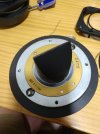
For my next projects I will have in mind your suggestions and I will consider using metal, I guess aluminum would be a good idea, for the bracing.

Even when my common sense told me about the power of subjective judgment, I have felt some doubt about my woofers, because they are not the ALNiCo version that everyone likes... So thank you for sharing your experience, it gives me a bit calm.

So far I can't believe I am building this nice speakers, this is pure enjoyment.
Cheers,
Rodolfo
 
Last edited:
The other advantage of solid wood is the much-reduced amount of work to build, considering the amount of finish work required for plywood and MDF (veneer/paint etc. I've done them all). It has been said solid wood moves too much (humidity effects) to be used in cabinets- that may be true of one piece planks, but using small width boards joined together mitigates that issue.

I have a special 30 watt amplifier and have been looking for a set of highly efficient speakers to pair with them. I really don't want to build another set of cabinets, but unless I locate an acceptable set, I may.

I'll be interested to read your opinions of the 416-8C, especially in the low and low-mid frequency performance. So if I build, I would consider the 416-8C in a Karlson cabinet. I have experience with 515's in an 828, and their performance in these bands, and physical size, lead me this way. The Karlsons should perform better lower, at least on paper. Would pair with a 511b/808 with current GPA diaphragms to keep the Altec flavor.
 
Last edited:
The other advantage of solid wood is the much-reduced amount of work to build, considering the amount of finish work required for plywood and MDF (veneer/paint etc. I've done them all). It has been said solid wood moves too much (humidity effects) to be used in cabinets- that may be true of one piece planks, but using small width boards joined together mitigates that issue.
It seams that I did it just right choosing the wood and this type of board. I was inspired by Jean Hiraga cabinets for the Altec 604. I thought if it worked for him for sure for me too, even when as you say, he uses a board with thin pieces of wood. But I got the sense of usefulness from him. And after checking the specs for the wood I use, well, sound a very good, choice.

I am very anxious to finish this cabinets and of course I will report my impressions. So far my bass reference are my Canton CT-90 they have 10" woofers but they are capable of 20hz according specs. So let's see how they compare.

I envy you for that special 30 watt amp.. so far I don't have anything that goes in that way. Only some solid state Kenwood's and one Denon power amp, but I hope to restore my Scott some day.

Cheers.
Rodolfo
 
And here is the other one
PD: Sorry to mix all this stuff guys, but I wasn't able to hold my self of sharing all this little toys I have to play around :)
Cheers,
Rodolfo

Hi Rodolfo,

Quick question on these drivers. Did you have to demagnetise them before stripping them apart? How did you remove the top plate from the base magnet?

Any advise on your method and process used would be most helpful.

Many thanks,
 
Hi Rodolfo,

Quick question on these drivers. Did you have to demagnetise them before stripping them apart? How did you remove the top plate from the base magnet?

Any advise on your method and process used would be most helpful.

Many thanks,
Did you check out this thread?

 
Hello again guys, it's been a long time since my last post. Many things happened since that, The good news is that my cabinets are finished and the all system is working and sounding amazing, and I even add a pair of very nice JBL 2405h with original diaphragm. The bad news is that now I suffer from tinnitus and lost hearing over 8Khz in my left ear... yes, it has been awful days since that happen. I had only like 3 months to enjoy my speakers with my hearing without problems. I am going to update the thread mostly with pictures to leave this project as finish and, well, to thank you all who came here to advise and to support in the amazing process.

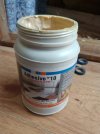
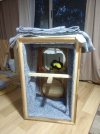
Vinylic adhesive to attach the internal padding
IMG_20230612_113025814.jpgIMG_20230612_113056439.jpgIMG_20230612_182923492.jpg


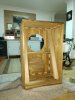
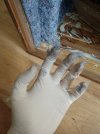
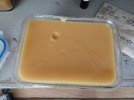
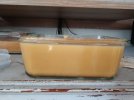
Turpentine and beeswax for the finish (I decided not to add any oil, because that's the recommendation I found on a paper from a UK institution to restore antique church furniture and I did not want the wood to darken), I do not remember what proportions I used, specially because I add turpentine until the proper texture.

IMG_20230529_100132395.jpgIMG_20230529_100138659.jpgIMG_20230601_225742624.jpg

Yes, working in the kitchen at night to not disturb my little son dreams :) This is after beeswax, you can see the difference in the side.
IMG_20230601_234638614.jpg

More later....
Cheers
 
Those are truly beautiful. You did a super job, down to the finish. I wish I had a pair made from that wood.

Tinnitus is not a hearing ending condition from what I read, and it does subside. Just protect your hearing religiously going forward
 
Trying to give you better detail of the finish:
P1160023.JPGP1160026.JPG


When the drivers were installed I did not take pictures, It was making the most of my time and was at nigth, I barelly did a video:
 
The last part of the process came in two parts, before and after adding the JBL 2405H. Here are the speaker finished whiteout the 2405. (At this point I was not imagined I would be buying the 2405H… Actually, I never imagine paying the price for them.... but, you know.)
At this moment I haven't installed my power amps and was driving all the driver using a pair of Kenwood KA-7100 on vertical bi amping and active crossover. Still not happy with the crossover setting, that toke me some weeks to figure out, but so far very happy with the high frequency extension but due to the help of some EQ.
IMG_20230619_112119691.jpgIMG_20230622_105008153.jpgIMG_20230622_105040197.jpgIMG_20230622_105118973.jpgIMG_20230622_105245079.jpgIMG_20230627_115311760.jpg
IMG_20230620_083333815.jpg
At this point I was thinking the project was finish, regarding the speakers construction and configuration, but later, a pair of JBL 2405H appear to my eyes and a very nice Technics SE-A7 and that set everything to go active tri-amping...
 
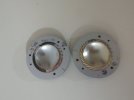
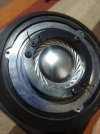
After some days listening to the speakers I realized something was not right on the highs.... well, I open for the first time my compression driver to find a not very nice surprise, broken diaphragms:

IMG_20230618_214815458.jpg
IMG_20230618_214830655.jpg

Seams, they were original Altec thin diaphragms. So I was afraid of no having a nice high frequency extension…
IMG_20230618_233034115.jpg
IMG_20230618_233047375.jpg

but at the end the driver sounded very nice with generic aluminum diaphragms, I just adapted the terminals:
IMG_20230618_230424550.jpg
IMG_20230618_231228669.jpg
 
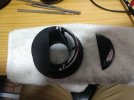
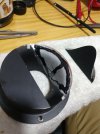
Well and finally the last piece of the crown appear.... kind of broken, but it was a very easy fix. I used contact cement to glue the part. Originally seams contact cement was used. And to my surprise seams they have original in good condition diaphragms! :banana:


IMG_20230729_173916805.jpg
IMG_20230729_173905522.jpg
IMG_20230729_173908906.jpg

IMG_20230729_180056131.jpg

IMG_20230729_163105545.jpg
 
Last edited:
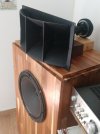
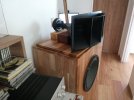
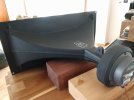
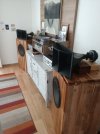
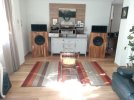
This is the final product, I find a provisional way to install the 2405H but at the end, was so simple and easy that I let it that way, until something better comes to my mind. The drivers are time aligned using the crossover and the crossing points are like this:
Butterworth 12dB/Oct at 787Hz - 1.32KHz - 10.1KHz the high pass filter for the JBL 2405 is Butterworth 18dB/Oct
I am also using an LP shelving at 5.08KHz at -6.6dB on mids (This is taken from the Z19 crossover by Zilch for the Altec Model 19; I am using a Shelving instead of a "T" filter)

IMG_20230731_093426302.jpgIMG_20230731_093436963.jpgIMG_20230731_093443724.jpgIMG_20230830_094157813.jpg

To power the system I am using a Kenwood M2A for bass, a Denon POA-2800 for mids and a Technics SE-A7 for Highs. Plenty of power for this sensitive speakers, but I am so far not into tubes... I came from solid state, let's see what the future brings.

Cheers,
Rodolfo
 
Back
Top Bottom