

You are using an out of date browser. It may not display this or other websites correctly.
You should upgrade or use an alternative browser.
You should upgrade or use an alternative browser.
Best cabinet for a 416-8C (flat ferrite magnet), 511B, 902-8T and more


morfeora
Active Member
Thank you TPK. It's very encouraging to hear other people been positive about loss hearing and tinnitus. Even when I mainly remain positive, still have my ups and downs... Deep downs regarding this, especially when listening is such important part of my life.Those are truly beautiful. You did a super job, down to the finish. I wish I had a pair made from that wood.
Tinnitus is not a hearing ending condition from what I read, and it does subside. Just protect your hearing religiously going forward
morfeora
Active Member
One thing is the electrical setting of the crossover, in this case is set at 787hz for the low pass, and other is the acustical result (this depends a lot of each driver características). To make this drivers crossing nicely at 1.32Khz, one should use this 787hz low pass. I was playing a lot, and this frecuency was the one given my the flattest response acusticly at crossing frecuency 1.32Khz. I take all this nice information from Zilch development of the Z19 crossover, the one he design for the Altec Model 19 wich uses the same drivers I am using.So your running the woofer up to 1.32 kHZ, then from there the mid horn comes in , (you mentioned 787 hz, which represents what?).
DID you try any other Low Shelf settings besides the -6db x 5.08kHZ?
Beautiful work by the way.
Here you will found that in better words:
Why do the Z-19 crossover values seem off?
This will be my first crossover build, so I'm looking for some insight. From what I've read I had always assumed that: 1) The LF and HF drivers used in the Z-19, and even the Altec Model 19 that it's based on, where 8 ohms 2) That a 2nd Order Butterworth was used 3) That the crossover...
audiokarma.org
morfeora
Active Member
Yes this is something I plan to do in the future, so far I am enjoying the sound is coming out from this diaphragm. As I am new to Altec horns, well, I stil don't know what I am missing.I’m not sure of the availability of them in Colombia, but I would ditch those “generic” diaphragms and get some GPA or Radian diaphragms. All the aftermarket Altec diaphragms I’ve used (with the exception of Radian) suck.
morfeora
Active Member
Yes you are right, that was one of my biggest concerns, specially because my other speakers, Canton CT-90, sound amazing from 20Hz. But we'll, this Altec certainly do not go that deep in the bass, as I recall from my measures they can reach to 35Hz, but that is more than enough to fill my living room, and the way they feel the room, they are very transparent (I mean they easily disappear) That makes Jazz and acoustic music to sound beautifully. So I am happy with the bass. For electronic music, yes, I miss the deep bass a bit but not too much, because any way this driver/cabinet sounds very well, I would say from 50Hz and up.As I recall (I'm too lazy to go back to the thread early posts), you were concerned about the bass output of the 416-8C. So how is it in your custom cabinets?
sunrayjack12
Active Member
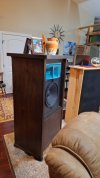
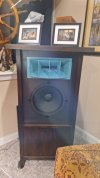
Here is my solution to model 19 cabinets.Hello friends,
A year ago my Altec Journey, started with the acquisition of a non-matching pair of possible 802B-802C (Still for identification, I might create a thread for this) compression drivers. I just bought them because I realize they were of value but with no idea of what to do with them in the future. But two weeks ago, everything started to move at a huge speed! I found here in my city a pair of 515B (for re-cone. I might create another thread to ask about this work too) and a pair of 416-8C with the original cone and in general good condition. Last week things become even better, I found a set of three 511B horns including 902-8T compression drivers. Well, maybe you can imagine my happiness because I got the feeling that this would be something... and all this for a very, very cheap price; to give you an idea, around $80 USD per horn+driver set.
I have been reading a lot, trying to figure out what to assemble with the 416-8C and 511B, 902-8T combo. I found that this make almost a late production Model 19, but I have been disappointed for all the bad comments on this variant of the 416 and the non-matching horn (Model 19 using the 811 horn).
Knowing this 416 is not the best performer, I would like to hear your ideas about what could be the best cabinet for this variant of the 416-8C. What cabinet could make the most of this woofer?
I have though about an Onken cabinet, but read from someone here that there is not a big difference when using a regular bass reflex cabinet. And for me this has a lot of sense, if Onken cabinets were such a good thing, for sure the big brands, let's say current JBL, would be using this type of cabinets?
My other idea was to build a model 19 cabinet, but again, the model 19 cabinet was designed based on the 416-8B, and adding the complaints about the Model 19 using the 416-8C, well, seams not the best option.
So far my best option is to build a 620 cabinet (and set the horn on top), at least in the "Customizing Altec Enclosures" paper there are specs and measures to adapt this cabinet specifically to the 416-8C, and as I am not a speaker designer and my experiences with box design is little (even when I have been reading a lot about this too), this is possible the best to do.
View attachment 2558874
What do you think guys? Am I right thinking that my the best option is to build a 620 cabinet? Or to design a new bass reflex enclosure could get more out of this woofer. Any help to solve this confusion will be great, guys. One more question, it is this the 416-8C really that bad? Does anyone have make measures comparing this with the 416-8B?
Cheers,
Rodolfo
Build cabinets that are pleasing to you.
Something with the volume and venting.
I have always thought the 19's cabinet was ugly beyond words.
So I built my own, they are fantastic.
Attachments
morfeora
Active Member
A long time without checking over here.. beautiful solution. I have the feeling your boxes are bigger than Model 19. Did you keep the same internal volume?Here is my solution to model 19 cabinets.
Build cabinets that are pleasing to you.
Something with the volume and venting.
I have always thought the 19's cabinet was ugly beyond words.
So I built my own, they are fantastic.
bowtie427ss
Lunatic Member
Something with the volume and venting.
Model 19 is not a simple rectangular box @ volume, and it does not perform like one.
It has a second resonant chamber connected to the bass reflex chamber via a throat, a la dual resonant tunings.
The engineers knew what they were doing, it wasn't just simply a 3rd iteration of the Valencia(a rectangular box).
bowtie427ss
Lunatic Member
I'm not sure that it would show a peak as the 2nd tuning may be there to correct what would otherwise appear as a null.
I was told many moons ago by an Altec engineer that they spent thousands and thousands(of mid 1970's dollars) on the development of the model 19 and it's proprietary(at the time) components. Every part of the 19 including the cabinet was re-engineered, 1 piece cast return structures on the woofer and compression driver, a radially slit, plastic phase plug, a network with EQ and compensation built in.
I was told many moons ago by an Altec engineer that they spent thousands and thousands(of mid 1970's dollars) on the development of the model 19 and it's proprietary(at the time) components. Every part of the 19 including the cabinet was re-engineered, 1 piece cast return structures on the woofer and compression driver, a radially slit, plastic phase plug, a network with EQ and compensation built in.

Correct on the 45 hz.
Thanks Bowtie.
FEIW, I ditched the 416-8C’s in favor of 16” frame 416-8A’s that I reconed.
The horn to woofer transition is now nearly seamless. You always have said the -C’s had issues and you were correct.
My HF drivers are the 806 tangerine units from the 9849’s. They are very sweet.
Thanks Bowtie.
FEIW, I ditched the 416-8C’s in favor of 16” frame 416-8A’s that I reconed.
The horn to woofer transition is now nearly seamless. You always have said the -C’s had issues and you were correct.
My HF drivers are the 806 tangerine units from the 9849’s. They are very sweet.

twiiii
Lunatic Member
You have some big issues. One the voice coils of the 3 drivers should be in perfect vertical align ment so when using passive crossovers you wont have anomalies one octive either side of the crossover frequency. Or that the the vertical alignment be so that the vertical line is perpendicular to the line from the throat of the mid horn to your ear. Because the directivity of the horn and the woofer are not the same you will always hear the transistion from one to another. Same goes for the mid horn and the tweeter. The reason a lot of people love the A7 800 is because the directionality of the short horn of the woofer is the same as the directivity of the 811b Horn. Because of the length of the short woofer horn the arrival times of the woofer and HF Horn are the same and Voice coils are in perfect alignment. With the higher 800 or 1200 HZ crossover the diaphragm excursion will be reduced for the horn and therefore the power handing for the 800 HZ crossover will be 1.7 times better and for the 1201 crossover twice as much. Plus you will get rid of that honking sound that happens when using the 500 HZ crossover with the 511B horn. Buy using a ported box you have also reduced the efficiency of the woofer by over 3 to 5 db also, further compromising the sound depending on the volume of the box and the tuning of the port. Remember the 90wer handling of a 902 and 802 driver with a 500 HZ crossover is only 10 watts rms long term. SO 17 watts is a significan't increase. Now peaks can be 6 db higher when using pink noise. So you should need an 80 watt amps to keep from clipping prematurely destroying the diaphragm, but the long term average with an 800 HZ crossover still has to remain below 17 watts RMS. Which is about 116 db 4 ft 1 watt 8 ohms. Now for the woofer to reach the same level you would need almost 400 watts of undistorted power to achieve the same peak levels. Now you you know why we biamped using electronic crossovers. We might 400 watts for our 291-16 B divers for the midrange on 311 90 horns at crossed 770 Hz. But for the 3156 or 421 woofer in 817 boxes stacked in pairs to be flat to just below 40 HZ. with a 6 db increase below 75 HZ in the shape of a shelf. we would need 500 watts per pair or a total of 2000 watts. So 400 watts total for the mid range and 600 watts for the 16 MR-902-16 hf in groups of 4. So thats one MC 2255's for the Mids. 1 MC 2255's for the tweeters and and two MC 2600's for the LF horns. Always remember Mcintosh power amps always put out at least 33% more power than rated before the Power Guard stopped the amps from clipping with less than 2% distortion. At 25% over rated power the amps still met factory specs. Some time is we had the room we use 4 Klipsch MWM w horns which were three db more efficent reducing the number of woofers from 16 down 8. So we use either 2 2255's or 2 MC 2500's or 2 MC 2600's with two MC 7300's. The large systems we quadrupled everything. On some some systems we used multiple la scala bottoms or 816 boxes with 515B's as mid-woofers to get frequencies from 90 HZ to 770 hz up in the air to get a similar point of origin as the mids and tweeter. I mean when you have 3 to 500 people on a dance floor you need some real acoustic horse power.
Discos in old Mexico were nothing like the US where there were mandated sound levels that could not be exceeded. In Mexico they wanted at least 110 db at ear height on the dance floor and that was where people were just starting to get happy.
Discos in old Mexico were nothing like the US where there were mandated sound levels that could not be exceeded. In Mexico they wanted at least 110 db at ear height on the dance floor and that was where people were just starting to get happy.