There are two ways to do this... Both are fairly messy:
Option A:
To get your desired result you can use your tape monitor out going into the line in on your speaker. In this case you're getting full volume out of the tape out, and full frequency. The problem runs into whether you have a crossover and line level on your sub woofer. Most sub in a box powered subs will have both of these. The real perceived problem here is that you run into an issue of having both an amp volume and a line level volume on your sub. This becomes problematic as every time you adjust the volume on your receiver your sub woofer will be out of balance with the rest of your system. This is the most dirty way to achieve what you want.
Option B:
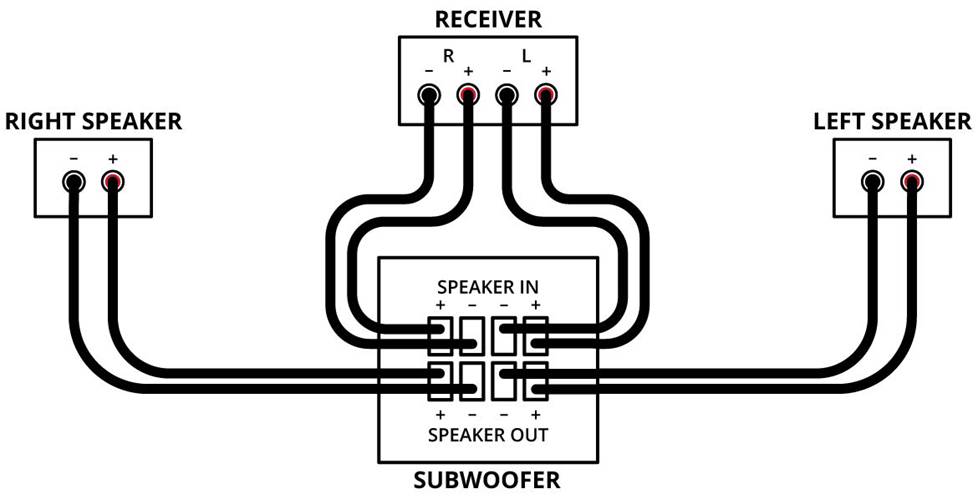
The other way, which is neater, is to run your speaker terminals to your speaker level input on your sub woofer and run the speakers from the speaker output on your sub woofer. This is the preferred method. As your using both amps your sub amp will handle the frequency your standard receiver is not capable of handling by itself. The amps act in tandem as a biamp setup. The sub woofer has an active crossover and you set the crossover at a point where it handles only the lower frequencies. You set the crossover frequency once and the amp resolves the volume, you also get bass and treble adjustments from the amplifier.
More technical guff:
Contrary to popular belief its not hard at all to tune a crossover by ear, its quite easy really. You just have to adjust the crossover until one set of speakers doesn't overpower the other. If you can't spot this point then find someone suitable who can. Contrary to any of the poo pooing above, this is also a perfectly good way to compliment your speakers in components. In my case, my Rogers export monitors handle 40hz - 25kHz, and my Onkyo SKW-320 handles 25hz to 200hz. The key here is to set the crossover at somewhere around 40hz, this way I get the compliment of a sub that can handle 25hz to 40hz, and a driver/tweeter system that can handle 40hz to 25khz.
In this way both amps and speakers compliment each other. This is actually the traditional way of doing things. Most traditionally you would have 3 separate speakers in separate boxes. You would have a bass driver, a mid driver and a horn (tweeter.) Since the middle part of the last century its become common to combine all three in a floor standing speaker box. This is more so about convenience and ease of tuning components. It's much more difficult when you have to consider the placement and tuning of all three speakers individually, but individual components placed correctly will still provide a superior result.
Here's a suitable example of 1960s era Fisher 3 way component system, of course you're not building anything as shmansy-fancy as that what you will be building is a two way or three way system with a separated sub woofer. Your horn (if you have one) will be in your speaker cabinet or on the speaker itself if its coaxial.