• The move to the new server is done. There are some software and database maintenance updates in process. This has us passing the hat around to help out. We appreciate any donations. Seriously, even a dollar helps. The payment page may be found here - https://www.audiokarma.org/support.html

Big expensive quality amplifier market dead?

Status
Not open for further replies.
I’m thinking (and rambling) more about this.

In the ‘70s when Solid State objectively passed the capabilities of tube amplification, tubes were dead. A few decades later these heavy, hot, high-maintenance devices became fashionable but it was proven that the pleasant distortion that tube amps produced could be produced by carefully designed solid-state (the Bob Carver Challenge), but they live on.

Later, in the ‘80s Phillips had developed the CD format, which was more accurate than all but the most expensive and finicky turntable and LPs with far less expense and maintenance, I felt that vinyl was dead, I stashed my faithful R2R never to be taken seriously again, it too was obsolete.

Today people pay a premium for tube audio, and for LPs aka: vinyl, and even some analog tape formats are seeing some popularity again. All of this ignoring the fact that almost all music processed, recorded, remastered, broadcast or otherwise made available today is processed at least a few times through A/D-D/A conversion and very little is actually truly analog (including most new vinyl pressings).

My father’s home audio consists of TVs with soundbars.

It’s not about the specs entirely, just love what you love and don’t worry about “educating” the rest of us or shaming us for our choices. You might spend your money on a loaded Silverado and I on a Macan or a Tesla, it’s all good and we’re all happy.
 
New, disruptive technologies nearly always cause arguments between the legacy users and the new adopters. Personal preference regarding audio gear has no wrong or right side. IMO, I see the newer amp tech taking a bigger slice of the low to medium tier audio market segment as time passes. It will also have an impact on the value and demand of vintage gear. New tech nearly always crowds out old tech as time passes whether it be with with audio equipment, automobiles, televisions, etc. I do like that very good sound quality is becoming more affordable and in a form factor that makes using it much more versatile with everything from amps, DACs, pre-amps and even speakers. This should grow the number of audiophiles which is a good thing for all of us who are currently audiophiles.
 
The vintage receivers and amps from the 70’s, that youse old heads fawn over incessantly, are by now all in need of extensive repairs to replace their electrolytic capacitors, that have exceeded their use-by dates by nearly 20 years. On the other hand, a quality new class d amp should not require similar capacitor replacements for at least 20 years. This is the crux of what is being discussed when we tout the reliability of class d, which incidentally, typically also run at lower temperatures and are therefore less affected by heat related stresses incurred by class a and class a/b gear.
I have amplifiers made by Carver SAE, Quad, Crown, Musical Fidelity that are 40 years old that have never been repaired and still dont need repair. Most amp failure happen with capacitor coupled output stage that is why I like DC amplifiers, they also sound way better. In most instances especially speakers replacing working capacitors wont change the sound unless you want to hear it because you have gone through the trouble.
 
Okay, one of my amps is rated at .005%THD from 100mW to beyond its 600WPC
Where does this 240WPC at <1% THD compare to “the best amplifiers ever produced”? 1% is 200x the distortion, and that’s possibly only at its rated 230W output and much higher at lower power
(that important first watt).

Fact check:

ASR measured Fosi V3 at ~0.004% @ 5W.
 
I have been out of the industry for a while, things might have changed in the past decade but last I knew I could not find an industrial-grade electrolytic capacitor that was rated for over 10years. Everything else, yes, but EL caps only 10years.

That was of course 10 years of life within its spec temperature range and if so rated, 24/7. EL caps that are not in use also degrade with time (although in some cases can be “reformed” to recover much of their original performance if stored for a long time).

This doesn’t mean that the capacitor won’t work, nor that the equipment in which it is installed won’t work, it is however degraded.

I have put many older caps on my SENCORE cap analyzer just to see how they have aged. Many times they are within tolerance (capacitance) but the ESR is not. Most of the time when I test at rated voltage they fail the leakage test.

Transistors, resistors, they all can (and do) drift also with time and use. Your gear might work, and sound fine to you, but most likely it is not performing to spec / as new.

FWIW.
 
I have been out of the industry for a while, things might have changed in the past decade but last I knew I could not find an industrial-grade electrolytic capacitor that was rated for over 10years. Everything else, yes, but EL caps only 10years.

That was of course 10 years of life within its spec temperature range and if so rated, 24/7. EL caps that are not in use also degrade with time (although in some cases can be “reformed” to recover much of their original performance if stored for a long time).

This doesn’t mean that the capacitor won’t work, nor that the equipment in which it is installed won’t work, it is however degraded.

I have put many older caps on my SENCORE cap analyzer just to see how they have aged. Many times they are within tolerance (capacitance) but the ESR is not. Most of the time when I test at rated voltage they fail the leakage test.

Transistors, resistors, they all can (and do) drift also with time and use. Your gear might work, and sound fine to you, but most likely it is not performing to spec / as new.

FWIW.
As I lifelong electronics tech I agree with this post :thumbsup:

And without an actual failure it is a slow creep so one will never really notice.
 
That is far better than the <1% that David posted, I wonder where his number came from?

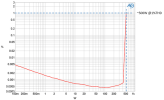
Here's a McIntosh MC462 -

McIntosh could have called it a 500W @ 1% THD amp, but they chose not to. They picked other point(s) on the curve that painted a "cleaner" picture, but it's same amplifier either way.

The general nature/shape of this curve is representative of many, many, many amplifier's THD vs output. The only thing that changes much is the actual numbers for that amp, and the points on the curve you or the manufacturer choose to use to represent it.

MC462.png
 
Here's a McIntosh MC462 -

McIntosh could have called it a 500W @ 1% THD amp, but they chose not to. They picked other point(s) on the curve that painted a "cleaner" picture, but it's same amplifier either way.

The general nature/shape of this curve is representative of many, many, many amplifier's THD vs output. The only thing that changes much is the actual numbers for that amp, and the points on the curve you or the manufacturer choose to use to represent it.

View attachment 3625059
No “misunderstanding” on my part if this is what you’re implying.

This is why the McIntosh MC452/MC462 is a 450WPC amplifier, with a THD spec of “.005%THD from 100mW to full rated output”. To your point they could also have claimed .00045% distortion at 100WPC.

Seems pretty transparent, after that point the Powerguard senses distortion and limits output. If David’s post that I quoted above had cited any point along the graph that is far less than 1%THD (post #158) this would be a different conversation. I think that most of us understand that THD specs live within an amplifier’s rated power output.

Is there a graph of the amplifier that David was referencing as well vs its rated output at 4 Ohms? I took it from his post that the amplifier was actually rated / advertised to put out 230WPC, is this incorrect? Clearly I was responding to the specifications in that posting and the claim that this spec was “among the best amplifiers in the world” in performance. The spec posted clearly did not, more information will certainly help support or refute this claim.
 
Last edited:
No “misunderstanding” on my part if this is what you’re implying.
More widespread than any given person.

Plenty of comments to be found about THD, the nature of which suggest there is plenty of misunderstanding.

Is there a graph of the amplifier that David was referencing as well vs its rated output at 4 Ohms? I took it from his post that the amplifier was actually rated / advertised to put out 230WPC, is this incorrect? Clearly I was responding to the specifications in that posting and the claim that this spec was “among the best amplifiers in the world” in performance. The spec posted clearly did not, more information will certainly help support or refute this claim.

There's information around for those truly interested in seeking it. It can be be found the same way I find many things. Google is my friend.
 
So please help me to understand your point in continuing to quote me.

I quoted David and countered his point using his distortion numbers at 230W vs a vintage high-power amp
You quoted me with your “fact check” of the V3 distortion at 5W, but only at 5W.
I questioned the relevance and where David got his number
You responded with an unrelated amplifier having higher distortion 50W above its rated max output, which is expected
I questioned the relevance and what the V3 distortion curve is to compare
You tag out saying that anyone can find the information.

So, are we back to my point, 17 posts ago where I am still showing that a vintage amplifier is significantly better within its power rating than the V3 that David mentioned without any relevant information showing it to be as good within its power rating? It seems like you’ve posted a lot, quoted a lot, but never really addressed the point made in post 160. If you truly want to make a point, find the data that proves your point regarding the V3 thus proving David (and me) wrong instead of deflecting.
 
Status
Not open for further replies.
Back
Top Bottom