

You are using an out of date browser. It may not display this or other websites correctly.
You should upgrade or use an alternative browser.
You should upgrade or use an alternative browser.
Big expensive quality amplifier market dead?
- Thread starter EPB
- Start date
- Status
- Not open for further replies.


DesertRatt
All Bark, No Bite!
That's of course true. But also, you are paying for all the overhead it took to bring the first unit to market. The time to make all the CAD drawings, the PCB layouts, the BOMs, the schematics, the purchasing of parts, and many other functions necessary to ship UNIT #1. These high-end amps are not made in anywhere near efficient production quantities, so all prices of the machined parts are quite high. I can testify that there is no efficiency in producing low numbers of high-end gear. And none of that accounts for the countless hours that some engineer or auteur spent thinking, planning, imagining the kind of amp it is to be.A lot of what you pay for in big heavy amps is machining the metal - front panel and heatsinks.

My buddy passed about 10 years ago leaving behind a very sizable audio collection in his home and an even bigger one at his storage facility. His girlfriend (retired nurse) wanted nothing to do with it and his only relative was his sister who was a school teacher and her physician husband. To say they didn't care about vintage audio was an understatement. If it wasn't for my intervention all that Mac, Altec, Luxman, tube gear etc. would've gone straight into the 30 yard dumpster sitting his driveway.
I found out quickly that stuff that means the world to the owner does not have the same value for the people left behind that have to deal with it. Getting the good stuff to homes was a lot of work which took me about a year of constant selling. I'll admit there were occasions when I felt like tossing it all rather than dealing with the Craig"s flakes, no shows and worst of all the lowballers.
I agree; unless there's a person knowledgeable about vintage audio involved chances are it's headed for the scrap heap when the owner passes.
Hate to admit it, but when my father kicks the bucket I also wouldn't konw what on earth to do with his stamp collection.
Kind of the antithesis of what AK is all about.So, buy an inexpensive, lightweight, disposable device with no resale value so that it's easier for relatives to dispose of when you die ... ? That's some kind of sales pitch. It's also how industries die.
You guys have lost your minds.
P.s. There is however a difference between owning a set of good stuff to use and collecting a ton of gear.
DesertRatt
All Bark, No Bite!
That one is pretty easy. Almost every city has a stamp and coin dealer that will buy whole collections. Not for a lot of money - but they will give you something, especially if it is a decent collection.I also wouldn't konw what on earth to do with his stamp collection.

No; take care of the good stuff before the inevitable happens. I had a health scare late last year so a good deal of my heavy but rarely used "guy stuff" left so my wife doesn't have to deal with it.So, buy an inexpensive, lightweight, disposable device with no resale value so that it's easier for relatives to dispose of when you die ... ? That's some kind of sales pitch. It's also how industries die.
You guys have lost your minds.
It's called looking ahead and having a bit of compassion for the one or ones you leave behind.
I'll sit down with him to have a reality check on what to do (from both sides..).That one is pretty easy. Almost every city has a stamp and coin dealer that will buy whole collections. Not for a lot of money - but they will give you something, especially if it is a decent collection.
I'd feel torn for a loooong time if rare things get handed over for peanuts.
Who knows. Perhaps the old old man actually does have a feasible plan up his sleeves..
DesertRatt
All Bark, No Bite!
I live in an area with LOTS of estate sales (retirement city around here). I mean LOTS of them. Anywaay, I have gone to a few here and there when wifey shows me a pic of some interesting "thing" that the estate sale people put on FB, and whatever.
My experience has been this: They get a darn good price for quality items. There ain't no McIntosh amp being sold for $20. There ain't no Hasslebald camera going out the door for $5. One reason is EBAY has become the ultimate reference for "dumb" estate sale personnel to find out what X, Y, or Z is worth. Then they reduce it by say 20% and that's the price.
As to buyers, we live near enough to a big metro area, that the "floggers" drive in every fri/sat by the hundreds to get to these sales early, grab the valuable stuff, and head home and put it on Ebay.
Admittedly, this is just what I see in MY AREA, and probably isn't universal.
EDIT: The one thing that is very hard to sell is big heavy furniture.
My experience has been this: They get a darn good price for quality items. There ain't no McIntosh amp being sold for $20. There ain't no Hasslebald camera going out the door for $5. One reason is EBAY has become the ultimate reference for "dumb" estate sale personnel to find out what X, Y, or Z is worth. Then they reduce it by say 20% and that's the price.
As to buyers, we live near enough to a big metro area, that the "floggers" drive in every fri/sat by the hundreds to get to these sales early, grab the valuable stuff, and head home and put it on Ebay.
Admittedly, this is just what I see in MY AREA, and probably isn't universal.
EDIT: The one thing that is very hard to sell is big heavy furniture.


I would say that 100% of the reason I switched to a pair of Fosi ZA3 amps and a ZD3 DAC over my vintage components was for better sound quality. The smaller size, lower price and freedom from dealing with repair hassles are just perks coming my decision. Before this, I was somewhat of a "vintage snob" and close minded regarding other options. It is coming up on two years since I switched to the ZA3s and I haven't had a single urge to switch back to my vintage NAD and Denon components. One area I will not go to smaller, newer options is with speakers. I like the older ones I currently use and will only swap them for something newer and smaller when I am forced to do so for some reason. One thing I know is that the older I get, the more I am going to appreciate having very much smaller and lighter gear to deal with. Not giving up sound quality in return is a real blessing.So, buy an inexpensive, lightweight, disposable device with no resale value so that it's easier for relatives to dispose of when you die ... ? That's some kind of sales pitch. It's also how industries die.
You guys have lost your minds.

freedom from dealing with repair hassles
Once again I find myself wondering what is meant about newer gear having some advantage vis-a-vis repairs. Some sincere questions (which of course you don't have any obligation whatsoever to respond to
 )
)Is your expectation that newer gear will not need repairs during your ownership? Or that it will be hassle-free to get it repaired? Or that it's disposable, and if it fails, you'll simply replace it?
I am happy to answer. What I have found with owning vintage gear is that getting repairs done is going to be necessary at various points in time. I have also found that finding competent techs to do the repairs in a timely manner is getting ever more difficult. The cost of these repairs is rising too. Also, one of the reasons I have for keeping multiple pieces of vintage gear is for redundancy since my last NAD repair took almost four months to complete.Once again I find myself wondering what is meant about newer gear having some advantage vis-a-vis repairs. Some sincere questions (which of course you don't have any obligation whatsoever to respond to
Is your expectation that newer gear will not need repairs during your ownership? Or that it will be hassle-free to get it repaired? Or that it's disposable, and if it fails, you'll simply replace it?
The big advantages with the newer components is they sound better, they are relatively inexpensive, and they are a fraction of the size and weight of my vintage pieces. In 2023, I spent nearly $400 repairing my NAD 7600 receiver. I have about the same amount into two ZA3s, ZD3 and an op-amp swaps with the ZA3s. The companies putting out these newer high value components are very aggressive in bringing out newer, better products at a fast pace. If, or when, one of my Fosi components dies I will likely have a new and improved option to buy for less than the cost of a repair and little down time too. Personally, I think the Fosi components I have will last a very long time because they seem to have good build quality and use premium components where it matters most. The odds are that I will likely upgrade them well before they might fail.
First, it's basically not possible to find technicians near me to repair audio electronics. I've tried and failed more than once. Second, the gear from Fosi and Aiyima and Doug are so inexpensive that most pieces wouldn't be worth paying to have them repaired. They are essentially disposable. Of course, one can hope they'll be around a good number of years, but I consider my Fosi stuff to be disposable, even though it performs at an objectively very high level and I love it.
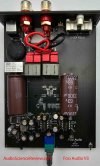
Having said all of that, take a look inside a Fosi V3 or V3 mono. Simple, all components right in your face, high quality name brand bits. If one were skilled at repair and diagnosis I'd think it would be MUCH easier and quicker to diagnose a V3 and fix it than a larger Class AB piece.
Having said all of that, take a look inside a Fosi V3 or V3 mono. Simple, all components right in your face, high quality name brand bits. If one were skilled at repair and diagnosis I'd think it would be MUCH easier and quicker to diagnose a V3 and fix it than a larger Class AB piece.


mrehorst
Super Member
The surface mount parts aren't the ones you'll need to replace.The radial capacitors look easy enough to replace but what about the surface mount components, are they easy to replace? Are the chips "off-the-shelf" or are they proprietary?
View attachment 3624410
Thanks, @OldJBL.
I think my takeaway from the gestalt of the whole thread so far is that, for buyers of newer gear, repairability is mostly not on the radar. And maybe I should add, I don't think that's irrational at all.
I'm going to try to stop myself from musing too much about the next few decades, but I wouldn't be shocked if repairs of now-current gear become an area of interest for a passionate few. SMD will not be an obstacle, at least for younger techs. And maybe those techs should invest, now, in a cache of TPA3255s. And maybe op amps in currently-fashionable packages. Oh, and print out datasheets for same - my guess is that those will be as close to you can get to service information.
I think my takeaway from the gestalt of the whole thread so far is that, for buyers of newer gear, repairability is mostly not on the radar. And maybe I should add, I don't think that's irrational at all.
I'm going to try to stop myself from musing too much about the next few decades, but I wouldn't be shocked if repairs of now-current gear become an area of interest for a passionate few. SMD will not be an obstacle, at least for younger techs. And maybe those techs should invest, now, in a cache of TPA3255s. And maybe op amps in currently-fashionable packages. Oh, and print out datasheets for same - my guess is that those will be as close to you can get to service information.
I'll handle Euro disposals:Yes, $$$ gear is dead. I can offer you a free disposal service.
Feel free to send me your unwanted Krell,McIntosh, and ARC
gear.
Burmester, Goldmund, Gryphon, Naim, Nagra, etc. At your service!

What, no Threshold, Pass Labs, Rowland or Leviinson? The transformers alone should be worth some money, eh?Yes, $$$ gear is dead. I can offer you a free disposal service.
Feel free to send me your unwanted Krell,McIntosh, and ARC
gear.

- Status
- Not open for further replies.