• The move to the new server is done. There are some software and database maintenance updates in process. This has us passing the hat around to help out. We appreciate any donations. Seriously, even a dollar helps. The payment page may be found here - https://www.audiokarma.org/support.html

Bose 1800 series 1 restoration - help appreciated!

Thanks for your reply! Never used a variac and I don't even own one, only have a multimeter..., but I get the idea, disconnect everything from the other side of the transfo to measure the primary circuit, slowly raising the current to avoid burning again everything.

I'm looking now into buying one 2nd hand as it may be usefull anyway.

I'm also waiting for my new resistors as the current one is blown, so no chance to do this test now.

Stupid question, but when I deconnect the diode bridges, I can disconnect the molex connectors on the boards as well as the transfo is not doing anything (besides being measured while I crank up the current slowly using the variac). I say it because in the second step you say 'disconnect molex connectors', I would do this anyway to avoid any damage by stupidity.

Talking about stupidity, I still don't get why I have a problem now. I used the amp for two weeks (on my spare speakers, to test it, i didn't care if they got blown they are Bose) without any issues, and I only rebuilt both boards and put a new rectifier bridge in. I'm really baffled.

The fuse is a TD-3AG T8 so it's a time delay size 3AG, but not to clear what the 'T8' means. There isn't any brand mentioned on the fuse but my guess would be it's 8A 220V, according to the manual it should be 7A 220V slow blow.
 
I tried again with the original rectifier bridge and without any channel connected, but with both bridges connected, now i get the high temperature indicator which goes 'on'. I guess this is because the channels are not connected.

R7 runs nice and cool, everything fine, no sparks anywhere.

test 2, connected both channels, spark from R7 and dead again...

problem is I can't do a lot of trouble shooting with everything blowing up all the time, only have 1 5ohm 10w spare resistor (luckily I bought 2...). At least it seems like R7 is working as a safety measure, good Bose design...pity it's such a pain to replace him each time would be better to put a fuse (maybe I can upgrade to a fuse now anyway?)
test2.png
 
Last edited:
It'll be very difficult to help you if you try different things at the same time in any order.

You probably soldered something the wrong way and there is a short on one of your boards.

Connect them one at a time, and use a bulb lamp in series with the AC chord when powering on, if the light stays on, then there's an issue on the board in use.
 
Ok I did some more methodical tests

Both bridges connected no boards: overheat led on, no power on led
Both bridges connected, no molex connectors connected(!) And thermostat of 1 board connected: overheat led on
Connect both thermostats: r7 burns
Rectifier bridge not connected, molex connectors and thermostats connected: power on led is on, overheat led is off no problem with r7

So the problem is not with the boards as only connecting the thermostats gives sparks but i cant see what the cause can be...
 
Last edited:
...only possible culprit is then the rectifier bridge?
Nope ..I doubt its the rectifier.
Check all of your output transistors. If there is a shorted output it will load down the start up relay coil voltage and the softstart "start up " relay will not function correctly and eventually burn up the ballast resistor R7.
 
Last edited:
Ok I did some more methodical tests

Both bridges connected no boards: overheat led on, no power on led
Both bridges connected, no molex connectors connected(!) And thermostat of 1 board connected: overheat led on
Connect both thermostats: r7 burns
Rectifier bridge not connected, molex connectors and thermostats connected: power on led is on, overheat led is off no problem with r7

So the problem is not with the boards as only connecting the thermostats gives sparks but i cant see what the cause can be...
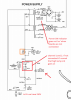
Do you show continuity between the + 96 vdc B+ point and the standby relay coil ?
 
The fact that R7 heats up is and indicator that the standby relay is not closing as it should shortly after power on.( a few milliseconds after power on )
 
Last edited:
When the standby relay operates properly "sets" it will drop the ballast resistor out of the circuit.
R7 is there to reduce the "inrush surge " at start up only.
 
to react on all your helpfull posts:
- I rechecked all transistors, none of them short circuit with the heatsink
- I measure continuity
- relay measures infinity when cold (logical..)
- stupid question, but can I short circuit the relay to see if the amp works? can there be a good reason why the relay does not open, due to a safety reason? I will put speaker protection relais in there.
- How can I test if the relay is broken? The relay does not close after R7 burns so your guess that it doesn't open is right, but why did it work perfectly a few weeks ago, relais don't break just like that?
 
I rechecked all transistors, none of them short circuit with the heatsink
Great.So the collectors are not shorted to chassis ground.Mica insulators are OK. :thumbsup: But .....Key !!! How about emitters to collectors?
 
Last edited:
Rectifier bridge not connected, molex connectors and thermostats connected: power on led is on, overheat led is off no problem with r7

Thanks, its 4.02 k ohm which is more than a few 100 but not sure if this is the reason?
Ok .Then the relay is probably OK. Check your output and driver transistors ( emitter to collector). Should have did this before you reassembled them.;)
 
Last edited:
Are those outputs in sockets ? If you remove the two fasteners do they unplug from the assembly ?
 
Last edited:
All outputs are soldered to the board so its not only undoing the bolts, it was some work but i measured all collectors to emitters and they measured between 10 and 30k ohm so seems to be ok, no open or short circuits.

If the coil measures ok the only reason could be that the coil is not charged correctly but no idea why this would be the case
 
Back
Top Bottom